Marketing agencies today are expected to deliver more—more content, faster campaigns, and clearer ROI—often without a proportional increase in resources. AI is helping close that gap by automating execution and accelerating workflows across content, campaigns, and reporting. According to this Ahrefs report, marketers leveraging AI publish up to 42% more content per month and save 13 hours per week in daily tasks.
But adoption doesn’t come without challenges. Despite widespread use, only 38% of organisations report fully integrating AI into their marketing operations, due to issues like data fragmentation and lack of technical expertise. For agencies, this makes choosing the right AI tools and using them effectively a key competitive advantage.
This blog breaks down what AI marketing actually means, where it solves real agency problems, and which tools are worth your time—by category.
What is AI Marketing?
AI marketing is the use of machine learning, natural language processing, and automation to plan, create, distribute, and optimise marketing activities. In plain terms, it’s a tool that learns from data and gets smarter over time, taking on tasks that used to require human time and judgment.
How is AI used in marketing?
AI is used in Marketing to solve specific operational challenges, such as enhancing efficiency, personalising customer experiences, or optimising ad spend. Broadly referred to as AI in Marketing, it is the practical use of AI tools to automate the repetitive, speed up the creative, and sharpen the strategic.
For marketing agencies, this shows up in three core ways in their workflow:
- Automation: Handling repetitive tasks like scheduling, reporting, and ad bidding without manual intervention.
- Generation: Producing first drafts of content, visuals, and copy at scale.
- Intelligence: Turning data into insights faster than any analyst could manually do.
The key distinction from older martech: AI tools don’t just execute instructions; they adapt based on results.
How can AI help marketing agencies?
Before diving into tools, it’s worth naming the problems agencies actually face, and how AI can help solve those, because that’s where AI earns its keep.
Margin pressure
Agencies are chronically understaffed for what clients demand. AI handles the volume work (drafts, reports, scheduling) so your team focuses on high-value strategy and creative direction, without growing headcount.
Client reporting bottlenecks
Pulling performance data across platforms, formatting decks, and writing commentary eats hours every week. AI-powered analytics and reporting tools compress this from a half-day job to minutes.
Content at scale
Managing content for multiple clients across multiple channels is a production nightmare. AI content tools let you multiply output while maintaining brand consistency, something that used to require a large editorial team.
Slow campaign iteration
Traditional A/B testing takes weeks to yield statistically significant results. AI-powered ad and campaign tools optimise in real time, learning which creative, copy, and targeting combinations are working and shifting spend accordingly.
Talent gaps
Not every agency can afford a dedicated SEO strategist, data analyst, and paid media specialist for every client. AI tools effectively compress expert knowledge into accessible platforms, closing the capability gap.
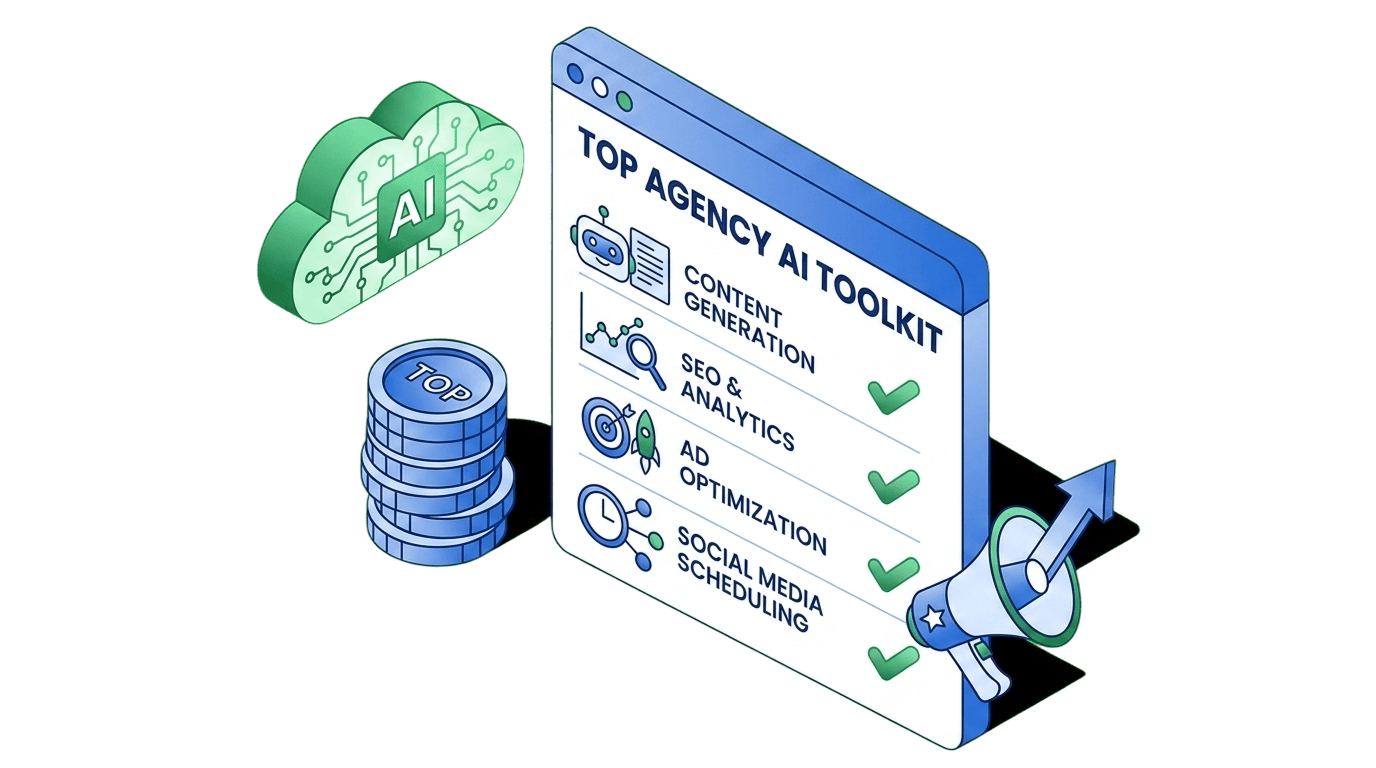
AI tools for digital marketing agencies are transforming how teams plan, execute, and optimise campaigns by automating time-consuming tasks across content, SEO, advertising, social media, and reporting. From generating content and managing campaigns to analysing performance and delivering client-ready reports, these tools act as a powerful layer on top of traditional marketing agency software.
The best AI tools for agencies not only improve efficiency but also enable teams to scale operations, handle multiple clients, and make faster, data-driven decisions, reducing manual effort while increasing output and consistency.
Let us take a closer look at the top AI Marketing tools for digital agencies.
1. Content creation
Can AI actually write good content?
AI can generate blogs, ads, emails, and social posts quickly while maintaining a consistent brand voice. It can also repurpose long-form content into multiple formats like captions, newsletters, and scripts. Additionally, AI suggests content ideas based on trends and audience behaviour, helping teams stay relevant.
What to look for
- Brand voice consistency
- Long-form capability
- SEO awareness
- Multi-format outputs (blog, email, social, ads),
- Fast iteration on drafts.
Top AI tools for Content creation:
Claude by Anthropic
Claude is a general-purpose AI assistant developed by Anthropic, designed for advanced reasoning and high-quality content generation. It is well-suited for agencies that need long-form content that feels natural and human-written, including blog posts, SEO briefs, content strategies, and client-facing copy. With features like Claude Projects, agencies can manage multiple clients by setting up separate workspaces, each with its own context, knowledge base, and chat history.
Agency fit
Best for agencies focused on content quality, strategy, and flexibility, especially those handling multiple brands that require distinct voices and tailored messaging.
Jasper
Jasper is a marketing-focused AI platform designed to support end-to-end content workflows. It offers a wide range of pre-built templates for different marketing use cases, along with tools to define and maintain a consistent brand voice. Agencies can use Jasper to streamline the entire content lifecycle, from initial brief to final output, while collaborating across teams.
Agency fit
Ideal for agencies that need a structured, scalable content system with strong brand governance, collaboration features, and repeatable workflows across multiple clients.
Copy.ai
Copy.ai is optimised for generating short-form, campaign-driven content at scale, including ad copy, email subject lines, landing pages, and social media posts. Its standout feature is the workflow builder, which allows agencies to chain research, drafting, and optimisation into automated sequences that run on demand.
Agency fit
A strong fit for agencies running high-volume campaigns or building programmatic content pipelines.
Quick takeaway
| Agency need | Best tool | Pros | Cons |
|---|
| High-quality, long-form content | Claude | Natural, human-like writing; Strong reasoning; Supports multi-client context via Projects | Lacks built-in marketing templates; Less structured workflow automation |
| Structured, scalable content production with brand consistency | Jasper | Marketing-specific templates; Strong brand voice controls; Team collaboration features | Can feel rigid; Higher cost at scale; Less flexible for nuanced writing |
| High-volume, automated short-form content workflows | Copy.ai | Fast content generation; workflow automation; Strong for campaigns and APIs | Weaker for long-form depth; Requires setup for workflows; Less editorial nuance |
2. SEO & search optimisation
Is AI changing how agencies do SEO?
AI helps identify high-impact keywords and optimise content for better search rankings. It can audit websites for technical issues and suggest improvements for on-page SEO. AI also tracks performance and analyses competitors to uncover new growth opportunities.
What to look for:
- Keyword research
- Content gap analysis
- On-page recommendations
- Competitive intelligence
- Integration with CMS platforms
Surfer SEO
Surfer SEO is an AI-powered content optimisation tool that combines real-time content scoring with writing assistance. It analyses top-ranking pages for a given keyword and provides live recommendations on structure, keyword usage, and topical depth as you write. This helps ensure content is aligned with current SERP expectations and improves ranking potential. Higher-tier plans provide unlimited brand workspaces, API access, advanced SERP analysis and a dedicated success manager.
Agency fit
Best for agencies running content-led SEO programs that need to produce and optimise large volumes of search-focused content consistently.
Semrush Copilot
Semrush Copilot is an AI assistant built into the Semrush platform that continuously monitors SEO projects and surfaces prioritised recommendations. It identifies keyword opportunities, technical issues, ranking changes, and competitor movements. When paired with ContentShake AI, it supports both SEO strategy and content execution within a single ecosystem.
Agency fit
Ideal for agencies that want an all-in-one SEO platform with AI-driven insights across strategy, technical SEO, and content.
OTTO SEO
Search Atlas’s OTTO SEO is an AI-driven agent that automates end-to-end SEO execution in real time by analysing data from sources like Google Analytics, Search Console, and Google Business Profile to identify opportunities across technical SEO, on-page optimisation, content, and link building. Unlike traditional tools that only provide recommendations, OTTO SEO can directly implement fixes and optimisations on your website. It also includes LLM visibility tracking across platforms like ChatGPT, Claude, Gemini, and Perplexity.
Agency fit
A strong fit for agencies managing multiple client websites that want automated execution, white-label reporting, and scalable SEO operations with minimal manual intervention.
Quick takeaway
| Agency need | Best tool | Pros | Cons |
|---|
| Real-time, SERP-aligned content optimisation during writing | Surfer SEO | Live content scoring based on top-ranking pages; Clear recommendations for keywords, structure, and NLP terms | Focused primarily on on-page/content SEO; Limited technical SEO capabilities |
| Centralised SEO management with AI-driven recommendations across projects | Semrush Copilot | Continuously monitors projects; Surfaces prioritised SEO actions; Integrated with the full Semrush suite | Requires familiarity with the Semrush ecosystem; recommendations still require manual execution |
| Automated SEO execution across multiple sites from a single system | OTTO SEO | Identifies and deploys SEO optimisations; Integrates multiple data sources; Includes LLM visibility tracking | Limited manual control over implemented changes; Relies on platform-defined optimisation logic |
3. Paid advertising & campaign management
Can AI improve Ad performance?
AI can generate ad creatives and optimise audience targeting for better results. It automatically adjusts bids, budgets, and placements to maximise ROI. It also analyses campaign performance in real time to improve conversions and reduce wasted spend.
What to look for:
Performance Max is Google’s AI-driven campaign type that automates ad delivery across all Google channels, including Search, Display, YouTube, Gmail, and Discover. It uses machine learning to optimise bids, audiences, creatives, and placements in real time based on conversion goals. By consolidating multiple campaign types into one, it simplifies campaign management while maximising performance through automation and data signals. There is no fixed cost or startup fee to run a Performance Max campaign. Instead, you only pay for your ad budget spend.
Agency fit
Best for agencies managing performance-driven campaigns across Google’s ecosystem, especially those looking to scale results with minimal manual optimisation.
Optmyzr
Optmyzr is a Pay-Per-Click (PPC) optimisation platform focused on improving performance across Google Ads and Microsoft Ads. It uses AI to surface actionable insights, automate bid adjustments, and streamline repetitive optimisation tasks. With features like bulk operations and cross-platform and multi-account management, it helps agencies efficiently manage paid search campaigns across multiple clients.
Agency fit
A strong fit for PPC-focused agencies that need efficiency, control, and scalable optimisation for search advertising campaigns.
Meta Advantage+ is an AI-first advertising tool within Meta Ads that utilises machine learning to automate the entire campaign lifecycle across Facebook and Instagram. In 2026, the platform has pivoted to a “creative-as-targeting” model, in which the AI analyses visual and textual signals to identify audiences, largely replacing manual interest-based segmentation. It features consolidated budget controls that prioritise campaign-level fluid spend and incorporate Manus AI, an autonomous agent built directly into Ads Manager to analyse real-time performance. There are no additional fees to use these features beyond your standard ad spend budget.
Agency fit
Ideal for agencies running high-volume, conversion-focused social campaigns that want to streamline execution and scale performance with automation.
Quick takeaway
| Agency need | Best tool | Pros | Cons |
|---|
| Automated campaign execution across all Google channels with a single setup | Performance Max | Runs across all Google channels; Automated bidding, targeting, and creative optimisation based on conversion goals | Limited visibility into performance by channel; Restricted control over placements and audience segmentation |
| Automated social ad campaigns focused on conversions and scaling | Meta Advantage+ | Automates audience targeting, placements, and creative combinations; Efficient scaling for conversion campaigns | Reduced control over audience definitions and placements; Limited transparency in optimisation decisions |
| Granular PPC optimisation across multiple accounts with automation support | Optmyzr | Automates bid adjustments and routine tasks; Bulk operations for multi-account management; Customizable optimisation rules | Primarily supports Google Ads and Microsoft Ads; Does not manage full cross-channel campaigns |
4. Social Media Management
How can AI make social media less time-consuming?
AI can create and schedule posts across platforms with minimal effort. It analyses engagement data to recommend the best content and posting times. AI also identifies trends and suggests strategies to increase audience engagement and reach.
What to look for:
- AI-assisted scheduling
- Caption generation
- Performance analytics
- Trend tracking
- Competitor monitoring
- Multi-platform support
Hootsuite
Hootsuite is an industry-leading social media management platform with deep AI integration across content creation, publishing, and analytics. It offers AI-powered caption generation, trend-based post suggestions, sentiment analysis, and customisable reporting. Agencies can manage multiple client accounts from a unified dashboard. Higher-tier plans offer custom pricing, SSO, and dedicated support.
Agency fit
Best for agencies that need a robust, enterprise-grade platform with advanced analytics, social listening, and centralised control across multiple clients.
Sprout Social
Sprout Social is an all-in-one platform that combines content creation, publishing, engagement, and sentiment and performance analysis into a single workflow. Its AI Assist helps generate and refine posts, maintain brand voice, and adapt content across channels, while smart scheduling optimises posting times based on audience behaviour. The platform also offers strong reporting and structured workflows for approvals and collaboration.
Agency fit
Ideal fit for analytics-driven agencies that need polished, client-ready reports and structured approval chains.
Sendible
Sendible is an agency-friendly social media management tool that supports bulk scheduling, automated publishing, and centralised management of multiple client accounts through a unified dashboard. The platform also includes automated reporting, collaboration tools such as approval workflows and shared calendars, and optional white-labelling for client-facing deliverables.
Agency fit
A strong fit for cost-conscious agencies that need reliable multi-client management, collaboration features, and streamlined publishing workflows.
Quick takeaway
| Agency need | Best tool | Pros | Cons |
|---|
| Centralised social media management with advanced analytics and listening | Hootsuite | Supports multiple networks from one dashboard; includes social listening, sentiment analysis, and AI-assisted content creation | Advanced features are available only in higher-tier plans; The interface can be complex for new users |
| Structured publishing, engagement, and reporting with strong client workflows | Sprout Social | Unified inbox for engagement; detailed reporting and analytics; built-in approval workflows and scheduling optimisation | Higher cost compared to alternatives; limited customisation in some reporting elements |
| Multi-client social media management with collaboration and scheduling tools | Sendible | Supports bulk scheduling and automated publishing; Client approval workflows; Centralised dashboard for multiple accounts | Advanced analytics and listening capabilities are more limited compared to enterprise tools |
5. Analytics & Reporting
Can AI make reporting less painful?
AI can automatically collect and analyse marketing data from multiple channels. It generates clear reports with key insights, trends, and performance metrics. It also provides actionable recommendations to help teams make faster, data-driven decisions.
What to look for:
- Cross-channel data aggregation
- Automated insights
- Natural language reporting
- Predictive analytics
- White-label options
Agency Analytics
AgencyAnalytics is a reporting platform built specifically for marketing agencies, designed to manage multiple clients from a single interface. It integrates with 80+ marketing platforms, including Google Analytics, Meta Ads, LinkedIn, and SEO tools, and uses AI to generate performance summaries and insights. The platform also supports white-label reporting with fully branded dashboards and automated report scheduling for consistent client delivery.
Agency fit
Best for agencies that need a structured, scalable multi-client reporting system with strong automation and integrations.
Whatagraph
Whatagraph is a reporting tool purpose-built for agencies managing multiple client accounts, with strong white-label capabilities for fully branded reports. Its AI feature, Whatagraph IQ, can generate reports instantly, explain performance in plain language, and allow users to ask follow-up questions directly from their data. The platform also supports automated report delivery, making it easy to maintain consistent client communication.
Agency fit
Ideal for agencies that want fast, AI-driven insights and simplified client reporting with strong storytelling capabilities.
Supermetrics
Supermetrics is a marketing intelligence platform that focuses on data integration, analysis, and automation rather than traditional reporting. It connects and centralises marketing data from multiple platforms, then uses AI to analyse, clean, and activate that data. The platform supports automated data pipelines, scheduled data refreshes, and flexible integrations with tools like Google Sheets and Looker Studio. Unlike all-in-one reporting tools, Supermetrics acts as a data layer, enabling agencies to build custom dashboards and workflows. It also supports white-label data products and APIs to create branded dashboards and reporting systems externally.
Agency fit
Best for agencies that need advanced data control, cross-channel data centralisation, and scalable analytics infrastructure, especially those comfortable building their own reporting layer.
Quick takeaway
| Agency need | Best tool | Pros | Cons |
|---|
| Structured, all-in-one reporting with built-in dashboards and automation | AgencyAnalytics | 80+ integrations; Automated report generation; Native white-label dashboards and scheduled delivery | Less flexible for custom data modelling or combining non-native data sources |
| AI-driven reporting with instant insights and storytelling | Whatagraph | AI-generated summaries (Whatagraph IQ); Fast report creation; Strong visual dashboards for client presentation | Less control over raw data; Limited ability to perform complex data transformations |
| Centralised data integration and advanced analytics workflows | Supermetrics | 130+ data connectors; Powerful data pipeline automation; Flexible integrations | Requires external tools for visualisation/reporting; Steeper learning curve; Does not provide native dashboards |
How to get started with AI for your marketing agency?
If you’re new to building an AI stack, don’t try to adopt everything at once. Start where your agency’s biggest time drain is, pick one tool per category, and build from there. The agencies getting the most from AI in 2026 aren’t using every tool. They’re using a few tools deeply, with clear processes around them. The goal isn’t to replace your team. It’s to make every person in it more effective.
Frequently Asked Questions