Cross-border data transfers are more important now as countries continue to introduce new privacy laws and update existing frameworks. In 2026, businesses operating internationally must navigate a growing set of rules governing the transfer of personal data across jurisdictions. These regulations often attempt to balance the protection of individuals’ data with the practical needs of global business operations. For companies that process or store data in multiple countries, understanding these requirements is essential to ensure compliance and maintain responsible data practices.
What are cross-border data transfers?
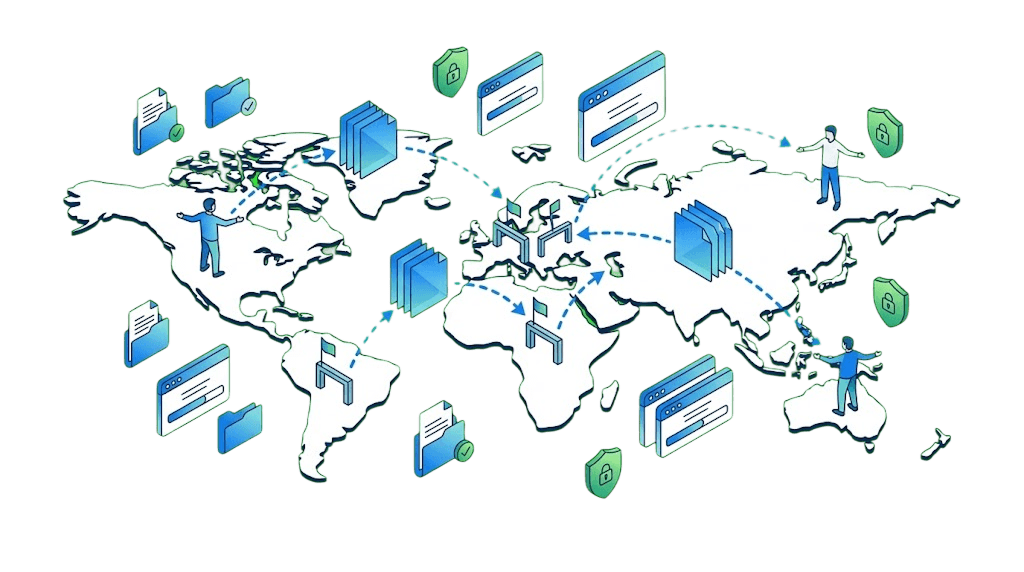
Cross-border data transfer occurs when personal data moves from one country to another. This includes cloud storage, international HR systems, customer databases, and third-party vendor processing.
These transfers are routine in our interconnected economy, but they trigger strict data protection laws across multiple jurisdictions.
What is data localisation?
Data localisation means rules that require certain data to be stored or processed within a country’s borders. These data localisation laws are often introduced to support data sovereignty, allowing governments to exercise greater control over data. They require certain categories of personal or sensitive data to be stored or processed within the country’s borders or place restrictions on transferring such data abroad.
For example, China’s Personal Information Protection Law (PIPL) requires companies to conduct security assessments and, in some cases, store certain data within China before transferring it overseas. Russia’s data localisation law requires personal data of Russian citizens to be stored on servers located within Russia.
Key regulatory trends in cross-border transfers
Privacy regulations in 2026 have become more prescriptive than ever, with three major trends reshaping compliance requirements.
Stricter transfer mechanisms
Organisations operating in regions with cross-border data transfer rules, including the EU (such as Germany and France), and Brazil, should ensure that personal data continues to receive an equivalent level of protection when it is transferred outside the country.
Cross-border transfers are generally prohibited unless specific conditions are met, such as adequacy decisions, standard contractual clauses, or binding corporate rules.

Enhanced data localisation requirements
Data sovereignty rules are becoming increasingly prescriptive. Organisations face detailed expectations around where specific categories of data may be stored, processed, and accessed. This directly impacts cloud strategy and vendor selection.
Regional frameworks vary significantly. The European Union maintains its adequacy decision approach, while China requires security assessments for critical infrastructure operators and certain high-volume transfers.
Countries like Singapore, Japan, and Australia have implemented their own frameworks requiring comparable protection standards.
AI processing and consent requirements
Lately, we have been seeing how the intersection of AI and data protection has become a major compliance focus.
The majority of rules under the EU AI Act became enforceable in August 2026, introducing explicit requirements for AI systems processing personal data. The Act will become enforceable in Aug 2027.
Key AI-related obligations include:
- Informed consent: Consent is required for real-world testing of high-risk AI systems.
- Data Protection Impact Assessments: Required for AI systems that materially affect individuals
- Transparency requirements: Organisations must document their lawful basis for AI processing and provide clear explanations to data subjects
- EU AI Act Risk Classification: Classifies AI systems into four categories—unacceptable, high, limited, and minimal risk, with stricter compliance obligations for higher-risk systems.
California CCPA requires businesses to conduct risk assessments before initiating any processing of sensitive personal information. Risk assessments are also mandatory for automated decision-making technology (ADMT) used for significant decisions, selling or sharing personal data and using automated processing to infer characteristics about consumers.
Common compliance challenges in 2026
Organisations face several critical challenges when managing cross-border data flows:
- Complex multi-jurisdictional requirements: With around 155 countries having privacy laws, each with different consent models, transfer mechanisms, and enforcement approaches, compliance requires data governance frameworks.
- Sensitive data processing: Health information, biometric identifiers, precise geolocation, and children's data now require explicit consent in most jurisdictions. Organisations must track these data categories across their entire processing ecosystem.
- Third-party risk management: Include AI governance clauses, data processing agreements, and clear identification of subprocessors in vendor contracts. Organisations remain accountable for ensuring processors meet compliance standards.
- Documentation and audit requirements: Regulators expect comprehensive records of processing activities, transfer impact assessments, consent logs, and evidence of lawful data flows between controllers, processors, and jurisdictions.
How CookieYes helps in cross-border compliance
Managing consent across multiple jurisdictions requires intelligent automation. CookieYes provides solutions specifically designed for organisations serving international audiences.
Geo-targeted consent banners
CookieYes geo-target banners automatically detect visitor locations and display region-appropriate consent banners. This means EU and UK visitors see GDPR-compliant banners, California users receive CCPA-compliant banners with "Do Not Sell" links, and other regions display banners appropriate to local requirements, including Brazil's LGPD, Canada's PIPEDA, and various U.S. state laws
Companies can configure separate banner templates for different regions, ensuring compliance without creating a one-size-fits-all approach that may violate stricter jurisdictions' rules.
Comprehensive consent logging
CookieYes maintains detailed audit trails of all consent events with timestamps, creating the documentation needed for regulatory compliance. Consent logs capture user consent choices, cookie preferences, consent withdrawal and modification, Global Privacy Control signal recognition, etc.
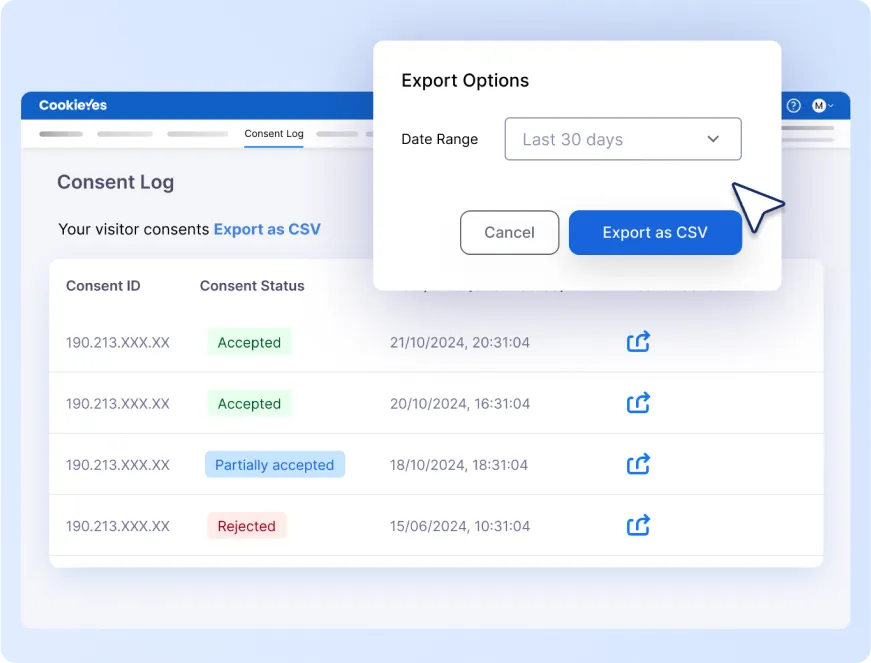
These logs come handy during regulatory audits, data subject access requests, and transfer impact assessments.
Google Consent Mode v2 Integration
As a Google-certified Consent Management Platform, CookieYes integrates with Google Consent Mode v2, enabling organisations to adjust tag behaviour based on user choices, maintain measurement capabilities while respecting privacy preferences, and support both basic and advanced consent mode implementations.
Multi-regulation support
CookieYes supports compliance across multiple frameworks simultaneously, including:
- GDPR and ePrivacy Directive (EU/UK)
- CCPA/CPRA (California) and other U.S. state privacy laws
- LGPD (Brazil)
- PIPEDA (Canada)
- IAB Transparency and Consent Framework v2.3
Organisations can implement both GDPR and U.S. State Laws templates concurrently, with independent geo-targeting configurations for each regulation.
How can businesses meet GDPR cross-border data transfer rules?
To comply with GDPR cross-border data transfer rules, businesses must ensure that personal data transferred outside the European Economic Area (EEA) receives a level of protection comparable to that guaranteed within the EU. The GDPR sets out specific mechanisms under Chapter V (Articles 44–50) to make such transfers lawful.
Key ways to meet these GDPR cross-border data transfer requirements include:
- Transfer data to countries with an adequacy decision: The European Commission recognises certain countries (such as the UK, Japan, and Switzerland) as having adequate data protection laws. Transfers to these countries are allowed without additional safeguards.
- Use Standard Contractual Clauses (SCCs): SCCs are the most common transfer mechanism. These legally binding contracts ensure that both the data exporter and importer follow GDPR-level data protection standards and provide enforceable rights to individuals.
- Implement Binding Corporate Rules (BCRs): Multinational companies can adopt BCRs to allow secure data transfers within the same corporate group. These rules must be approved by EU data protection authorities.
- Conduct a Transfer Impact Assessment (TIA): Following the Schrems II decision, organisations must assess whether the destination country’s laws could affect the protection of transferred data. This evaluation helps determine whether additional safeguards are necessary.
- Apply supplementary technical safeguards: If risks are identified, organisations should implement additional protections such as strong encryption, pseudonymisation, data minimisation, or privacy-enhancing technologies (PETs).
- Use GDPR derogations only in limited cases: Under Article 49, transfers may be allowed for specific situations such as explicit consent, contractual necessity, or legal claims. However, these exceptions are meant for occasional transfers, not routine operations.
In practice, most organisations meet GDPR cross-border transfer requirements by combining Standard Contractual Clauses, Transfer Impact Assessments, and strong technical safeguards to maintain EU-level data protection even when data is processed outside the EEA.
Checklist: Best practices for cross-border data management in 2026
Here’s what an organisation can do to stay proactive with cross-border regulations:
- Map all data flows: Document where personal data originates, where processing occurs, and where data is stored with real-time classification. Distinguish between data controllers and processors across your ecosystem.
- Implement transfer mechanisms: Ensure every international transfer has a valid legal mechanism (adequacy decisions, SCCs, BCRs).
- Conduct regular assessments: Perform Impact Assessments for all cross-border flows, especially to countries without adequacy decisions.
- Automate consent management: Use automated tools to flag potential vulnerabilities before they reach production. For websites, leverage consent platforms supporting geo-targeting, automatic cookie scanning, and consent signal transmission.
- Embed privacy controls early: Implement granular access controls and consent mechanisms from the beginning of development cycles.
- Establish cross-functional governance: Assign clear responsibilities across legal, IT, product, marketing, and operations teams.
- Monitor and adapt: Track regulatory updates and maintain flexible systems that can quickly adapt to new requirements.
- Invest in privacy education: Tailor training programs to each audience- engineers learn secure coding, marketing learns about consent and disclosures, executives understand strategic trends and regulatory risks.
Cross-border data transfer vs localisation: The path forward
- Organisations that invest in robust, flexible compliance infrastructure today will be best positioned to navigate the cross-border and data localisation requirements.
- Success requires balancing operational efficiency with diverse regulatory requirements, embedding privacy into design from the outset, and maintaining the agility to adapt as the regulatory environment continues evolving.
The debate between data localisation and cross-border transfers will continue shaping digital policy for years to come. While some economies like Russia move toward greater restrictions, others like European Union choose interoperability and trusted frameworks. Organisations must prepare for both realities, building systems that respect sovereignty concerns while enabling the global collaboration essential for innovation and growth.