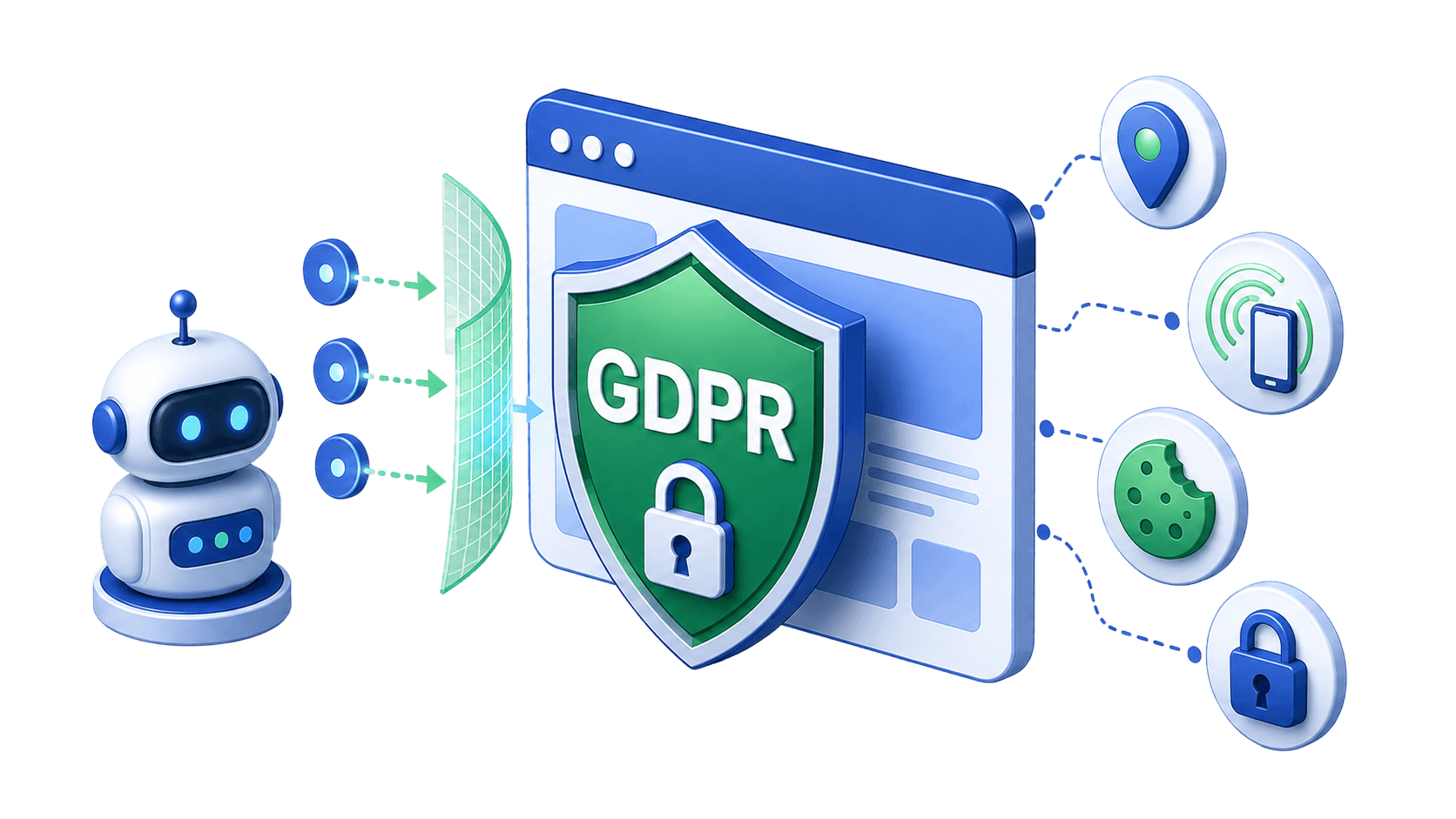
Your website needs protection from bots that scrape content, test stolen credentials, or overwhelm servers. But detecting them often means analysing every visitor's IP address, device information and browsing behaviour.
Bots do not have privacy rights. However, when bot-detection tools process information about identifiable users, the GDPR applies. This guide explains the key GDPR obligations for bot traffic, including lawful basis, security cookies, CAPTCHA providers and data breach requirements.
Does the GDPR apply to bot traffic?
Bot traffic itself does not automatically fall under the General Data Protection Regulation because bots are not individuals. However, the tools used to detect bots may process personal data belonging to website visitors from the European Union.
For example, a CAPTCHA, firewall or fraud-detection tool may collect:
- IP addresses and approximate location;
- Browser and device information; and
- Behavioural signals, such as mouse movements or typing patterns.
Under Article 4(1) of the GDPR, this information may qualify as personal data if it can identify or single out a person, either independently or when combined with other information.
Data generated entirely by automated means may fall outside the GDPR if it cannot be connected to a person. In practice, however, bot-detection tools often analyse bots and genuine visitors together. Website owners should therefore assess what these tools collect and comply with GDPR obligations wherever personal data is involved.
What GDPR principles apply to bot detection?
Where bot management involves personal data, the principles in Article 5 of the GDPR apply. Website owners should be able to explain what they collect, why they need it and how long they keep it.
| GDPR principle | What it means for bot detection |
|---|---|
| Lawfulness, fairness and transparency | Identify a lawful basis and explain the processing clearly in your privacy notice. |
| Purpose limitation | Limit the use of personal data to the purpose of collection. Avoid unauthorised repurposing. |
| Data minimisation | Avoid collecting personal data when less intrusive signals can provide adequate protection. |
| Accuracy | Review detection rules and threat lists so that outdated information does not repeatedly block genuine users. |
| Storage limitation | Set retention periods for server logs, WAF records and other security data instead of keeping them indefinitely. |
| Integrity and confidentiality | Protect security logs with appropriate access controls and other measures under Article 32. |
Accountability sits behind all of these principles. It is not enough to follow them in practice; businesses must also be able to demonstrate compliance.
What is the appropriate lawful basis for bot detection?
Every processing activity involving personal data needs a lawful basis under Article 6 of the GDPR. The right basis depends on the organisation, the purpose of the processing, and how the technology works.
Legitimate interests
Legitimate interests under Article 6(1)(f) will often be relevant. Protecting a website and its users against credential stuffing, fraud, scraping, and disruption can be a legitimate interest. However, a controller should not select this basis simply because obtaining consent would be inconvenient.
A legitimate interests assessment (LIA) can help the organisation consider three questions:
- Purpose: Is there a specific and genuine interest, such as protecting customer accounts or maintaining service availability?
- Necessity: Is the processing reasonably necessary, or could the purpose be achieved through a less intrusive method?
- Balancing: Do the organisation's interests outweigh the possible effect on users' rights and reasonable expectations?
The assessment should reflect how the tool actually operates. A system that briefly checks an IP address to identify an obvious attack presents a different privacy impact from one that creates a persistent device fingerprint and continuously analyses a person's behaviour.
Consent is usually difficult to rely on for core security checks that must operate before a visitor can interact with the site. Other lawful bases may be available in limited circumstances.
Do bot-detection cookies require consent?
Some bot-detection tools place cookies on a visitor's device or access information already stored there. When they do, both the GDPR and applicable cookie laws must be considered.
Consent may not be required when a bot-detection cookie is strictly necessary to provide a service requested by the user or to transmit a communication. For example, a short-lived security cookie used only to protect a login page may qualify as essential.
However, not every cookie described as "security" is automatically exempt. Consent may be required if the technology:
- Tracks visitors across sessions or websites;
- Creates a persistent device fingerprint;
- Supports analytics, advertising or other secondary purposes; or
- Collects more information than is necessary for security.
Assess each cookie or tracking technology based on what it actually does. The applicable rules and exemptions may also differ between European countries.
CookieYes can scan your site for cookies and trackers, helping you identify and categorise them correctly. You can then use the CookieYes CMP to collect consent where required and respect visitors' preferences.
Who is responsible when a third-party service is used?
Websites often use third-party providers for CAPTCHAs, fraud prevention, content delivery and bot protection. Under the GDPR, responsibility depends on how each provider uses personal data.
In most cases:
- The website owner is the controller because they decide why and how personal data is processed.
- The service provider is the processor when it handles data only on the website owner's instructions.
- The website owner and provider may be joint controllers if they make important decisions about the processing together.
If the provider is a processor, you need a Data Processing Agreement that meets Article 28 of the GDPR. It should explain how the provider protects data, reports breaches, assists with privacy requests, uses subprocessors, and deletes or returns data.
You should also find out where the provider processes the information. If personal data is transferred outside the European Economic Area, appropriate safeguards, such as an adequacy decision or Standard Contractual Clauses, may be required.
Should bot detection appear in the Record of Processing Activities?
If bot detection involves personal data, it should be captured in the organisation's Record of Processing Activities (RoPA) where Article 30 applies. The record should provide enough detail to understand the processing, including:
- Its security or fraud-prevention purpose;
- The categories of people and personal data involved;
- Recipients or categories of recipients;
- Relevant international transfers;
- Expected deletion periods; and
- A general description of security measures, where required.
Article 30(5) contains a limited exemption for some organisations with fewer than 250 employees. It does not apply, however, where the relevant processing is not occasional, is likely to pose a risk to individuals, or includes certain special-category or criminal-conviction data. Because bot detection commonly runs continuously, many organisations should not rely on the exemption without examining the conditions carefully.
Is a DPIA required for bot-detection tools?
A Data Protection Impact Assessment (DPIA) is required under Article 35 where processing is likely to result in a high risk to people's rights and freedoms. Bot detection does not automatically meet this threshold.
It depends on factors such as the scale of monitoring, the sensitivity and volume of the data, whether users are systematically evaluated, the consequences of a false classification, and whether new or intrusive technologies are involved. Consult the EDPB's DPIA guidance and the Article 35(4) list published by the relevant supervisory authority.
For example, a basic server-side control that temporarily rate-limits repeated requests may present a relatively limited privacy risk. A large-scale system that creates persistent fingerprints, tracks detailed behaviour and automatically denies people access to an important service requires much closer assessment.
Even where a DPIA is not mandatory, a documented privacy review can help answer practical questions:
- Does the tool collect more data than the security purpose requires?
- How could a false positive affect a legitimate user?
- Can a blocked user challenge the decision or access support?
- How long does the provider keep the information?
- Would a less intrusive method provide adequate protection?
Can a bot attack become a personal data breach?
An attack involving bots is not automatically a personal data breach. What matters is its effect on personal data.
Under Article 4(12), a personal data breach involves a security breach leading to accidental or unlawful destruction, loss, alteration, unauthorised disclosure of, or access to personal data. A successful credential-stuffing attack that exposes customer accounts is a clear example.
Controllers should document personal data breaches under Article 33(5). Notification requirements then depend on risk:
- The controller must notify the competent supervisory authority without undue delay and, where feasible, within 72 hours of becoming aware of the breach, unless it is unlikely to result in a risk to people's rights and freedoms.
- Affected individuals must be informed without undue delay where the breach is likely to result in a high risk, subject to the exceptions in Article 34.
Security logs can be important evidence when establishing what happened, which data was affected and when the organisation became aware of the breach. Retention should balance this need against the storage-limitation principle.
A practical GDPR checklist for bot detection
Website owners can begin with the following steps:
- Identify every CAPTCHA, WAF, content delivery network, fraud service and custom script involved in bot management.
- Record what each tool collects, where the data goes, how it is used and how long it remains available.
- Where relying on legitimate interests, complete and document an LIA based on the real processing.
- Assess each technology under the applicable ePrivacy rules instead of treating every security cookie as automatically exempt.
- Determine the parties' roles per processing operation and put the appropriate agreement in place.
- Explain security processing in clear language.
- Keep bot and security logs only for as long as the relevant purpose requires.
- Give genuine users a reasonable way to regain access or request support.
- Reassess the operation when a vendor, purpose, signal, or detection method changes.
CookieYes can help website owners scan their sites for cookies, categorise them and manage consent preferences through our cookie consent solution.
Our cookie scanner can also support periodic checks as website technologies change. These tools form one part of a broader compliance process that should also cover lawful basis, transparency, vendor governance and security.
Manage your site's cookie compliance from one place
Sign up for CookieYes, create and deploy your custom cookie banner today
Sign up for free- 14-day free trial
- Cancel anytime
Frequently asked questions
Is bot traffic personal data under the GDPR?
Not by itself. Bots are not natural persons. However, IP addresses, device identifiers and behavioural information processed by bot-detection tools may be personal data when they relate to an identified or identifiable person. The answer depends on the information and the context in which it is processed.
Do reCAPTCHA cookies require consent?
Usually, yes. In the EU and UK, reCAPTCHA cookies or similar device-access technologies need prior consent unless they are genuinely strictly necessary to protect a specific service or form from abuse.