Full site index for AI agents: llms.txt. Every page is also available as Markdown: replace the trailing slash with .md, so /pricing/ becomes /pricing.md. Or send the header Accept: text/markdown to the page URL itself.
Simpler, more seamless cookie consent for Shopify stores.
Shopping from the comfort of home is now part of everyday life. People browse, compare and buy with just a few clicks, and many e‑commerce sites deliver a personalised experience. A part of these conveniences relies on cookies, small text files that store information about your visit. But they also involve personal data, and that means privacy rules apply.
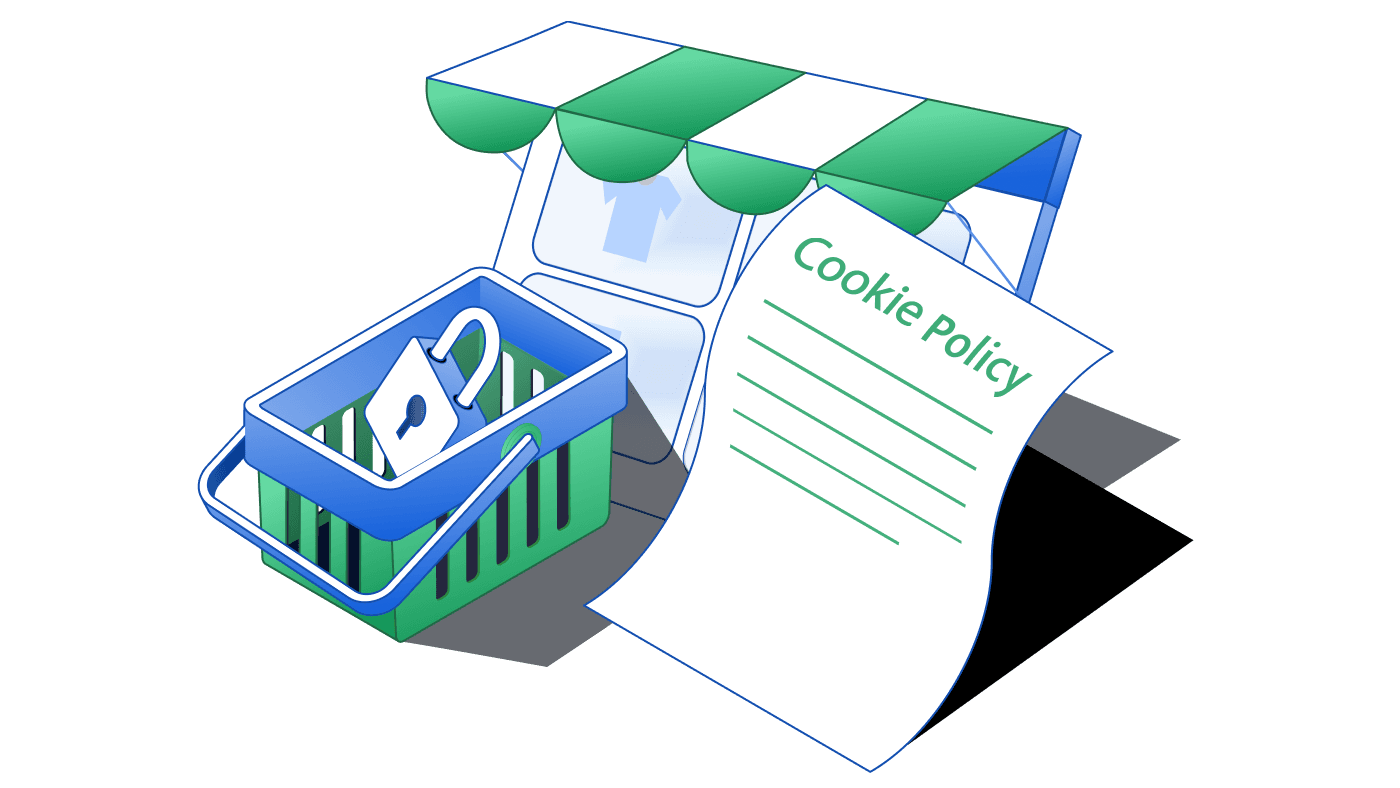
A cookie policy explains what cookies are used on a website, why they are used, who sets them and how users can manage them. This guide explains how you can write an e‑commerce cookie policy, what to include, cookie policy examples and best practices.
What are cookies and why do e‑commerce websites need them?
Cookies are pieces of data placed on a user’s device when they visit a site. They typically contain a unique identifier and the site name. E‑commerce sites use multiple types of cookies for several practical reasons:
User authentication and session management: Cookies remember login credentials, avoiding repeated logins. They also maintain shopping carts so items remain in the basket if a shopper navigates away.
Personalisation: They store language, currency and other preferences, enabling customised recommendations, targeted offers and personalised content.
Analytics and performance: Cookies track how visitors interact with a site, revealing which products are viewed, what is added to the cart and what leads to conversions. This helps merchants improve user experience and marketing strategies.
Advertising and remarketing: They record browsing history to show relevant ads on other sites or social platforms.
Security and fraud prevention: Cookies monitor behaviour for unusual patterns or failed logins, helping to detect suspicious activity.
Third‑party integrations: Payment gateways, social media plugins and other services use cookies to function.
Therefore, many of the seamless and personalised features shoppers expect would not work without internet cookies.
Why do e‑commerce sites need a cookie policy?
In a time where privacy is a competitive differentiator, a transparent website cookie policy shows that you take user data seriously. Here are more reasons an e-commerce cookies policy is important:
A cookie policy keeps shoppers informed about what data you collect and why you collect it.
It builds trust and encourages them to accept cookies that improve their experience.
It also clearly explains your practices, reducing the risk of complaints or fines.
A cookie policy helps you gather more accurate analytics because consent is given knowingly.
How does a cookie policy differ from a privacy policy?
A cookie policy is a document that lists all cookies used on your site and explains each one’s purpose, lifespan and the data it collects.
It also identifies who sets each cookie (your business or a third party) and describes how users can manage their preferences. The cookie policy can be standalone or part of a wider privacy policy, but it is narrower in scope.
A privacy policy covers all forms of personal data collection, storage and sharing, while a cookie policy focuses specifically on cookies and similar trackers.
Though you may combine your privacy and cookie policy into a single document, it is highly recommended to keep them separate for easier access and convenience.
What to include in your cookie policy?
Your website cookie policy doesn’t need to be long, but it does need to be complete. At a minimum, it should include:
Definition of cookies and why you use them
In this section, you should explain what cookies are and why they are used by websites.
The cookie policy of Asos defines what cookies are and how it uses them.
Types/categories of cookies
Group cookies into categories (essential, functional, analytics and marketing) and mention that essential cookies keep the site running and do not require consent.
Types of cookies employed on Glossier’s e-commerce site, as detailed in its cookie policy (translated from French).
The following are the different types of cookies:
Necessary
Operate core functions like login, cart and checkout.
Functional
Remember user choices such as language, region or login status. They provide a personalised experience
Performance/analytics
Measure site usage. They collect data on page views, conversion funnels, bounce rates and time on site.
Advertising/targeting
Track browsing across sessions and sites to deliver personalised ads.
First-party cookies
Set directly by your domain, they’re often used for core site functions like remembering cart items or storing login sessions.
Third-party cookies
Set by domains other than yours, they are often embedded via analytics, ad networks, payment processors or social media plugins.
Session cookies
Temporary cookies that expire once the browser is closed.
Persistent cookies
Remain on the user’s device for a set period (days, weeks or years) unless deleted.
Purpose of cookies and their retention period
In your website's cookie policy, describe thecommon purposes of each cookie, such as session management, cart functions, personalising content and ads, and analysing website/app performance. Being specific builds credibility and satisfies GDPR and CCPA’s requirement for informed consent.
Furthermore, set apart how long cookies stay on the user’s device. Distinguish between session cookies, which disappear when the browser closes, and persistent cookies, which may last days, weeks or years.
The cookie policy of & Other Stories provides the names of cookies and their life span, while also explaining what their functions are.
Name third‑party cookies
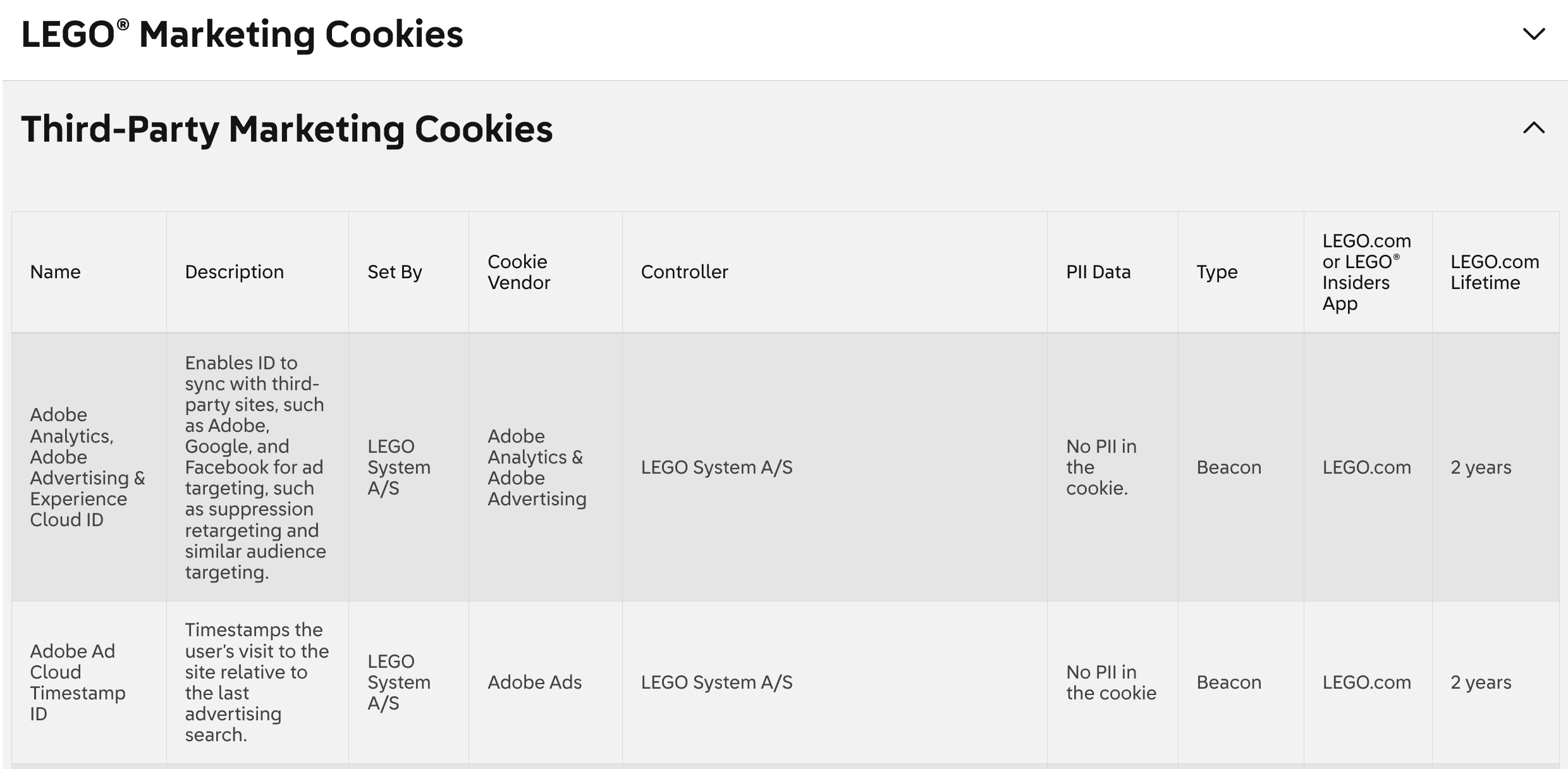
Identify any external services that set cookies (like Google Analytics, Facebook, advertising networks or payment providers) and link to their policies.
Different third-party marketing cookies on Lego’s website
Explain cookie control options
Provide instructions for opting out or changing preferences via your banner, browser settings or industry tools, and tell users how to contact you with questions. Make clear that consent can be withdrawn at any time.
Your Choices section of the eBay cookie policy defines how users can exercise their cookie preferences or withdraw their consent
Other required information
Include your company’s contact details, such as a privacy officer’s email, for questions or requests.
State how often you update the policy and provide the date of the last update.
Also, explain how users will be notified of changes (e.g., via banners, notices or email).
How you write and present your cookie policy matters as much as what it says. Here are a few tips to keep in mind while writing your e-commerce cookie policy.
Use a scanning tool to find all first‑party and third‑party cookies on your site.
Use plain language so anyone can understand what cookies do and how they work.
Keep the document concise but complete, using a table or simple bullet list to organise information.
Update the policy when you add new technologies or when laws change.
Post your e-commerce cookie policy somewhere obvious. This can be the website footer, menu or privacy centre.
Also, add a link to the cookie policy from your consent banner.
If you serve customers in different regions, note that EU users need to opt in to non‑essential cookies, while some US laws allow opt‑out.
Save hours of legal writing
Generate a custom cookie policy for your website with CookieYes
What are the data privacy laws impacting website cookie policy?
Online tracking has raised privacy concerns, leading to laws that restrict how cookies are used. Two main European regulations are the ePrivacy Directive (often called the Cookie Law) and the General Data Protection Regulation (GDPR).
The ePrivacy Directive requires websites to obtain informed consent before storing or accessing information on a user’s device. It covers cookies and similar technologies, including pixels, device fingerprinting and unique identifiers
The GDPR regulates the processing of personal data, including information collected through cookies. Under GDPR cookie consent requirements, you must:
Obtain prior and explicit consent before setting non‑essential cookies.
Ensure consent is an affirmative action, meaning no pre‑ticked boxes or implied consent.
Provide granular controls, allowing users to choose which categories of cookies to accept.
Make consent freely given, that is, no coercive designs or dark patterns.
Inform users about the cookies and their purposes in plain language.
Offer an easy way to withdraw consent.
Keep records of consent, including when and what users agreed to (Consent log).
Renew consent at regular intervals.
In the United States, the California Privacy Rights Act (CPRA) require websites to inform users about cookie usage and provide opt‑out options. The CPRA explicitly forbids dark patterns, which are deceptive designs that manipulate user choices.
Privacy and Electronic Communications Regulations (PECR) in the UK align with the EU cookie law and apply to any entity setting cookies on devices in the UK.
Other jurisdictions, such as Brazil (LGPD) and South Africa (POPIA), have similar obligations.
Creating your cookie policy: A practical checklist
Use a cookie scanner to discover all the cookies on your site.
Group cookies into categories and note their purposes and lifespan, including benefits for the user.
Determine which data protection laws apply based on your factors, such as your customers’ location, and tailor your policy accordingly.
Draft your cookie policy in plain and clear language.
Cover all essential elements: cookie definitions, categories, purposes, third parties, duration, opt‑out instructions, legal basis and contact details.
Keep records of when and how users consented and refresh consent at appropriate intervals.
Update your policy and banner when you add new services, change your practices or when regulations evolve.
How can CookieYes help?
Manually keeping track of every cookie on your e-commerce site can get complicated, especially as your store grows, adds new integrations, or runs campaigns across different regions. That’s where CookieYes makes the process effortless.
CookieYes offers an all-in-one consent management platform (CMP) designed for e-commerce compliance. It can:
Scan your website automatically to detect all cookies and similar tracking technologies.
Generate a custom cookie policy that’s tailored to your store and easy for shoppers to understand.
Display a fully configurable cookie banner that meets GDPR, CCPA, LGPD and other major privacy law requirements.
Enable granular consent so customers can accept or reject specific categories of cookies.
Keep consent logs to prove compliance in case of an audit.
Integrate with popular platforms like Shopify, WooCommerce and Magento without complicated setup.
Multi-lingual cookie policies
By automating cookie detection, consent collection and policy generation, CookieYes saves you time, reduces compliance risks, and builds trust with customers from their very first visit.
Fast track your cookie compliance
Secure an effortless consent management experience with CookieYes
A cookie policy for e-commerce is a legal notice that tells visitors what cookies your store uses, why you use them (e.g., cart functionality, analytics, ads), who sets them, how long they last, and how customers can manage or refuse them.
What elements should be included in an e‑commerce cookie policy?
A good cookie policy for an e-commerce website lists cookie types, their purpose, duration, third‑party sharing, and explains how users can accept, reject, or withdraw consent.
What legal frameworks govern cookies in e‑commerce?
E-commerce businesses must comply with global privacy and cookie laws to protect user privacy. The UK's PECR and UK GDPR, the EU's ePrivacy Directive and GDPR, and US state laws like California's CCPA all regulate cookie usage, requiring clear information and consent. Non-compliance can lead to severe penalties. Businesses need robust cookie policies, consent banners, and regular updates to ensure compliance.
What are the rules for cookies on websites?
The rules for cookies on websites depend on the privacy laws in the region where you operate and where your visitors are located. Under laws like the GDPR and ePrivacy Directive in the EU or PECR in the UK, you generally need informed consent before setting non-essential cookies, must explain what cookies do, why you use them, and who sets them, and provide users with an easy way to accept, reject, or later withdraw consent.
Under the CCPA/CPRA in California, there is no strict requirement for prior consent, but you must disclose your use of cookies in your privacy policy, inform users if cookies “sell” or “share” their personal information, and provide a clear “Do Not Sell or Share My Personal Information” link if applicable. Each law has its own requirements, so your cookie practices should align with the locations of your users.

![The cookie policy of Asos[nofollow] defines what cookies are and how it uses them.](https://assets.cookieyes.com/cpecom_intro_726e4bb647.png)
![Types of cookies employed on Glossier’s e-commerce site[nofollow] , as detailed in its cookie policy (translated from French).](https://assets.cookieyes.com/cpecom_cookietypes_78af683bab.png)
![The cookie policy of & Other Stories[nofollow] provides the names of cookies and their life span, while also explaining what their functions are.](https://assets.cookieyes.com/cpecom_cookie_span_9964d03082.png)
![The cookie policy on Lego[nofollow] ’s website explains the use of third-party cookies on its website.](https://assets.cookieyes.com/cpecom_thirdparties_f3ef1cb85e.png)
![Your Choices section of the eBay cookie policy[nofollow] defines how users can exercise their cookie preferences or withdraw their consent](https://assets.cookieyes.com/cpecom_yourchoices_0df78e27ca.png)
![Contact information as seen on Argos’ cookie policy[nofollow]](https://assets.cookieyes.com/cpcom_contact_6c60d0a846.png)