Manage user consent online and meet PDPA compliance
Automate consent management and align your business with regulatory compliance with our no-code, easy-to-use cookie consent solution.
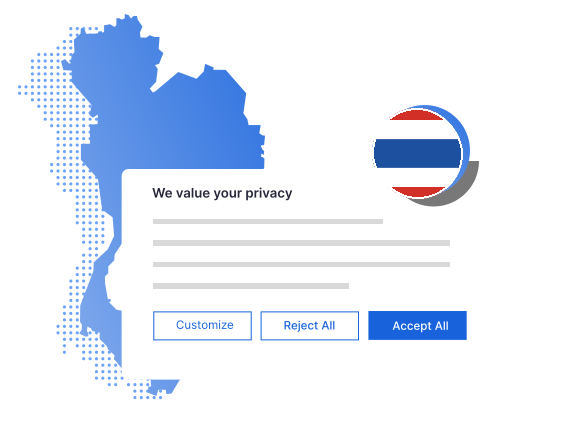
The #1 cookie consent solution, trusted by 1.5 Million+ websites



Check your PDPA Compliance
CookieYes will scan your website and keep you informed on the personal data your website collects through cookies.


The Thailand Personal Data Protection Act (PDPA) is the first data protection law in Thailand that aims to regulate the collection, use, and disclosure of personal data for commercial purposes. The PDPA was enacted in 2019 and was enforced from June 1, 2022, after being postponed due to the pandemic.
PDPA Compliance Checklist for Websites
- Obtain user consent for cookies and trackers
- Record user consents to demonstrate proof
- Include an accurate, up-to-date privacy policy
- Limit data collection only for legitimate purposes
- Notify data breaches to DPAs and users
Comply with PDPA Thailand using CookieYes
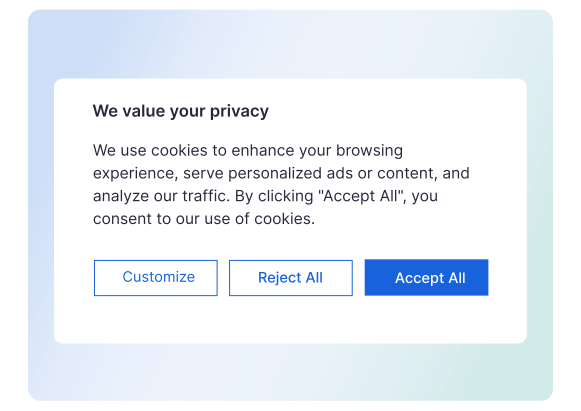
Display cookie consent banner for visitors
PDPA Thailand requires businesses to notify users regarding the use and disclosure of personal data at the point of collection and request users for their consent.
With CookieYes you can
- Scan your website against a 100,000+ cookie database
- Display a custom cookie banner to get opt-in consent
- Show a consent revisit widget for users to withdraw consent
Automate consent management
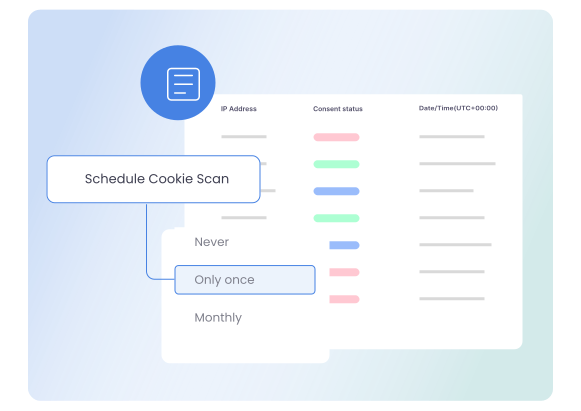
Businesses should also ensure ongoing compliance with PDPA’s obligations for consent and leverage automated tools.
With CookieYes you can
- Auto-block all third-party cookies before user consent
- Schedule cookie scanning for continuous compliance
- Record consent logs for proof of consent during audits
Generate a compliant privacy policy
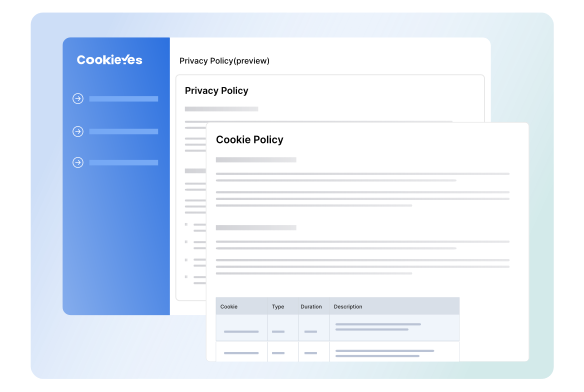
Under PDPA Thailand, businesses should notify users of the purposes for which they collect personal data and it should be easy to read and understand.
With CookieYes you can
- Use our pre-built, legally compliant policy templates
- Generate your privacy policy and cookie policy in minutes
- Simply copy-paste the legal policies to your website
Learn more about PDPA and take the next step towards compliance

What is PDPA Thailand?
The Personal Data Protection Act is a data protection law in Thailand. The PDPA was enacted to regulate the collection, use, disclosure, and protection of personal data to safeguard individuals’ rights and privacy. It establishes principles and guidelines for organizations handling personal data, including consent requirements, data subject rights, data security standards, and obligations for data controllers and processors.
The PDPA applies to both Thai and foreign organizations operating in Thailand that process personal data. The PDPA Thailand was enacted in May 2019 and came into full effect on June 1, 2022.

Who does PDPA apply to?
The PDPA Thailand applies to individuals or entities engaged in the commercial collection, use, disclosure, or transfer of personal data within Thailand. However, certain exceptions exist, and the PDPA does not cover personal data collected by government agencies, organizations working for the public interest, the House of Representatives, the Senate, Parliament, or credit bureaus. Data collected for domestic or personal affairs is also not protected under the PDPA.
Entities operating outside Thailand fall under the PDPA’s purview if they collect, use, or disclose personal data of Thai individuals while offering goods or services in Thailand or monitoring activities within the country.

What are consumer rights under PDPA?

Right to be informed
The right to be informed about how their personal data will be used, and to be notified if personal data is disclosed to third parties.

Right to access
The right to access personal data and to have it available in a clear and readable format, free of cost.


What is the penalty for non-compliance?
The penalty for non-compliance with Thailand’s Personal Data Protection Act (PDPA) includes administrative fines and criminal penalties. The maximum administrative fine for non-compliance with the PDPA is up to THB 5 million.
Criminal penalties for non-compliance involve imprisonment terms not exceeding one year, in addition to administrative fines. Moreover, the PDPA also allows for punitive damages up to twice the amount of the actual damages, and civil damages can be multiplied as Thailand allows data subjects to bring a class action lawsuit.
FAQ on PDPA Thailand Compliance
The Thailand Personal Data Protection Act (PDPA) came into full effect on June 1, 2022. The Thai PDPA was originally set to enter into effect on May 31, 2020, but was postponed due to the COVID-19 pandemic.
Fast-track your PDPA compliance in minutes
Set up a cookie consent banner in 3 simple steps and automate your compliance.