What is Google Analytics?
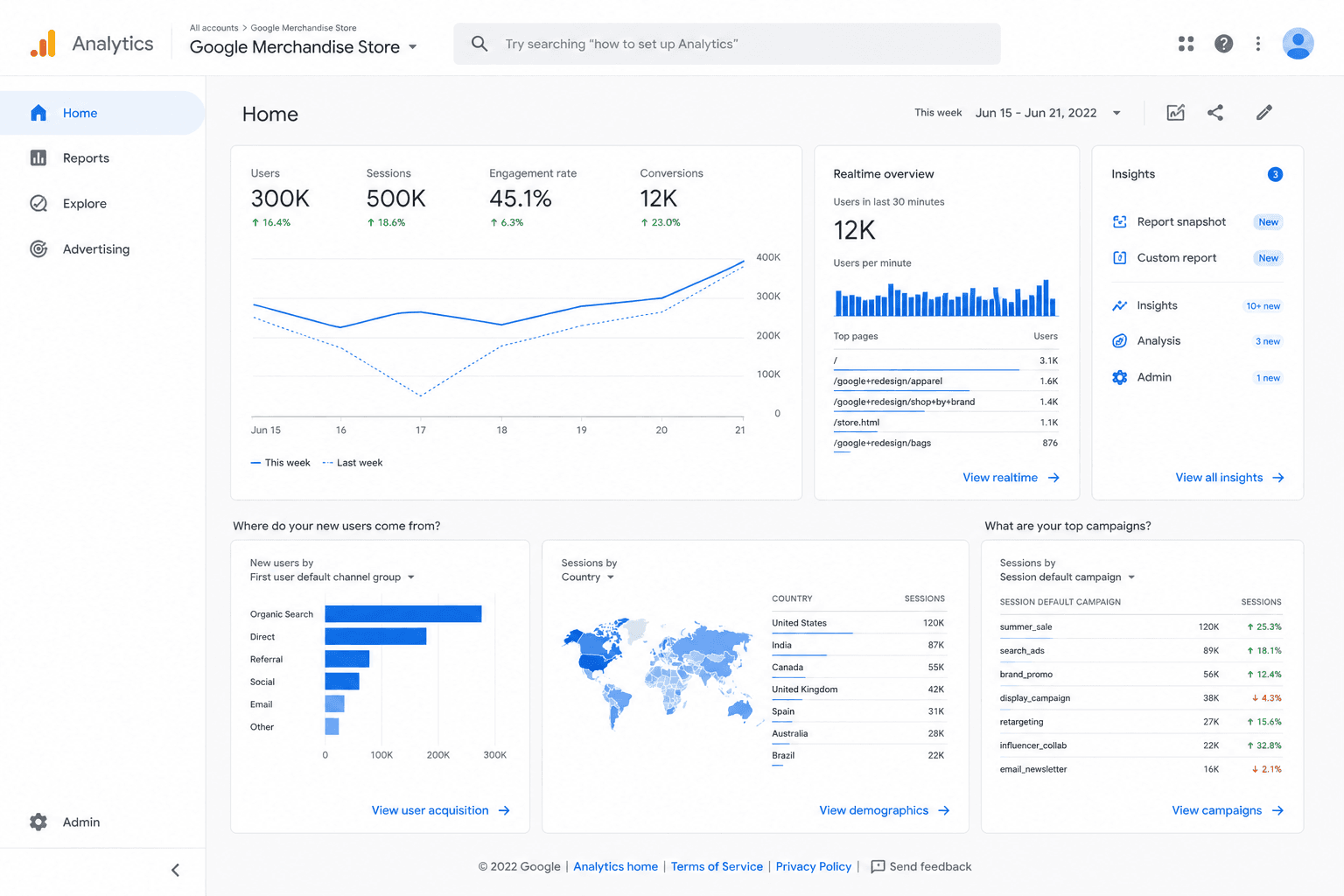
Analytics dashboard visualization for illustrative purposes only.
Why do Google Analytics users need a privacy policy?
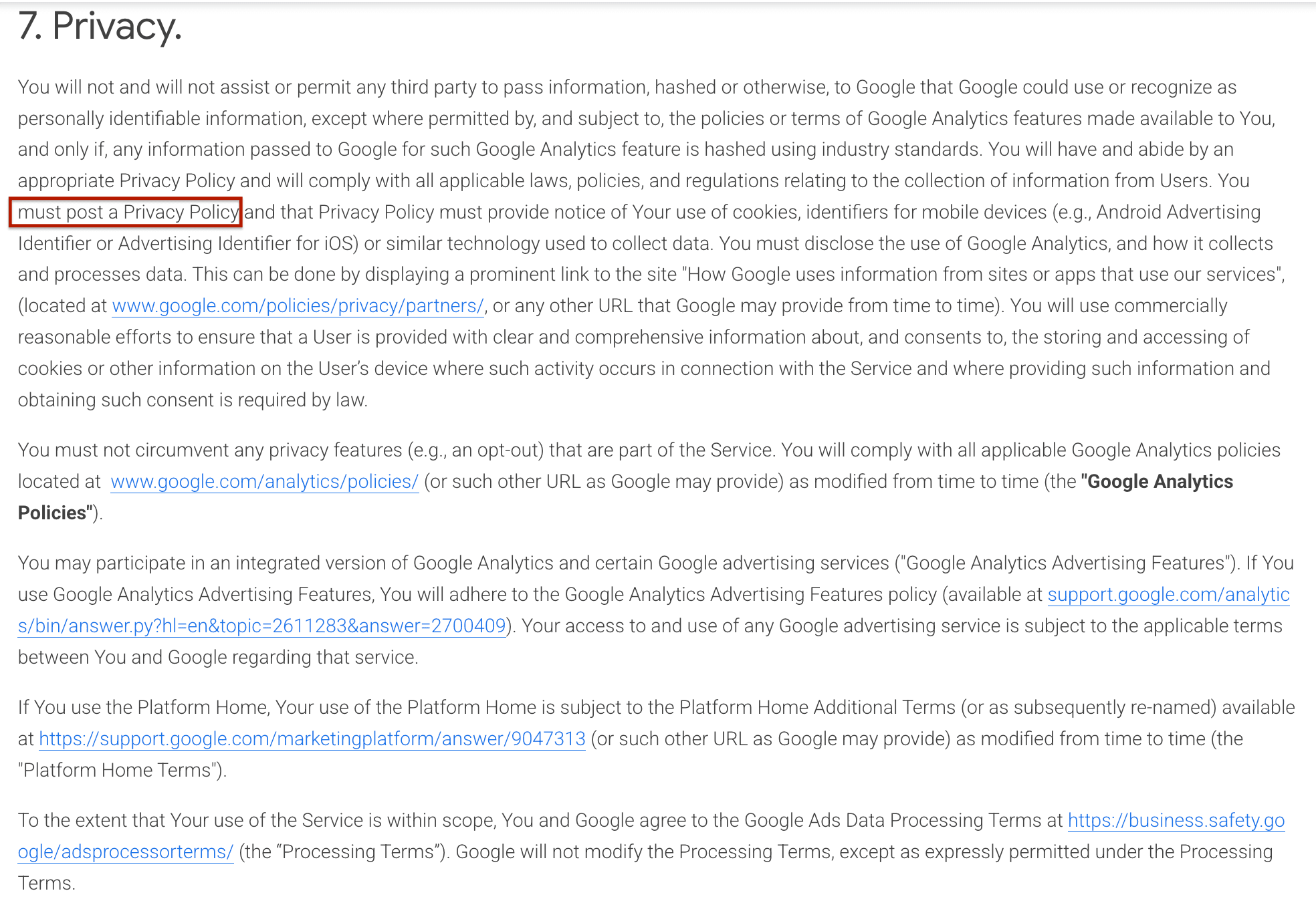
Google Analytics Terms of Service require website owners to maintain a privacy policy and disclose their use of Google Analytics, cookies, and similar technologies.

What data does Google Analytics collect?
What should a Google Analytics privacy policy include?
Keeping cookie disclosures accurate can be difficult because cookies change whenever you add new tools, plugins, or marketing tags. A cookie scanner can help identify active cookies and generate an up-to-date cookie inventory for your privacy policy.
Say that you use Google Analytics
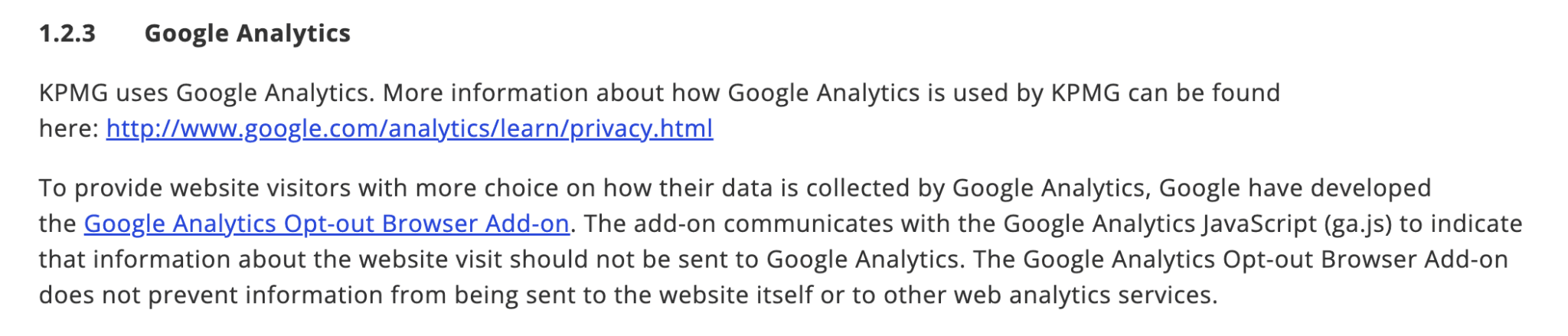
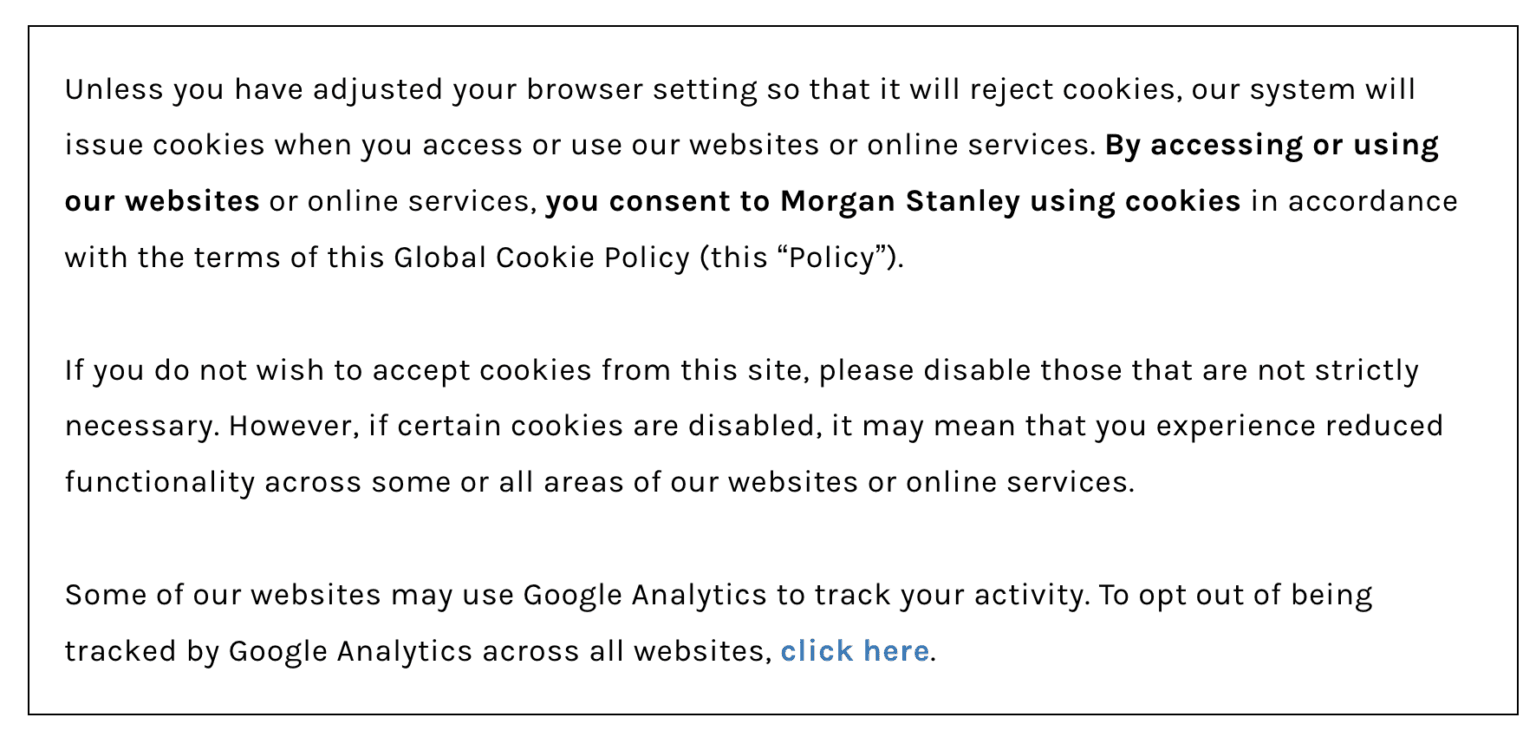
Sample clause:
We use Google Analytics to understand how visitors use our website and to improve website performance. To know more about how we use Google Analytics, visit https://policies.google.com/technologies/partner-sites.
Explain what data is collected
Mention cookies and identifiers
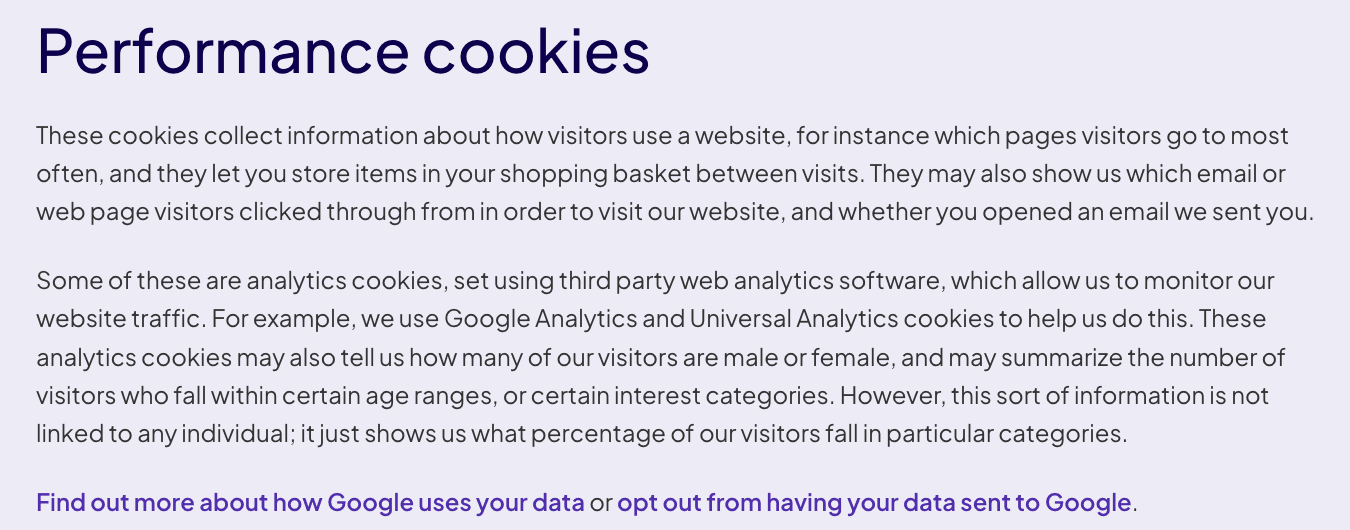
State purpose of data collection
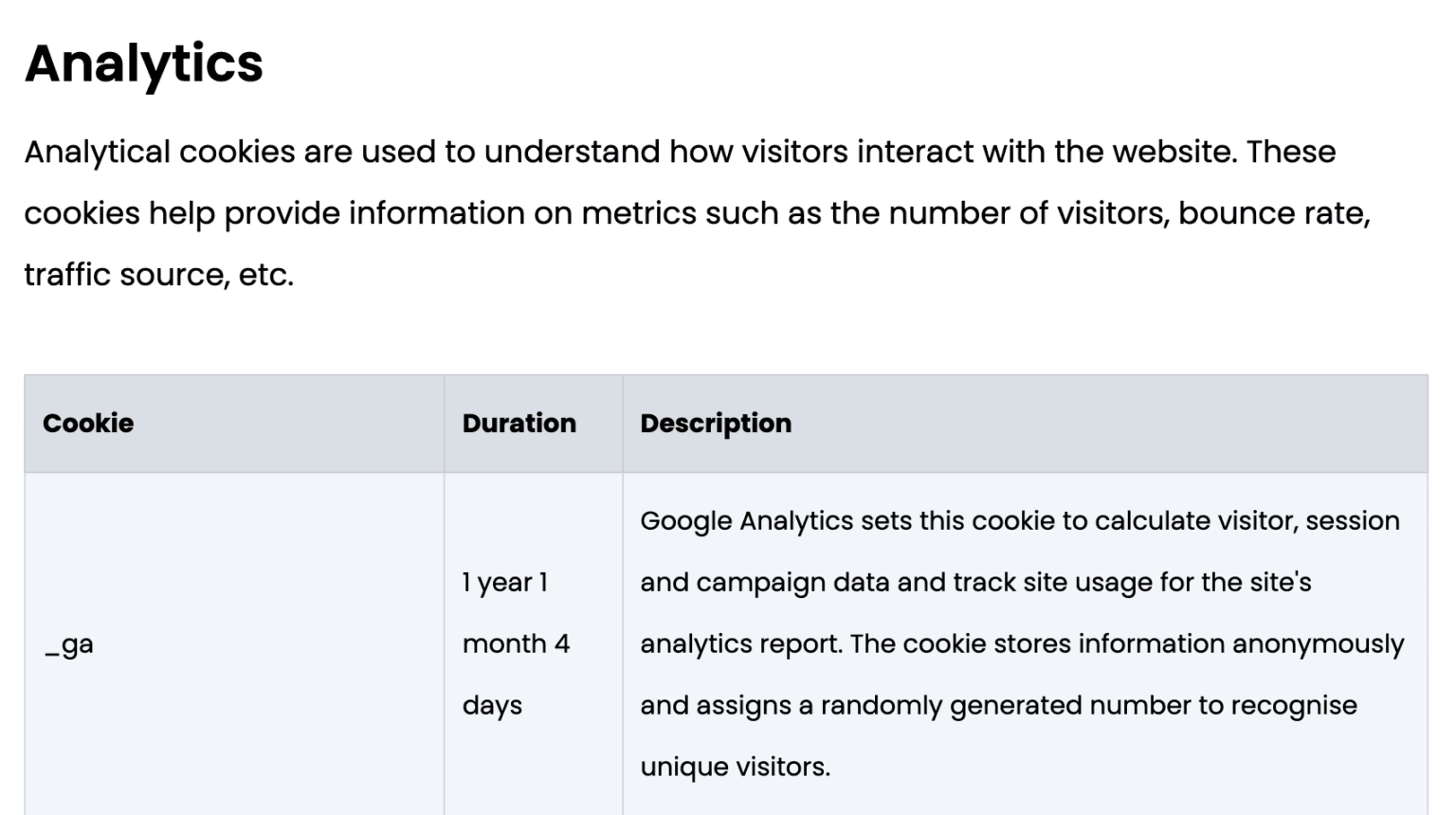
Disclose Google Analytics Advertising features

Note: Google now requires websites targeting the EU, UK, or Switzerland to use a certified Consent Management Platform (CMP). Generic cookie banners are no longer enough; your site must pass explicit compliance signals.
Include your data retention period

Explain opt-out options
Add user rights
Google Analytics sample privacy policy template
<div id="gaPrivacyTemplate" class="cy-pp-template-content">
  <h1>Privacy Policy</h1>
  <p class="cy-pp-template-meta">Last updated: [Date]</p>
  <p>[Company Name] (“we”, “us”, or “our”) respects your privacy. This Privacy Policy explains how we collect, use,
    disclose, and protect personal information when you visit our website or use our services. Please read the following
    carefully to understand our views and practices regarding your personal data and how we will treat it.</p>
  <p>By visiting [website URL] (the "Site") or using our services or apps, you are accepting and consenting to the
    practices described in this Privacy Policy.</p>
  <h2 class="cy-pp-template-section-heading">1. Information We Collect</h2>
  <p>We may collect information that you provide directly to us, such as your name, email address, phone number, company
    name, billing information, and any details you submit through forms or support requests.</p>
  <p>We may also collect certain information automatically when you visit our website, including IP address information,
    browser type, device information, operating system, pages visited, time spent on pages, referring website, and
    interactions with our website.</p>
  <p>Other information we collect includes:</p>
  <ul>
    <li>[personal info]</li>
    <li>[personal info]</li>
  </ul>
  <p>We may also collect the following sensitive information when necessary with your consent or as otherwise permitted by
  applicable law:</p>
  <ul>
    <li>[Sensitive info]</li>
    <li>[Sensitive info]</li>
  </ul>
  <p>Some of this information is collected through cookies and analytics tools, including Google Analytics.</p>
  <h3 class="cy-pp-template-section-heading"> 1.1 If You Fail to Provide Personal Data</h3>
  <p>Where we need to collect personal data by law, or under the terms of a contract we have with you, and you fail to
    provide that data when requested, we may not be able to perform the contract we have or are trying to enter into
    with you (for example, to provide you with goods or services). In this case, we may have to cancel a product or
    service you have with us but we will notify you if this is the case at the time.</p>
  <h2 class="cy-pp-template-section-heading">2. How is Personal Data Collected</h2>
  <p>We use different methods to collect data from and about you, including via:</p>
  <ul>
    <li><b>Source name:</b> Description</li>
    <li><b>Source name:</b> Description</li>
  </ul>
  <h2 class="cy-pp-template-section-heading">3. How We Use Your Information</h2>
  <p>We have set out below, a description of all the ways we plan to use your personal data, and which of the legal
    bases we rely on to do so. We have also identified what our legitimate interests are where appropriate.
    Note that we may process your personal data for more than one lawful ground depending on the specific purpose for
    which we are using your data. Please contact us if you need details about the specific legal ground we are relying
    on to process your personal data where more than one ground has been set out in the table below.</p>
  <ul>
    <li>[Purpose, category of data used, legal basis]</li>
    <li>[Purpose, category of data used, legal basis]</li>
  </ul>
  <h2 class="cy-pp-template-section-heading">4. Cookies and Similar Technologies</h2>
  <p>We use cookies and similar technologies to operate our website, remember preferences, improve user experience, and
    analyze how visitors interact with our website.</p>
  <p class="cy-pp-template-subsection-heading">A. Strictly Necessary Cookies</p>
  <p>These cookies are required for our website to function and cannot be disabled. They are typically set in response
    to actions you take, such as logging in, setting privacy preferences, or completing forms.</p>
  <table class="cy-pp-template-cookie-table">
    <thead>
      <tr>
        <th>Cookie Name</th>
        <th>Purpose</th>
        <th>Provider</th>
        <th>Duration</th>
      </tr>
    </thead>
    <tbody>
      <tr>
        <td>[Cookie Name]</td>
        <td>[Explain what the cookie does]</td>
        <td>[Company placing the cookie]</td>
        <td>[Session / 30 days / 1 year / etc.]</td>
      </tr>
    </tbody>
  </table>
  <p class="cy-pp-template-subsection-heading">B. Functional Cookies</p>
  <p>Functional cookies enable enhanced features and personalization. They may be set by us or by third-party providers
    whose services we have added to our pages.</p>
  <table class="cy-pp-template-cookie-table">
    <thead>
      <tr>
        <th>Cookie Name</th>
        <th>Purpose</th>
        <th>Provider</th>
        <th>Duration</th>
      </tr>
    </thead>
    <tbody>
      <tr>
        <td>[Cookie Name]</td>
        <td>[Explain what the cookie does]</td>
        <td>[Company placing the cookie]</td>
        <td>[Session / 30 days / 1 year / etc.]</td>
      </tr>
    </tbody>
  </table>
  <p class="cy-pp-template-subsection-heading">C. Analytics Cookies</p>
  <p>Analytics cookies help us understand how visitors interact with our website.</p>
  <p>They may collect information about pages visited, navigation paths, time spent on pages, website performance, user
    interactions, and traffic sources.</p>
  <p>We may use Google Analytics and similar analytics services to generate reports about website usage and improve our
    services.</p>
  <table class="cy-pp-template-cookie-table">
    <thead>
      <tr>
        <th>Cookie Name</th>
        <th>Purpose</th>
        <th>Provider</th>
        <th>Duration</th>
      </tr>
    </thead>
    <tbody>
      <tr>
        <td>[Cookie Name]</td>
        <td>[Explain what the cookie does]</td>
        <td>[Company placing the cookie]</td>
        <td>[Session / 30 days / 1 year / etc.]</td>
      </tr>
    </tbody>
  </table>
  <p class="cy-pp-template-subsection-heading">D. Advertising and Targeting Cookies</p>
  <p>Advertising cookies help deliver relevant advertisements and measure campaign effectiveness.</p>
  <p>These cookies may be used to build audience segments, limit ad repetition, measure advertising performance, support
    remarketing activities, and personalize advertisements.</p>
  <p>Advertising cookies may be placed by us or by third-party advertising partners.</p>
  <table class="cy-pp-template-cookie-table">
    <thead>
      <tr>
        <th>Cookie Name</th>
        <th>Purpose</th>
        <th>Provider</th>
        <th>Duration</th>
      </tr>
    </thead>
    <tbody>
      <tr>
        <td>[Cookie Name]</td>
        <td>[Explain what the cookie does]</td>
        <td>[Company placing the cookie]</td>
        <td>[Session / 30 days / 1 year / etc.]</td>
      </tr>
    </tbody>
  </table>
  <h2 class="cy-pp-template-section-heading">5. Google Analytics</h2>
  <p>We use Google Analytics, a web analytics service provided by Google LLC, to analyze how visitors use our website.
    Google Analytics uses cookies to collect information about website usage, including pages visited, session duration,
    device type, geographic location, and traffic sources.</p>
  <p>The data collected through Google Analytics is transmitted to and stored on Google servers, which may be located
    outside your country.</p>
  <p>Google may use this data in accordance with its own privacy policy. You can opt out of Google Analytics by
    installing the <a href="https://tools.google.com/dlpage/gaoptout" target="_blank" rel="noopener noreferrer">Google
      Analytics opt-out browser add-on</a>.</p>
  <p>For more information about how Google uses data from websites that use its services, visit:<br>
    <a href="https://policies.google.com/technologies/partner-sites" target="_blank" rel="noopener noreferrer">https://policies.google.com/technologies/partner-sites</a>
  </p>
  <h2 class="cy-pp-template-section-heading">6. Google Analytics Advertising Features</h2>
  <p><em>[Include this section only if applicable.]</em></p>
  <p>We may use Google Analytics Advertising Features, including remarketing, Google Signals, demographic reporting,
    interest reporting, or Google Ads integration.</p>
  <p>These features may use additional cookies or identifiers to help measure advertising performance and show relevant
    ads.</p>
  <p>You can manage ad personalization through Google Ad Settings:<br>
    <a href="https://adssettings.google.com" target="_blank" rel="noopener noreferrer">https://adssettings.google.com</a>
  </p>
  <h2 class="cy-pp-template-section-heading">7. Sharing Your Information</h2>
  <p>We may share personal information with service providers that help us operate our website and services, including
    hosting providers, analytics providers, payment processors, marketing platforms, and customer support tools.</p>
  <p>We may also disclose information where required by law, to protect our rights, prevent fraud, enforce agreements,
    or complete a business transaction.</p>
  <p>We do not sell personal information to third parties.</p>
  <p><b>[Optional:</b> Include the following section if you sell, share, or disclose personal information in a way that
    may be considered a sale or sharing under applicable privacy laws.]</p>
  <p>We may sell, share, or disclose certain categories of personal information to third parties for purposes such as
    advertising, marketing, analytics, business partnerships, or other commercial activities, where permitted by
    applicable law.</p>
  <p>The categories of personal information that may be sold or shared include:</p>
  <ul>
    <li>[Personal information]</li>
    <li>[Personal information]</li>
  </ul>
  <p>The categories of third parties that may receive this information include:</p>
  <ul>
    <li>[Category]</li>
    <li>[Category]</li>
  </ul>
  <p>Depending on your location, you may have the right to opt out of the sale or sharing of your personal information.
    To exercise this right, please use our "Do Not Sell or Share My Personal Information" link or contact us using the
    details provided in this Privacy Policy.</p>
  <h2 class="cy-pp-template-section-heading">8. Data Retention</h2>
  <p>We retain personal information for as long as necessary to fulfill the purposes described in this Privacy Policy,
    unless a longer retention period is required by law.</p>
  <p>You can request deletion of your data as described in the “Your Rights” section.</p>
  <h2 class="cy-pp-template-section-heading">9. Security of Your Information</h2>
  <p>We implement reasonable technical, administrative, and organizational measures designed to protect personal
    information against unauthorized access, loss, misuse, disclosure, alteration, or destruction.</p>
  <p>However, no method of transmitting information over the internet or storing information electronically is
    completely secure. While we strive to protect your personal information, we cannot guarantee its absolute security.
  </p>
  <p>If we become aware of a security incident affecting your personal information, we will take appropriate steps to
    investigate, mitigate the impact, and provide any notifications required by applicable law.</p>
  <h2 class="cy-pp-template-section-heading">10. Your Rights and Choices</h2>
  <p>Depending on your location, you may have certain rights regarding your personal information, including the right to
    access, correct, delete, or restrict processing of your data. You may also have the right to object to certain
    processing activities or to receive a copy of your data in a portable format.</p>
  <p>To exercise these rights, please contact us using the information provided at the end of this policy.</p>
  <p>You may also manage your cookie preferences at any time through our cookie consent tool or by adjusting your
    browser settings.</p>
  <h2 class="cy-pp-template-section-heading">11. Children’s Privacy</h2>
  <p>Our website is not intended for children under the age required by applicable law, and we do not knowingly collect
    personal information from children. If we become aware that we have collected personal information from a child
    without appropriate authorization or consent, we will take reasonable steps to delete the information as soon as
    practicable.</p>
  <p>If you believe a child has provided personal information through our website, please contact us using the details
    provided in this Privacy Policy.</p>
  <p><strong>Optional: If your website, app, or service is intended for children or knowingly collects children's
      personal information</strong></p>
  <p>Where we knowingly collect personal information from children, we do so in accordance with applicable laws and
    obtain parental or guardian consent where required. Parents or legal guardians may contact us to review, update,
    correct, or request deletion of their child's personal information.</p>
  <h2 class="cy-pp-template-section-heading">12. Changes to This Privacy Policy</h2>
  <p>We may update this Privacy Policy from time to time. We will notify you of significant changes by posting the
    updated policy on this page with a revised effective date. We encourage you to review this policy periodically.</p>
  <h2 class="cy-pp-template-section-heading">13. Contact Us</h2>
  <p>If you have questions about this Privacy Policy, contact us at:</p>
  <address class="cy-pp-template-contact-block">
    [Company Name]<br>
    [Address]<br>
    [Email Address]<br>
    [Phone Number]
  </address>
</div>Do you need cookie consent for Google Analytics?
Common Google Analytics privacy policy mistakes
Use the Advanced Cookie Scanner to identify every cookie and tracker currently active on your website. Compare the results against what your privacy policy or cookie policy discloses.