Full site index for AI agents: llms.txt. Every page is also available as Markdown: replace the trailing slash with .md, so /pricing/ becomes /pricing.md. Or send the header Accept: text/markdown to the page URL itself.
We’re officially Built for Shopify. And it’s free. Cookie consent with no code and no slowdown.
Cookies are the quiet workers behind most websites. They keep users logged in, remember preferences, measure performance, and support personalized ads. But when cookies collect information about visitors, privacy laws expect businesses to make those behind-the-scenes activities clear. So, do you need a cookie policy on your site? For most websites, yes. If your site uses cookies, analytics tools, advertising pixels, embedded content, or similar tracking technologies, a cookie policy helps explain what is being used, why it is being used, and how visitors can manage their choices.
The exact rules depend on where your visitors are, and this guide breaks them down country by country.
Build a cookie policy that travels well
Start with a clear, customizable policy that helps explain your cookie use wherever your visitors come from.
A cookie policy is different from a privacy policy. A privacy policy explains how your business handles personal data generally. A cookie policy focuses specifically on tracking technologies used on the website.
Do I need a privacy policy on my website?
Yes, in most cases. If your website collects personal information, such as names, email addresses, payment details, IP addresses, or data from cookies and analytics tools, you need a privacy policy. It should explain what data you collect, why you collect it, how you use it, who you share it with, and what rights users have.
Do I need a standalone cookie policy?
Some businesses combine cookie disclosures into their privacy policy. Others publish a separate cookie policy. Both approaches can work as long as the information is clear, accessible, and detailed enough to meet transparency requirements.
Yes. The EU sets a high bar for privacy, and cookies are no exception. Under the GDPR and the ePrivacy Directive, websites serving EU users must clearly explain what cookies they use, why they use them, how long the cookies remain active, and whether third parties receive the data. This transparency obligation applies even to necessary cookies that do not require consent, such as security or session cookies.
What about cookie consent?
The EU follows a strict opt-in model. This means that most analytics, advertising, and tracking cookies cannot load until the user actively accepts them. Pre-ticked boxes, implied consent through continued browsing, and banners that make rejecting cookies harder than accepting them generally do not meet EU standards.
2. United Kingdom
Do you need a cookie policy in the UK?
Yes. The United Kingdom follows a similar approach to the EU under the Privacy and Electronic Communications Regulations (PECR) and the UK GDPR. Therefore, websites targeting UK users must explain what cookies they use, what those cookies do, their duration, and who places them. This is usually provided through a cookie policy.
What about consent banners?
The UK also follows a strict opt-in consent model for non-essential cookies. Analytics, advertising, and tracking cookies generally require consent before they are placed on a user’s device. The UK’s Information Commissioner’s Office (ICO) expects websites to provide a real choice. Reject options should be as visible and easy to use as accept options. The ICO has also issued guidance on UK cookie consent requirements, indicating the importance of cookie compliance in the country.
Example of a standard opt-in cookie banner for EU & UK
3. United States
Do you need a cookie policy in the USA?
Usually, yes. The United States does not have a single federal cookie law like the GDPR. Instead, cookie compliance is mainly governed by state privacy laws.
Laws such as California’s CCPA/CPRA require businesses to explain what personal data they collect, how it is used, and whether it is shared with third parties. Since cookies often collect personal data, most websites disclose these practices through a privacy policy or dedicated cookie policy.
Does the US require cookie consent?
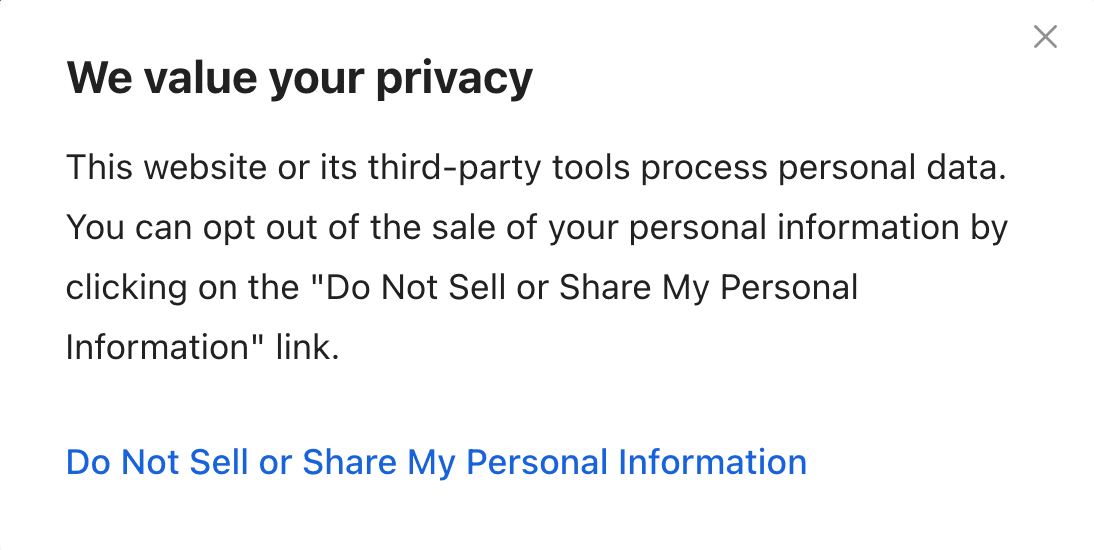
Generally, no. Most US privacy laws use an opt-out model, not an opt-in model. This means advertising and analytics cookies can usually load by default, but users must have a clear way to opt out of targeted advertising or data sharing. Simply, this means you still need a cookie opt-out banner. Under the CCPA/CPRA, businesses that use tracking cookies for advertising may need to provide a “Do Not Sell or Share My Personal Information” link and must recognize Global Privacy Control (GPC) signals.
States such as Colorado, Virginia, and Texas have also adopted comprehensive state privacy laws.
Example of an opt-out cookie banner with a “Do not sell” link
4. Canada
Do you need a cookie policy in Canada?
Yes, in most cases. Under PIPEDA, businesses must explain how they collect, use, and disclose personal information. Since cookies can collect personal information, websites targeting Canadian users should disclose what cookies they use, why they use them, and how users can manage their choices. This can be included in a privacy policy or a separate cookie policy.
Does Canada require a cookie banner?
Canada does not require GDPR-style opt-in consent for all non-essential cookies. Implied consent may be acceptable for low-risk cookies where the purpose is clear. However, for behavioural advertising, users should be clearly informed at or before collection and given an easy opt-out that takes effect immediately. Express opt-in consent may be required for sensitive information, unexpected tracking, or more intrusive profiling.
What about Quebec?
Quebec’s Law 25 takes a stricter approach. Websites using non-necessary cookies for Quebec users should generally obtain opt-in consent before those cookies are activated.
5. Brazil
Do you need a cookie policy in Brazil?
Yes. Brazil’s LGPD requires businesses to have a legal basis for processing personal data. Since many cookies collect personal data, websites should clearly explain what cookies they use, why they use them, and whether data is shared with third parties.
Does Brazil require cookie consent?
Non-necessary cookies, such as advertising and analytics cookies, need consent before loading. As a result, Brazilian websites should use consent banners similar to those seen in the EU (opt-in banners). Brazil's data protection authority, the ANPD (Autoridade Nacional de Proteção de Dados), has issued guidance relevant to cookie compliance.
6. Australia
Do you need a cookie policy in Australia?
Australia’s Privacy Act focuses more on transparency than prior consent. Under the Australian Privacy Principles (APPs), businesses are generally expected to explain how they collect and use personal information, including through cookies and tracking technologies.
Does Australia require cookie consent?
Not generally. Australia does not currently require GDPR-style prior consent for cookies. However, Australian privacy reforms could tighten online tracking rules in the future. The best practice is to have a cookie banner on your site.
7. India
Do you need a cookie policy in India?
Yes. India’s Digital Personal Data Protection Act, 2023, has been enacted, and the DPDP Rules, 2025, have now been notified to operationalize it. However, implementation is being phased in, so not all compliance obligations apply at once.
The law places strong emphasis on notice and transparency. Websites should explain what personal data is collected through cookies, why it is collected, and how it is used.
Does India require cookie consent?
Likely yes for non-necessary cookies that collect personal data. The DPDP Act requires consent to be free, specific, informed, unconditional, and unambiguous. Since many analytics and advertising cookies collect personal data, businesses targeting Indian users may need opt-in consent for those cookies.
8. China
Do you need a cookie policy in China?
Yes. China’s Personal Information Protection Law (PIPL) requires websites to clearly explain what personal data is collected through cookies and tracking technologies, why it is collected, and whether third parties receive the data. Transparency is a central part of China’s privacy framework.
Does China require cookie consent?
Yes. China follows one of the strictest consent models globally. Businesses generally need informed consent before processing personal information through tracking technologies.
When you might not need a cookie policy
You may not need a cookie policy in very limited situations:
Your website does not use any cookies or tracking technologies at all. In practice, this is rare. Even basic website features, embedded content, analytics tools, or login functions often rely on cookies.
No privacy laws apply to your website or visitors. For example, your business operates in a country without data protection laws and does not serve users from regions with privacy regulations. But since websites are accessible globally, this situation is increasingly uncommon.
In all other cases, you will almost certainly need a cookie policy, even if you only use strictly necessary cookies.
Cookie policy vs cookie banner
A cookie policy and a cookie banner are not the same thing. A cookie policy explains in detail how cookies are used, whereas a cookie banner is the mechanism through which a user manages their consent choices.
Some countries only require disclosure through a cookie policy. Others require both disclosure and consent. For example:
The EU and UK generally require a cookie policy and an opt-in consent banner
US state laws usually focus on disclosure and opt-out rights
Australia focuses mainly on transparency
This distinction matters because many businesses assume adding a banner automatically makes them compliant. It does not.
Is a cookie banner necessary?
In most cases, yes. Many countries require websites to provide a cookie banner or similar consent mechanism, especially when using analytics, advertising, or tracking cookies. The EU, UK, Brazil and China generally follow opt-in consent models, while US state laws often require clear opt-out choices for targeted advertising or data sharing.
The policy should also be easy to access. Most websites link it from:
the website footer
the cookie banner
or the privacy policy
If you are preparing to create a cookie policy for your site, use our cookie policy checklist to make sure you do not miss anything.
Do you need a cookie policy: Country-by-country summary
Country/Region
Governing Law
Consent Model
Cookie Policy Required
EU/EEA
GDPR + ePrivacy Directive
Opt-in
Yes
UK
PECR + UK GDPR
Opt-in
Yes
US (federal)
State privacy laws
Mostly opt-out
Yes
Canada (federal)
PIPEDA
Mostly opt-out
Yes
Quebec
Law 25
Opt-in
Yes
Brazil
LGPD
Opt-in
Yes
Australia
Privacy Act 1988
No specific model
Yes
India
DPDP Act 2023
Opt-in
Yes
China
PIPL
Opt-in
Yes
Note: A cookie policy does not always need to be a separate page. Many laws require clear cookie disclosures, which may be included in your privacy policy. However, a standalone cookie policy is often better because it is easier for visitors to find, read, and revisit.
Create a cookie policy in minutes
Writing a cookie policy manually can get difficult, especially when cookies change regularly, and different privacy laws require different disclosures.
CookieYes helps automate the process with a cookie policy generator that scans your website, detects cookies in use, and generates a structured cookie policy automatically. The policy updates whenever new cookies are detected, helping keep disclosures accurate over time.
With CookieYes, you can:
automatically scan and categorize cookies
generate a customizable cookie policy
keep cookie disclosures updated automatically
manage cookie consent requirements
store consent logs
and integrate with platforms like WordPress, Shopify, Wix, and Webflow
Create your cookie policy today
Scan your site, detect cookies in use, and generate a custom cookie policy in minutes with CookieYes.
Yes. Websites targeting UK users generally need a cookie policy under PECR and the UK GDPR. The policy should explain what cookies the website uses, why they are used, and whether third parties receive the data.
Can I include cookie disclosures inside my privacy policy?
Yes, you can include cookie disclosures within your privacy policy instead of publishing a separate document, as long as it is easy for users to find on your website. However, the best practice to stay legally safe is to maintain a separate cookie policy.
Do strictly necessary cookies require disclosure?
Usually yes. Even where consent is not required for strictly necessary cookies, privacy laws often still require businesses to explain their use as part of transparency obligations.
Is a cookie banner enough?
No. A cookie banner and a cookie policy serve different legal purposes. The banner manages consent or opt-out choices, while the cookie policy explains how tracking technologies are used.