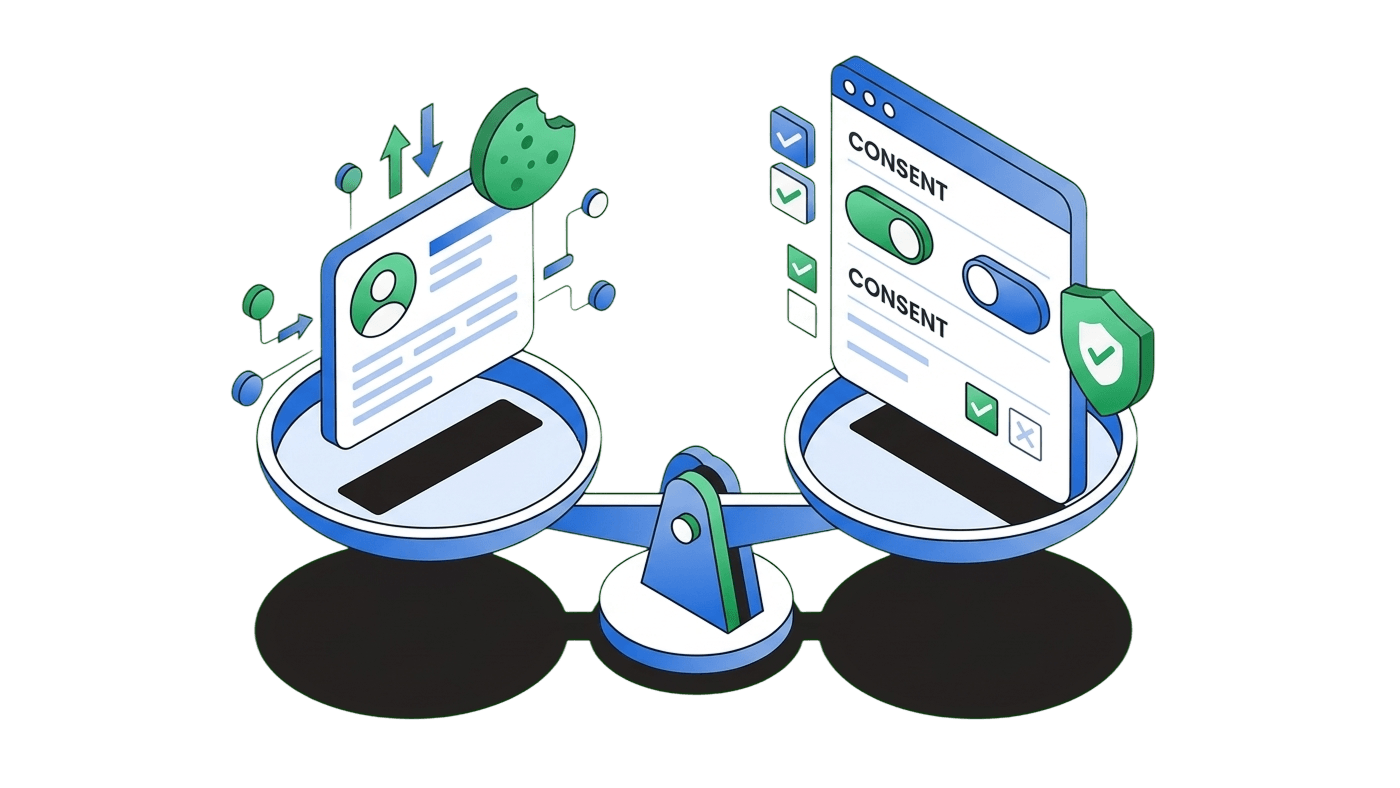
Data personalization has consistently been a preferred approach for marketers and product teams. It helps deliver relevant emails, smarter product recommendations, and tailored web experiences that keep users engaged. At the same time, targeting and behavioural tracking are now closely regulated. Laws are placing limits on how user data can be collected and used. Conversations around data privacy and personal data autonomy are more common, so businesses should treat data responsibly.
This blog explores how to strike that balance by examining the current regulatory landscape, designing effective cookie banners, implementing privacy‑preserving technology, and building trust through a comprehensive privacy preference center.
What is data personalization?
Data personalization is the process of using user data, such as behavior, preferences, location, or past interactions, to tailor content, products, or experiences to individual users. In simple terms, it means showing people what’s most relevant to them instead of offering the same experience to everyone.
Examples:
- An e-commerce site recommending products based on browsing history
- A streaming platform suggesting shows based on past viewing
- A bank offering personalized loans and credit cards.
Data personalization typically relies on first-party and zero-party data and sometimes third-party data, but today it increasingly depends on consented data due to privacy laws like the GDPR and US cookie compliance frameworks.
Zero-party data: information a user actively and intentionally shares, such as answers to preference quizzes, declared interests, or stated communication preferences, is emerging as the most privacy-safe foundation for personalisation.
When done right, it improves user experience and engagement. But it must always be balanced with transparent consent and user control.
The promise and pitfalls of personalization
Personalization works because it reflects a value exchange: users share information about their interests and behaviors in return for more relevant content. Studies show that effective personalization can lift revenues, reduce acquisition costs, and improve customer satisfaction.
However, personalization may rely on cookies and trackers that collect browsing patterns, device identifiers, and sometimes sensitive personal data. The misuse or overcollection of such data has led to regulatory crackdowns and a growing concern about targeted ads.
Consent fatigue is a real challenge
When users are bombarded with cookie banners and data requests across every website they visit, they become desensitised and either dismiss all prompts or accept everything without reading. Well-designed banners with a clear value proposition help counter this.
Similarly, dark patterns, such as confusing opt‑out flows or pre‑selected consent boxes, are being targeted by regulators. Striking the right balance means prioritizing transparency and user control at every step of the personalization journey.
The third-party cookie landscape: where things stand
For decades, personalization relied heavily on third-party cookies. Safari and Firefox blocked them by default years ago. Google spent six years developing the Privacy Sandbox as a replacement, but in October 2025, Google officially retired the initiative and its core APIs, including Attribution Reporting, Topics, and Protected Audience, citing low adoption and regulatory pressure. Third-party cookies remain in Chrome indefinitely for now.
This means the landscape is less settled than anticipated, and the practical implications are significant:
- First-party data remains essential regardless: Regulatory pressure from GDPR, CCPA, and other laws constrains how third-party data can be used. Data collected directly on your own domain is the most durable personalisation asset.
- Server-side tagging: It moves data collection off the user's browser and onto your own server, reducing client-side dependency and improving consent signal enforcement.
- Contextual targeting: Serving content based on the page being viewed rather than a user's tracked history remains a strong privacy-compliant alternative for advertisers.
Businesses should not interpret the survival of third-party cookies as a reason to delay first-party data investment. Consent laws apply independently of cookie technology, and browser behaviour can change again.
Personalization and Privacy: GDPR, CCPA/CPRA and beyond
European Union: Opt‑In Consent and ePrivacy
The General Data Protection Regulation (GDPR) and ePrivacy Directive set the standard for online consent in Europe. Under GDPR, organizations must obtain explicit consent before placing non‑essential cookies such as analytics or marketing trackers.
- Consent must be freely given, informed, and specific.
- Users should be able to decline cookies as easily as accept them.
- Pre‑ticked boxes, implied consent (e.g., continued browsing), or bundled approvals are not valid.
- Websites must block non‑essential cookies until consent is obtained.
- The GDPR also requires businesses to keep records of consent and provide mechanisms to withdraw consent at any time.
Consent is not the only lawful basis. Under Article 6 GDPR, organisations may also rely on legitimate interests to process personal data for certain personalisation purposes.
Non‑compliance can lead to fines up to €20 million or 4% of global annual turnover and reputational damage.
As privacy laws evolve, organizations need flexible solutions that geo-target consent flows based on jurisdiction.
United Kingdom: UK GDPR and ICO guidance
Following Brexit, the UK operates under UK GDPR, which mirrors EU GDPR in most respects but is regulated by the Information Commissioner's Office (ICO) rather than national EU supervisory authorities. The ICO has published its own cookie and consent guidance, which broadly aligns with EU standards but may diverge over time as the UK develops its own regulatory direction. Businesses operating in both the EU and UK must ensure compliance with both frameworks independently.
United States: Opt-out consent model
Unlike the EU, the U.S. lacks a single federal privacy law; instead, states are enacting their own privacy legislation.
California's CCPA (amended by CPRA) requires businesses to give consumers the ability to opt out of the sale or sharing of their personal information. Though a cookie banner is not strictly required, California law mandates a prominent Do Not Sell or Share My Personal Information link.
A CCPA-compliant banner must also honour browser signals like the Global Privacy Control.
Other states follow similar patterns with variations. US privacy compliance is shaped by several state privacy laws, including the Colorado Privacy Act (CPA), Connecticut Data Privacy Act (CTDPA), and Virginia Consumer Data Protection Act (VCDPA). While requirements differ slightly, the core expectation is the same: clearly inform users about cookies and tracking, and give them a simple way to opt out.
Children and sensitive data
Both the GDPR and CPRA impose stricter rules when handling data from children or sensitive categories.
GDPR: Processing children’s data for information society services generally requires parental consent for users under 16 (with some EU countries setting lower age thresholds), and organizations must apply enhanced transparency and protection measures when handling sensitive data.
US privacy laws: Most state laws require businesses to obtain opt-in consent before selling or sharing the personal data of users under 16 and provide clear mechanisms allowing users to limit the use of sensitive personal information.
Start collecting consent for cookies
Sign up to CookieYes and deploy your cookie banner today!
Try for free- 14-day free trial
- Cancel anytime
Designing effective consent management
Consent management is to privacy what personalization is to user experience. It gives users control over how their data is used. A well‑designed banner fosters trust and encourages informed decisions; a poorly designed one drives frustration and regulatory risk.
The following cookie consent best practices merge user experience (UX) and compliance:
- Use plain language and clear purposes: Consent banner message should be easy-to-understand and explicitly state why cookies are used (e.g., advertising vs. improving experience).
- Offer symmetric choices: Give equal prominence to “Accept” and “Reject” buttons. Also, give a dedicated “Preferences” link. Avoid pre‑selected options and confirm that all choices lead to the same number of steps.
- Provide granular controls: Allow users to selectively consent to cookie categories, such as Necessary, Analytics, Personalization, and Marketing. CCPA guidelines recommend separate opt‑outs for targeted advertising.
- Link to detailed policies: Provide links to the full cookie policy and privacy notice in your banner, where users can find information about retention periods, third‑party recipients, and their rights.
- Make design accessible and non‑intrusive. Place banners in a non-intrusive manner. Use a responsive design so banners adapt to mobile screens.
- Respect global privacy signals: Modern browsers support signals like the Global Privacy Control (GPC). Many U.S. states require businesses to honor these signals automatically.
- Avoid dark patterns. Design elements that manipulate users into consenting (e.g., bright accept buttons and muted reject buttons) are prohibited under GDPR and various U.S. laws.
- Enable geo-targeting: Adapt your cookie banner based on user location to meet region-specific requirements like EU cookie consent or US cookie compliance.
- Ensure IAB TCF compliance: Support frameworks like the IAB Transparency and Consent Framework to standardize consent collection and communication with ad vendors.
- Recognize consent signals: Capture and transmit user choices across your tech stack (Google Consent Mode, etc. )to ensure enforcement.
Following these principles ensures your banner not only meets regulatory obligations but also signals respect for your visitors’ autonomy, encouraging them to share information voluntarily.

Creating a privacy preference center
A privacy preference center offers a centralized space where users can manage their consent choices anytime.
It allows users to toggle consent for each category individually and provide a single click to withdraw consent. Businesses must quickly recognize any such changes to consent.
When a user updates their preferences, ensure the changes propagate across your analytics, ad platforms, and email systems. This avoids inadvertent tracking or marketing to users who have withdrawn consent.
Personalisation and privacy-preserving ad measurement
Traditional ad measurement relies on tracking individual user journeys. This raises legitimate privacy concerns and often conflicts with consent regulations.
Technology companies have been developing privacy-preserving ad measurement systems that provide aggregate insights without exposing individual data.
- Apple's SKAdNetwork: The most mature deployed standard for mobile app install attribution at the aggregate level, without device-level identifiers.
- Mozilla's Privacy-Preserving Attribution (PPA): An emerging protocol that splits and encrypts ad interaction data across independent servers, combining them only into aggregate statistics.
- First-party conversion tracking: Using your own domain and server-side events to measure campaign performance without third-party dependencies.
Turn privacy expectations into better experiences
CookieYes helps you collect user consent, manage cookies, and align your tracking with modern privacy expectations.
Try for free- 14-day free trial
- Cancel anytime
Balancing data and personalization: practical strategies
Striking the right balance between collecting data for personalization and respecting privacy also earns trust. The following strategies can help organizations navigate this balance:
- Adopt a privacy‑by‑design mindset. Build consent mechanisms and data minimization into your product development process from the outset rather than retrofitting them after the fact.
- Audits: Conduct regular audits to identify unnecessary cookies and third‑party scripts.
- Collect only what you need: Limit data collection to information necessary for the intended personalization. Avoid hoarding data.
- Offer value in exchange for data: Explain how user data will be used to improve their experience and get their lawful consent.
- Use consent management platforms (CMPs). CMPs automate cookie categorization, geo‑target consent experiences by jurisdiction, and integrate with ad and analytics platforms to enforce user choices. Choose a CMP that supports privacy‑preserving technologies like Google Consent Mode v2 for anonymized measurement.
- Educate your team. Legal, marketing and product teams should understand privacy obligations. Documenting and communicating privacy policies internally is vital to maintaining consistent practices.
- Plan for the future. With state laws proliferating and browsers pushing new privacy features, expect more requirements around consent and measurement. Develop flexible systems capable of adapting to new laws and technologies quickly.
By following these strategies, organizations can leverage data responsibly, maintain regulatory compliance, and continue to deliver personalized experiences that users appreciate.
Frequently asked questions
What is privacy‑preserving ad measurement?
Privacy-preserving ad measurement is a method of tracking ad campaign performance using aggregate data, without identifying or following individual users. Instead of linking clicks and conversions to specific people, it groups results statistically so advertisers can measure effectiveness while staying compliant with privacy laws like GDPR and CCPA. Apple’s SKAdNetwork is the most widely used example for mobile apps. This approach protects individual privacy while still allowing businesses to understand campaign performance — making it increasingly important as third-party cookies disappear and regulatory scrutiny grows.
What does a privacy preference center do?
A privacy preference center allows users to manage their data and consent choices beyond the initial cookie banner. It centralizes settings for cookie categories, marketing communications, and personalization, enabling users to modify or withdraw consent at any time. A robust preference center should adapt to jurisdiction‑specific rules, keep time‑stamped consent records, and sync with your marketing and analytics systems to ensure user choices are honored
How to navigate data personalization vs data privacy?
Balancing data personalization with data privacy means using only the data you need while giving users clear control over how it’s collected and used. Businesses should rely on first-party and consented data, implement transparent cookie banners, and offer granular choices through a privacy preference center.
Instead of invasive tracking, companies are shifting to privacy-preserving technologies and consent-aware analytics. The key is to personalize experiences based on user permission and not assumption, so you stay compliant with laws like the GDPR and US cookie compliance frameworks while building trust.