
“95% of businesses believe that customer trust hinges on privacy.”- CISCO [2025 study]
If you’re one of them, here’s the big question: Is your website doing enough?
The cookie policy and cookie consent are often the first test. They are the groundwork of honest websites, and at the centre of both is the cookie banner and cookie policy.
Despite talked about together, cookie consent and a cookie policy serve very different roles. One asks users for permission while the other explains what they’re saying yes or no to.
Together, they form the privacy toolkit your website needs to stay compliant and to build the kind of trust that keeps users coming back. Read on for more on cookie consent vs cookie policy.
What are cookies?
Cookies are small text files placed on a user’s device when they visit a website. Some cookies are essential- like session cookies that keep you logged in. Others, like marketing cookies or analytics cookies, track user behaviour to personalise content and advertising.
Internet cookies were not popular among common people until 1996, when the Financial Times published an article about them.
Different types cookies are:
- Strictly necessary cookies: These are essential for basic website functions like page navigation or secure login. Without them, a site may not work properly.
- Performance cookies: They collect data on how users interact with a site. This helps improve user experience by analysing visits, clicks, and errors.
- Functional cookies: These remember user preferences such as language, location, or login details to enhance usability.
- Targeting or advertising cookies: Used to deliver relevant ads based on browsing behavior. They track users across websites to build a profile.
- First-party cookies: Set by the website the user visits. They typically support core site functionality.
- Third-party cookies: Set by domains other than the one visited, usually for advertising or analytics.
What is a cookie policy?
A cookie policy is a dedicated document that informs users about the cookies on a website. It tells the users what cookies are used
What should a cookie policy include? (Cookie policy requirements)
A cookie policy typically includes:
- The types of cookies used (e.g., strictly necessary, performance, analytics, marketing)
- The purpose of each cookie
- Whether data is shared with third parties
- Cookie lifespan and expiry
- Cookie management options for users
Here's a cookie policy checklist:
- Use plain language
- Categorise cookies clearly
- Include third-party cookies if any
- Mention how users can reject cookies
- Link to browser-level controls
- Keep it easy to find and access
Most sites place their cookie policies in the footer or link them via the cookie consent banner. If your site serves users in the EU, a standalone cookie policy is recommended.
Custom cookie policies without the manual work
Generate a cookie policy using CookieYes in minutes
Sign up to create- 14-day free trial
- Cancel anytime
What is cookie consent?
Cookie consent is the user’s permission for storing or accessing cookies on their device, particularly non-essential cookies.
In the past, many websites displayed simple pop-ups stating that by continuing to use the site, visitors were agreeing to cookies. These "implied consent” notices or cookie walls that block access unless users accept cookies are now considered non-compliant under most privacy laws.
Cookie consent requirements
Most major privacy laws, including the following, set out specific cookie requirements for businesses:
- European General Data Protection Regulation (EU GDPR)
- California Consumer Privacy Act (CCPA)
- Brazil Lei Geral de Proteção de Dados (LGPD)
- Canada Personal Information Protection and Electronic Documents Act
Opt-in cookie banner
Under GDPR cookie consent rules, LGPD, PIPEDA and the ePrivacy Directive:
- Consent must be freely given, specific, informed, and unambiguous.
- Users must have a “reject all” option as visible as the “accept all” option.
- Pre-checked boxes and implicit consent, like scrolling or inactivity, are invalid.
- Users should be able to change or withdraw consent at any time.
- Records of consent (consent log) must be stored for audits.

Opt-out cookies banner
As the CCPA operates on an opt-out basis, its cookie consent regulations differ. Websites catering to Californians can use cookies without upfront consent. However, there must be a straightforward and effective method for users to decline third-party cookies that might share or sell personal information.
In all these cases, a cookie pop-up/ cookie consent banner/ cookie consent notice comes into play. It acts as the interface for user choice and legal compliance.
A cookie banner displays a message informing users that the website uses cookies and explaining how they can manage their cookie preferences.
Cookie rules differ across regions, but the fundamentals remain the same.
A cookie banner should:
- Give users a real choice without steering them toward acceptance
- Avoid dark patterns or design tricks that push users to consent
- Use clear and simple language
- Keep the message concise and easy to follow
Examples of an opt-in and opt-out cookie banner:

Opt-in cookie banner
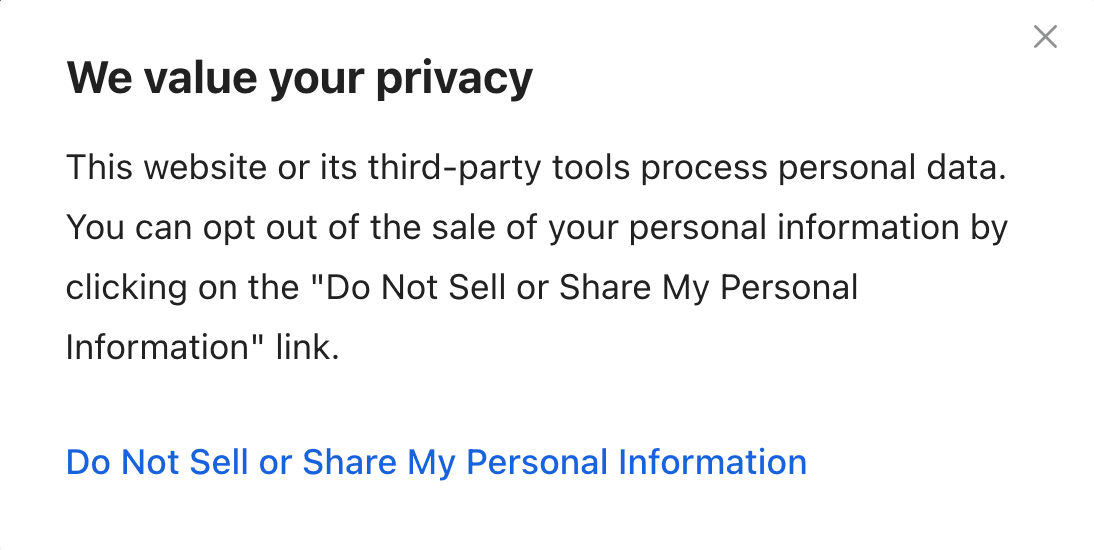
Opt-out cookie banner
Complete cookie compliance from banner to policy
Set up a custom cookie banner for your website
Sign up for free- 14-day free trial
- Cancel anytime
What are the key differences between the cookie policy and the cookie consent?
| Feature | Cookie Policy | Cookie Consent |
|---|---|---|
| Purpose | Transparency: what cookies are used and why | Permission: actively request user consent |
| Format | Static document on your website | Interactive banner or pop-up |
| Scope | Covers all cookies (including essential) | Covers only non-essential cookies |
| Legal Role | Fulfils disclosure/transparency duties | Fulfils consent and transparency requirements (e.g., gdpr cookie consent) |
| Mandatory | Yes, under most privacy laws | Yes, except for opt-out laws like CCPA |
Do I need a cookie policy or cookie consent notice if I don't collect personal data via cookies?
Yes. Even if you don’t collect names or emails, cookies are often treated as personal data because they track identifiers and behaviour. Under GDPR, consent is required for all non-essential cookies, and US state laws like the CCPA/CPRA also demand clear disclosures and opt-out choices.
The safest approach is to maintain a cookie policy or at least include cookie disclosures in your privacy policy, paired with a banner that gives users a real choice.
Should I use a separate cookies policy and cookie consent notice?
Yes, having both is important.
The cookie consent notice is what users see first when they visit your site. It tells them that cookies are being used and gives them a choice to accept, reject, or manage their preferences. This is required under the GDPR and many other laws because users must have a chance to decide before non-essential cookies are placed on their devices.
The cookie policy is different. It goes deeper by listing out the actual cookies your site uses, why you use them, how long they last, and whether they come from your site or a third party. It also explains how users can change or withdraw their consent later. Regulators expect this level of detail so that visitors have full transparency, not just a quick pop-up.
Since regulators have different expectations for each, a cookie policy and cookie consent banner should be kept separately.
Together, the banner and the policy work hand in hand:
- The banner handles real-time consent.
- The policy provides the full disclosure behind that consent.
Even in regions like the US, where laws such as the CCPA/CPRA don’t always ask for a separate cookie policy, businesses are still required to disclose tracking technologies.
Both make compliance easier across jurisdictions and build trust with your audience.
Where to display your cookie policy and cookie consent notice?
The cookie consent banner must be displayed when users visit your site, and they should be able to access the cookie policy at any time. But there is more.
Cookie consent notice/ cookie banner
- The cookie banner must appear at the point of entry, when a visitor first lands on your website.
- It should be prominently placed (usually at the bottom, sides or top of the page).
- The banner should remain until the visitor makes a choice- accept, reject, manage preferences or close the banner.
- It should never be hidden behind another click or designed in a way that nudges users unfairly (no dark patterns).
Cookie policy
- The cookie policy should be accessible at all times from your site’s footer, alongside your privacy policy and terms of service.
- It should also be linked directly from the cookie banner, so users can easily review details before deciding.
- For mobile users, ensure the link is visible and easy to tap.
- Best practice is to place it in any area where users naturally look for legal or informational documents, such as “Legal” or “Policies” sections.
Why placement matters?
Placing your cookie consent notice upfront and keeping the cookie policy always accessible ensures transparency and compliance with laws like the GDPR, ePrivacy Directive, and CCPA/CPRA. It also fosters customer trust and brand reputation, since users can see you’re not hiding information or forcing consent.
Why does your website need both cookie consent and a cookies policy?
Thinking whether you need both cookie policy and cookie consent, here’s why the answer might be a resounding yes:
#1 Legal compliance
Most global privacy regulations operate on a two-part system. The cookie policy serves as the public-facing document that provides transparency and notice, as required by laws like the GDPR, the UK's cookie law, Brazil's LGPD, and India's DPDP Act. It must detail what cookies are, the data they collect, why they're used, and how long they're stored.
The cookie consent banner or tool is the active mechanism that demonstrates you have obtained and are managing consent in a verifiable way, a separate legal obligation. Even in opt-out jurisdictions like California's CPRA, a clear notice is still a core requirement.
#2 User trust and brand reputation
A website that transparently provides both a clear consent banner and a comprehensive cookie policy signals to visitors that their privacy is respected. This proactive approach builds a stronger foundation of trust. It shows that your business genuinely values and protects user data, which in turn enhances your brand reputation and customer loyalty.
#3 Avoid penalties
Failing to have either a policy or a consent mechanism can lead to severe financial consequences. The GDPR, for instance, can impose fines of up to €20 million or 4% of annual global turnover for major violations.
Similarly, CCPA fines for non-compliance can be up to $7,500 per incident. A lack of proper documentation (provided by both a policy and a consent log) makes it difficult to defend against these penalties.
#4 Better data quality
Collecting data only from consenting users ensures that your analytics and advertising strategies are obtained ethically. A detailed cookie policy is crucial, as it provides the transparent, specific information that makes consent informed, valid, and compliant.
This leads to higher-quality, more accurate data for business insights. Marketing campaigns built on this foundation are more likely to be successful, as they target users who have explicitly agreed to receive relevant communications.
#5 Data governance and accountability
Having both a policy and a consent banner is essential for an organisation's internal data governance. The cookie policy serves as your company's public commitment to its data practices, guiding internal teams on what information can be collected. The consent logs, generated by the banner, provide the necessary proof of consent for legal audits. Both documentations are critical for demonstrating compliance and accountability to regulatory authorities, especially in the event of a complaint.
Cookie consent vs cookie policy: Conclusion
Cookies play a crucial role in personalising content, optimising marketing, and delivering digital services. But they also bring privacy and cookie policy obligations that businesses must not ignore.
A well-drafted cookie policy for website transparency, combined with a compliant cookie consent mechanism, shows that your brand takes user rights seriously.
If you're looking for free cookie consent tools or planning to revise your cookie practices, platforms like CookieYes offer GDPR and CCPA-ready solutions with cookie compliance in mind.
CookieYes lets you create and manage your cookie banner and policy from one dashboard. It keeps compliance simple and organised.
Autopilot your cookie compliance
- Customisable and auto-generated banner
- Easy to set up and beginner-friendly
- Privacy and cookie policy generator
- Multi-lingual cookie policies
- Compliance with GDPR, CCPA, and more
- Language customisation
- Auto-scan for cookies
- Consent logs for compliance
- Google-certified CMP and IAB TCF v2.3 compliant
FAQ on cookie consent vs cookie policy
Do I need a cookie policy on my website?
Yes, most privacy laws like the GDPR (EU/EEA/UK), ePrivacy Directive, and CCPA/CPRA (California) require websites that use cookies or tracking technologies to inform users about the use of cookies on their websites, and how they control their use.
Does my website need a cookie policy and cookie consent?
Yes. Privacy laws like the GDPR, ePrivacy Directive, and CCPA require websites to tell users about cookies through a cookie policy.
A cookie policy explains what cookies you use, why you use them, and how people can control them. But that’s only half the job. These laws also set rules for user choice:
The GDPR says you need consent before placing non-essential cookies (like ads or analytics).
The CCPA says you must give users the option to opt out, often through a “Do Not Sell or Share My Information” link.
So, your site needs both: a cookie policy to explain and a cookie banner/consent to ask. Skipping either one leaves you exposed to enforcement actions.
How does the GDPR affect cookie policy and cookie consent?
The GDPR, together with the ePrivacy Directive, affects both cookie policies and cookie consent. A cookie policy is always required because websites must be transparent about any cookies they use, even if they are limited to essential ones. The policy should explain what cookies are in use, their purpose, and how users can manage or withdraw their choices.
When it comes to consent, the GDPR distinguishes between essential and non-essential cookies. Essential cookies, such as those needed for basic site functionality, can be set without consent but must still be disclosed. Non-essential cookies, such as analytics, advertising, or tracking cookies, require prior, explicit consent. This consent must be freely given, informed, specific, and easy to withdraw.