Full site index for AI agents: llms.txt. Every page is also available as Markdown: replace the trailing slash with .md, so /pricing/ becomes /pricing.md. Or send the header Accept: text/markdown to the page URL itself.
Trust used to be built in face-to-face meetings. Now, it starts on your homepage. For forward-thinking financial institutions, consent management has become more than just a compliance task. It’s a chance to lead with transparency, respect, and digital confidence.
With regulations like GDPR, CCPA, and the ePrivacy Directive setting the standard, managing user consent is a strategic part of your digital operations. This blog breaks down why consent management matters in financial services, what elements make it effective, how to implement it correctly, and the common pitfalls to avoid. Whether you’re leading a compliance team or managing digital transformation, this is your roadmap to building trust through compliance done right.
What is consent management in financial services?
Definition and importance of consent management in financial service websites
It is the process of collecting, recording, and managing user permissions for data usage. Consent management is essential in the finance sector due to the volume and sensitivity of user data handled, such as account information, transaction history, and identity details.
On Finserv websites, consent becomes essential at several key points:
Using third-party tools that process personal information, etc.
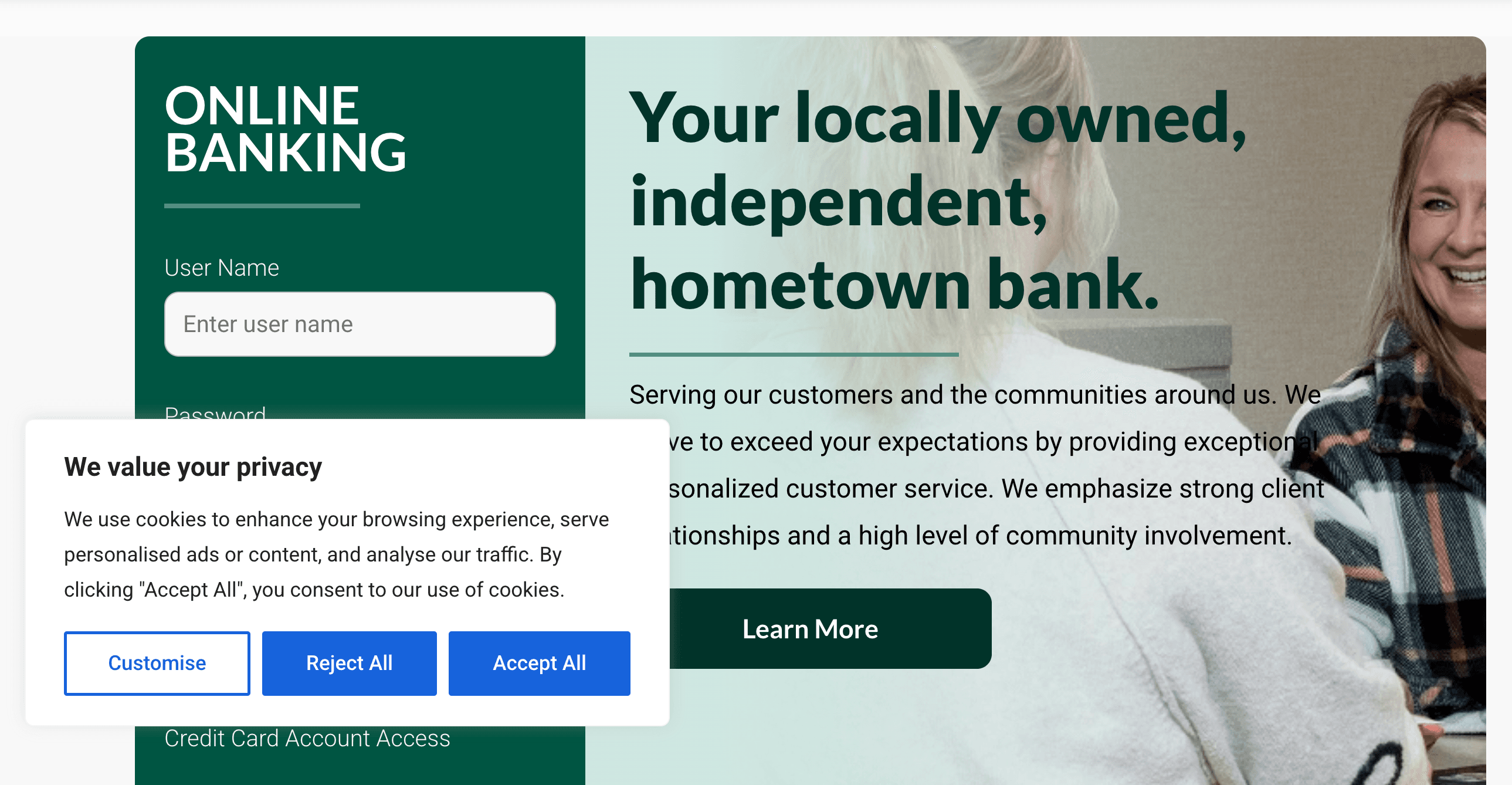
Cookie banner powered by CookieYes as seen on Bank of Milton’s website
Implementing a finance consent management strategy helps institutions meet legal requirements while creating a privacy-first experience for users.
Compliance frameworks like the GDPR, CCPA, and the ePrivacy Directive mandate that consent must be informed, freely given, explicit, and easy to withdraw.
Consent management platforms (CMPs) are vital tools that help financial services track, audit, and demonstrate valid consent in real time. It also supports accountability.
Regulations like GDPR and CCPA require institutions to prove that a user has given valid consent for data processing.
A well-implemented consent strategy simplifies this and ensures consistency across all digital channels.
The Spanish DPA (AEPD) fined Caixabank S.A. €6 million (later reduced to €2 million by the National Court on May 8, 2025 – SAN 2166/2025) for violating Articles 6, 13, and 14 of the GDPR.
The bank required customers to accept a privacy policy that allowed data sharing across the CaixaBank Group without offering a proper opt-out. To refuse, users had to send separate letters to each group company. The AEPD found that consent was not valid under GDPR.
For banks, consent management is not just a privacy tool but also a part of delivering a secure, transparent customer experience.
Why do financial services require strict cookie consent mechanisms?
Financial institutions handle sensitive personal data, including account details, transaction histories, and personal identifiers. Given the potential risks associated with data breaches and misuse, consent mechanisms are essential to protect customer information and comply with regulatory requirements.
Data privacy laws
Financial institutions operate under strict data protection laws. The General Data Protection Regulation (GDPR) in the EU and UK mandates that consent for data processing must be freely given, specific, informed, and unambiguous.
The ePrivacy Directive further emphasises the necessity of obtaining user consent before storing or accessing information on a user's device.
Similarly, the California Consumer Privacy Act (CCPA) requires clear disclosure about data collection and provides consumers the right to opt out.
Financial sector-specific data sensitivities
From credit histories to account access, financial data is deeply personal and highly regulated. Compromising its privacy definitely comes with huge consequences, including financial loss and identity theft.
That makes the stakes even higher when it comes to user consent. Consent management tailored for finance services must be precise, auditable, and user-friendly.
By giving customers clarity and control, banks demonstrate a commitment to data ethics and digital trust.
The high stakes of data breaches and non-compliance
In finance, a data breach is a trust crisis. Failing to properly manage consent can result in exposure to compliance risk, customer attrition, and operational setbacks.
Recent enforcement actions show that regulators aren’t just watching but acting. Therefore, financial institutions that integrate robust consent management systems position themselves as proactive, trustworthy, and compliant.
Ensuring transparency and building trust with customers is an ongoing process. In FinServ websites, where relationships are built on reliability, how data is handled plays a key role.
Clear, consistent consent practices demonstrate that an institution respects user privacy. This builds confidence, reduces hesitation during digital interactions, and fosters a sense of control for users, strengthening loyalty over time.
Key data privacy laws impacting consent management in financial services
GDPR (General Data Protection Regulation)
Applies to organisations handling personal data of EU residents
Requires consent to be freely given, specific, informed, and unambiguous.
Organisations must identify a legal basis for each processing activity (e.g., consent, contract, legal obligation)
Requires clear cookie consent for all non-essential cookies and prior opt-in.
Mandates records of processing activities (RoPA) for transparency and auditing.
Use a CMP to collect and manage cookie consent, document all legal bases, maintain RoPA and DPAs, and implement robust data protection controls.
CCPA (California Consumer Privacy Act)
Grants California residents rights over their personal information
Must provide a clear opt-out link for users
Consent is required before selling/sharing the personal data of minors below 16 years
Consumers must be clearly informed of their rights.
Applies to financial institutions operating in the U.S.
Requires clear disclosure of data-sharing practices and opt-out options for consumers.
Institutions must implement safeguards to protect personal financial information.
Actionable tip: Provide a privacy notice at account opening and annually; include opt-out mechanisms for non-affiliated third-party data sharing.
ePrivacy Directive (EU)
Complements GDPR by focusing on electronic communications.
Requires consent before storing or accessing information (e.g., cookies) on user devices.
Actionable tip: Display compliant cookie banners and block non-essential cookies until user consent is obtained.
Other regional laws
Varying regulations like LGPD (Brazil), PDPA (Singapore), and POPIA (South Africa) have similar consent requirements.
Actionable tip: Map user locations and dynamically adapt consent experiences by region.
These laws make consent management a legal obligation. Financial service websites must adopt platforms and processes that ensure valid, auditable, and region-specific consent.
A Consent Management Platform (CMP) is a tool that helps organisations collect, manage, and document user consents for data processing activities.
For Finserve websites, a CMP ensures that consent collection aligns with regulatory requirements and that records are maintained for auditing purposes.
#2 Essential CMP features for financial sites
Granular consent options: Allow users to consent to specific data processing activities, providing clarity and control.
Audit trails: Maintain detailed records of when and how consent was obtained, modified, or withdrawn.
User-friendly interfaces: Design intuitive consent prompts that clearly explain cookie usage, enhancing user understanding and trust.
#3 Ensure transparency and user trust
Clearly communicate data collection practices, purposes, and user rights. Provide easy access to privacy policies and options to modify or withdraw consent at any time. This openness fosters trust and demonstrates a commitment to user privacy.
Step-by-step guide to implementing consent management
#1 Conduct a cookie audit
Begin by identifying all cookies and tracking technologies used on your website. Understand their purposes and determine which require user consent.
#2 Choose the right CMP for finance
Select a CMP that caters to the specific needs of financial institutions.
A suitable CMP should offer:
Scalability: To handle large volumes of data and users.
Integration capabilities: Seamless integration with existing systems.
User-friendly interface: Ensuring ease of use for both administrators and customers.
CookieYes, for instance, offers solutions tailored to comply with various data protection laws, ensuring seamless integration and compliance.
#3 Customise consent banners for compliance
Design consent banners that are clear, concise, and compliant. Avoid pre-checked boxes and ensure users can easily accept or reject data processing activities.
Maintain comprehensive records of user consents. Ensure that these records are securely stored and easily retrievable for auditing purposes.
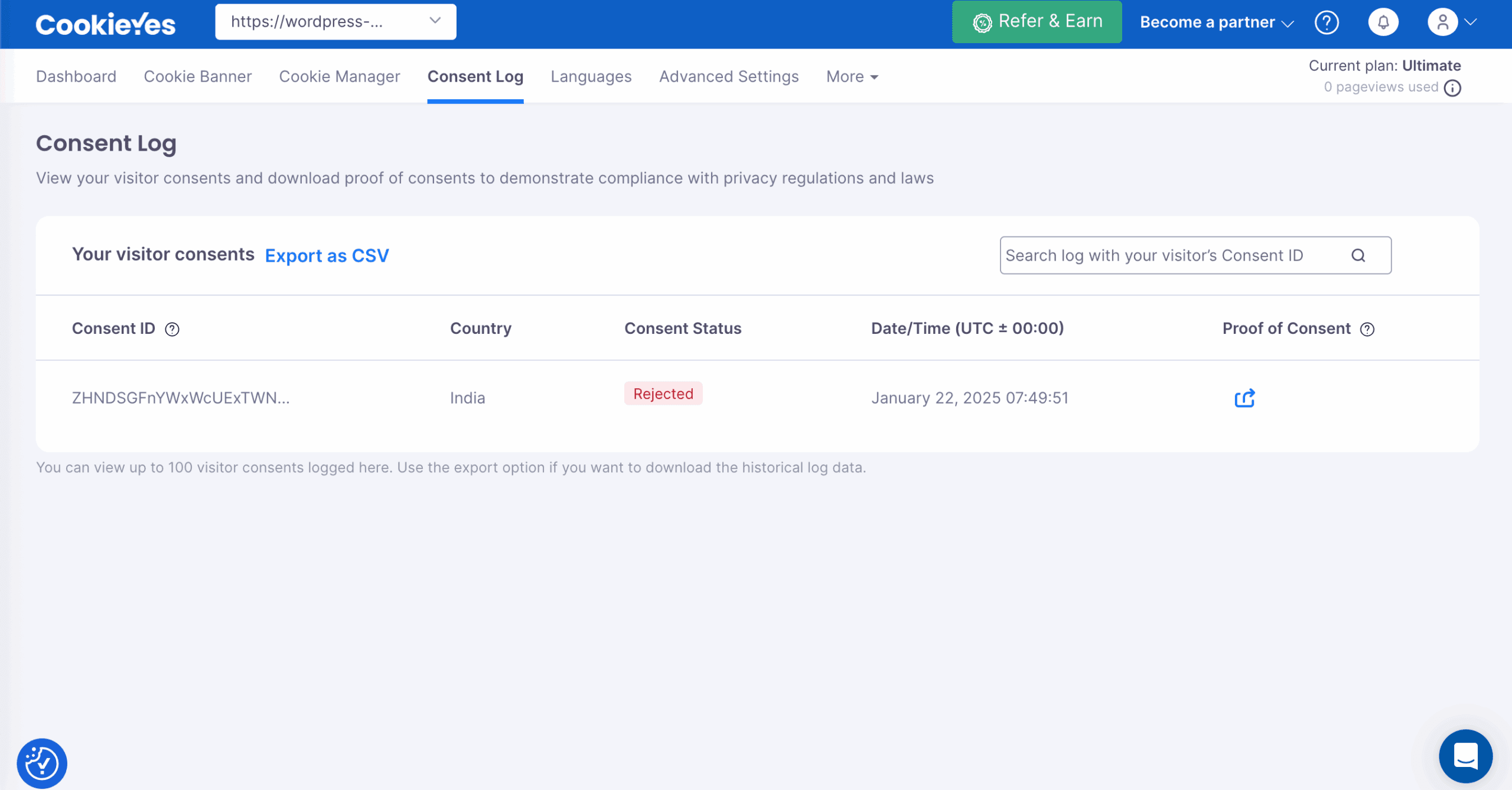
Consent log within the CookieYes dashboard that saves consent data in an exportable format.
Compliance pitfalls to avoid in financial services websites
Pre-checked boxes and implied consent
Using pre-checked boxes or assuming consent through user inactivity is non-compliant under most privacy laws. Ensure that all consent is obtained through clear, affirmative actions by the user.
Storing consent data insecurely
Consent records must be stored securely to prevent unauthorised access. Implement anonymisation and robust security measures to protect this sensitive information.
CookieYes anonymises the IP addresses of users to ensure data protection.
Ignoring regional regulatory differences
Data protection laws vary across jurisdictions. Ensure that your consent management practices comply with regional regulations, adapting as necessary for different markets.
What is acceptable in the United States may not be considered compliant under European data protection laws.
Advanced strategies & trends in consent management
Automation in consent management for financial services
Artificial Intelligence (AI) and automation streamline consent management by automating consent collection. This reduces manual efforts and saves time.
Real-time consent updates across financial ecosystems
Implementing systems that allow real-time updates ensures that any changes in consent preferences are immediately reflected across all platforms and services, maintaining consistency and compliance.
Get real-time consent updates
Automate your consent management today & stay compliant
Prepare for the future of consent in the financial sector
As regulations evolve and customer expectations shift, financial institutions must:
Stay informed: Keep notified of regulatory changes.
Invest in technology: Adopt advanced consent management solutions.
Educate stakeholders: Ensure all employees understand the importance of consent management.
FAQ on consent management for financial websites
What is consent management for banking websites?
Consent management refers to the process by which financial websites collect, store, and manage user permissions for data collection and processing, in line with regulations like GDPR, CCPA, and GLBA. It ensures transparency, accountability, and legal compliance.
Why is consent management important for banks and financial institutions?
Consent management is critical for protecting sensitive financial data, maintaining regulatory compliance, and preserving customer trust. It also helps institutions avoid legal penalties and reputational damage due to non-compliance with privacy laws.
Which data privacy laws apply to consent on financial websites?
Finance websites are typically subject to the following laws based on their operating location and where the visitors are from:
GDPR (EU)
CCPA/CPRA (California, US)
GLBA (US financial privacy law)
DPA (UK)
PDPA (Singapore, Thailand)
PIPEDA (Canada)
What kind of user consent is required on finance websites?
Explicit (opt-in) consent is often required for:
Tracking technologies like cookies
Marketing communications
Sharing data with third parties
Behavioural profiling or credit risk analytics
How do cookie banners work for financial institutions?