Full site index for AI agents: llms.txt. Every page is also available as Markdown: replace the trailing slash with .md, so /pricing/ becomes /pricing.md. Or send the header Accept: text/markdown to the page URL itself.
Think about the last time you tapped "Accept” just to read an article or access an app. Did you stop to read what you were agreeing to? Probably not. And you’re not alone.
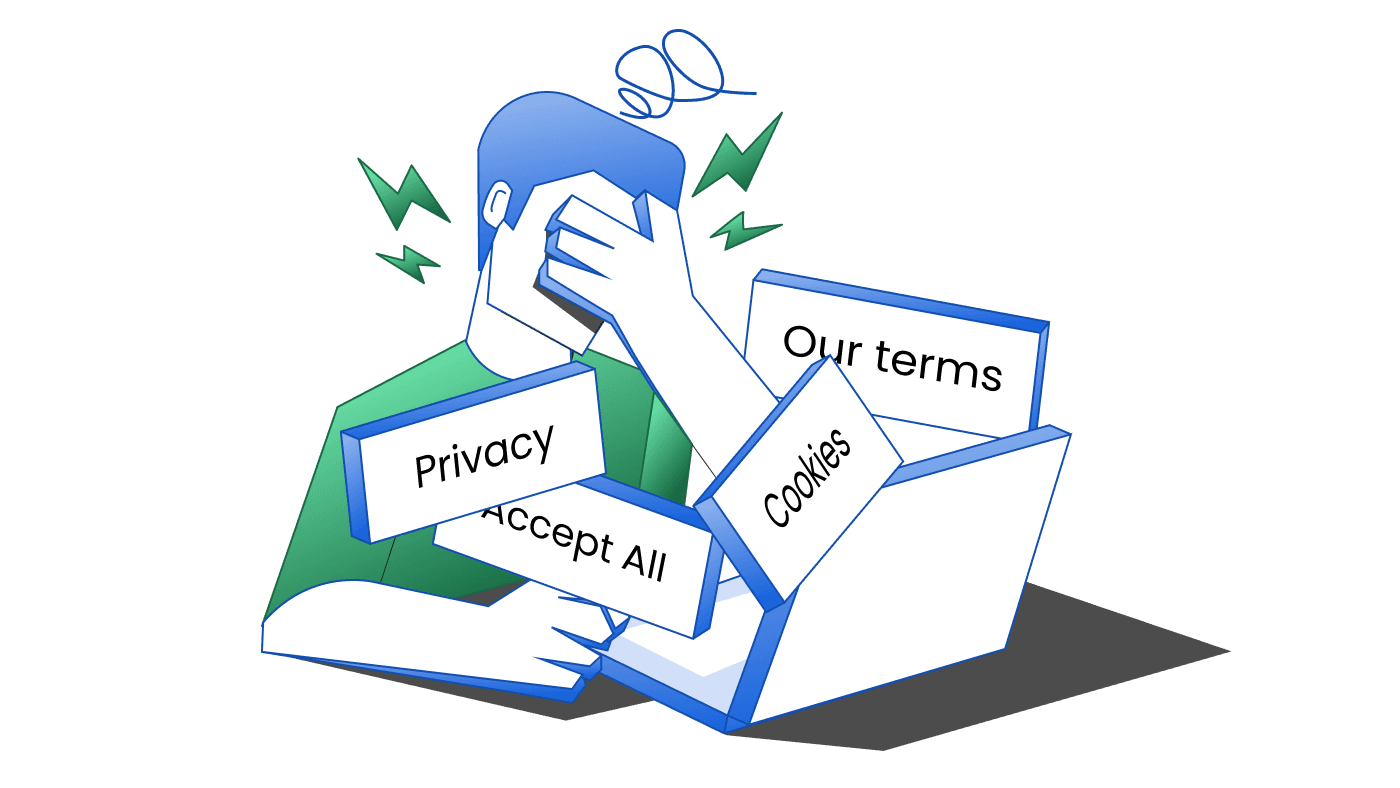
This pattern is the result of consent fatigue, a growing challenge where users, overwhelmed by constant prompts, start tuning them out. It doesn’t mean people don’t care about privacy. Instead, this means that the way consent is requested isn’t working as intended.
For businesses, this raises an important question: How can we make consent meaningful again, without wearing users down? Let’s explore what’s going wrong and what smart organisations are doing right.
What is consent fatigue?
Consent fatigue refers to the exhaustion and indifference users feel when frequently asked to provide permission for data collection and processing.
This fatigue has only grown since privacy laws like the GDPR and CCPA came into play. These laws are a big step forward in giving users control over their data. They require businesses to be transparent and get clear permissionbefore collecting personal information, which is a good thing.
But here’s the catch: most businesses rely on consent as their go-to legal basis for data processing, even though under the GDPR, it’s just one of six valid options.
That heavy reliance means users are constantly prompted, often in ways that feel repetitive or confusing. And that’s where things start to break down.
The issue isn’t with the laws themselves; they’re designed to protect people. It’s how platforms ask for consent that’s the problem. Poorly designed requests or too many of them can cause people to disengage entirely, which defeats the purpose of asking in the first place.
Consent fatigue vs privacy fatigue: Are they the same?
While consent fatigue arises from the overexposure to consent requests, privacy fatigue represents a broader sense of weariness regarding privacy matters, including complex policies and data breaches. Both phenomena can lead to user disengagement and reduced trust in digital platforms.
Consent fatigue: It is the exhaustion from repeatedly being asked for consent on cookies, data tracking, and app permissions. This may lead to blind acceptance, undermining true informed consent.
Privacy fatigue: It is the sense of overwhelm or helplessness when trying to manage personal privacy. This may lead to users giving up on reading policies and increasing risky behaviour online.
A recent study shows privacy fatigue is driven by cognitive overload and emotional strain, like cynicism and self-doubt, which can lead users to abandon privacy-protective behaviours altogether.
This detachment is harder to detect but just as damaging, as it silently erodes trust and increases data sharing risks.
For businesses, this means it's not just about reducing banner fatigue but also about designing systems that empower users without exhausting them.
What are the causes of consent fatigue?
Causes of consent fatigue are multiple. Here are some of them.
Overexposure to cookie banners and pop-ups
The digital environment is saturated with consent prompts. According to a report by Legiscope, Europeans collectively spend over 575 million hours annually managing cookie consent banners.
This constant barrage not only frustrates users but also diminishes the effectiveness of consent mechanisms.
Complex and lengthy privacy policies
Many privacy policies are dense and filled with legal jargon, making them difficult for the average user to comprehend. This complexity can lead users to ignore the details and hastily provide consent without fully understanding the implications.
Poor UX design and dark patterns
Some websites employ design tactics that manipulate users into giving consent, such as confusing language, cookie walls, hard-to-find opt-out options, and pre-checked boxes. These practices not only affect trust but also risk non-compliance with data protection laws.
Relying solely on user consent as the legal basis for data processing, without considering alternatives like legitimate interest, can lead to unnecessary consent requests. This over-reliance can contribute to consent fatigue and potential legal complications.
How to combat consent fatigue?
Practice the following strategies to mitigate consent fatigue:
#1 Offer granular consent choices
Allowing users to consent to specific types of data processing gives them greater control and can reduce the feeling of being overwhelmed by blanket consent requests.
For example, cookie banners providing specific controls for each non-essential cookie category help with consent fatigue while also keeping you compliant.
Cookie banner on Access for Music provides granular cookie control options for users
#2 Consolidate consent prompts
Imagine checking into a hotel after a long day of travel. Before you can head to your room, the front desk hands you five different forms, one for ID verification, another for room service preferences, a third for marketing emails, and so on. You're tired, annoyed, and more likely to sign without reading, just to get it over with.
Now think about your website.
When users land on your platform and are hit with separate pop-ups for cookies, email sign-ups, location tracking, and personalisation, it creates the same kind of frustration. It’s not just disruptive, but also exhausting.
By presenting consent prompts in a clear, well-organised format or placing them in a way that doesn’t interrupt the user journey, you ease the experience and signal that you value their time and attention.
This not only helps reduce consent fatigue but also strengthens user engagement and trust.
When information is easy to understand and unobtrusive, it builds confidence and reinforces that your business is privacy-conscious by design.
#3 Ensure transparency in data usage
Clearly communicating how user data will be used fosters trust and helps users make informed decisions about their consent.
Also, ensure that you do not bury your consent messages in too much information or jargon.
The cookie message on Formulux is simple and easy to understand
#4 Regularly audit and update consent mechanisms
Periodic reviews of consent practices ensure they remain effective and compliant with evolving regulations and user expectations.
Adopting a robust CMP can streamline the consent process, making it more intuitive for users. A well-designed CMP allows users to manage their preferences easily and ensures compliance with privacy regulations.
An efficient and proactive CMP like CookieYes also ensures timely updation of consent practices with evolving laws.
Quit chasing compliance- command it.
Sign up to CookieYes and lock in lawful consent from page one
#6 Utilise alternative legal bases like legitimate interest
Consent is only one of the six legal bases of data processing under GDPR. However, consent is a popular choice when it comes to processing.
Where appropriate, businesses can rely on legitimate interest as a legal basis for data processing, reducing the need for frequent consent prompts. This approach must be balanced with user rights and expectations.
01: Let’s say you run an online clothing store. When a customer places an order, you send them confirmation and shipping emails.
Rather than asking for consent every time, you can rely on legitimate interest or contractual necessity, since these messages are essential for fulfilling the purchase.
However, if you want to send promotional emails afterwards, you must obtain explicit consent, as marketing requires a separate legal basis.
02: Another example would be a bank monitoring transactions to detect fraud. This activity is vital for both the business and the customer’s security.
Here, the bank can rely on legitimate interest without needing user consent, because the processing is necessary to prevent financial crime.
But if that same bank wanted to use the transaction history to promote premium credit cards, consent would be required.
By understanding when legitimate interest applies, businesses can reduce unnecessary consent requests, improve user experience, and still remain compliant, but only if they balance it carefully with transparency and user rights.
#7 Design intuitive and non-intrusive consent interfaces
A well-designed consent interface builds trust while reducing friction. Here’s how to make yours clear and user-friendly:
Keep it concise and distraction-free: Avoid long-winded copy. Use plain language that helps users understand what they’re agreeing to.
Avoid dark patterns and cookie walls: Never hide "Reject” buttons, use pre-check boxes, or force consent by blocking access. Let users choose freely.
Make it easy to dismiss or come back later: Include a close or "X” button. Not everyone wants to decide immediately. Try to give them space.
Use a distinct and accessible design: Choose a visually noticeable colour that stands out from the rest of the page but still aligns with your brand. Ensure text and buttons meet accessibility standards.
Offer ongoing control: Let users revisit and adjust their preferences anytime via footer links, cookie widgets, settings pages, or browser tools. Privacy shouldn’t be a one-time decision.
#8 Provide clear options to withdraw or adjust consent
Users should have easy access to modify or withdraw their consent at any time. Transparent mechanisms for managing consent preferences empower users and demonstrate respect for their choices.
Cookie settings link in the website footer of Wired
FAQ on consent fatigue
What are the reasons for consent fatigue?
Consent fatigue happens when users are overwhelmed by too many consent requests, like constant cookie pop-ups or privacy notices. It’s often caused by:
Repetitive consent messages across websites and apps
Complex or confusing language in consent forms
Poor design that makes choices hard to find or understand
Lack of control, making users feel their preferences don’t matter
Can dark patterns contribute to consent fatigue?
Yes. When websites use manipulative interfaces like pre-ticked boxes or hard-to-find “Reject” buttons, it can increase user frustration and accelerate fatigue.
How to avoid consent fatigue?
You may implement the following best practices to reduce consent fatigue:
Offer granular controls instead of blanket consent
Keep the consent requests simple, concise and easy to understand
Avoid dark patterns to obtain consent
Use a Consent Management Platform (CMP)
Respect user choices across sessions through consent records
Provide clear and accessible privacy control dashboards or settings
Avoid repetitive prompts unless necessary
Ensure transparency in data collection and usage
Use alternative legal bases if possible
Make consent revocation and customisation easy and convenient

![Cookie banner on Access for Music[nofollow] provides granular cookie control options for users](https://assets.cookieyes.com/Cookie_banner_090b19b83f.png)
![The cookie message on Formulux[nofollow] is simple and easy to understand](https://assets.cookieyes.com/cy_banner_formulux_4_bcfcbba5dd.png)
![Cookie settings link in the website footer of Wired[nofollow]](https://assets.cookieyes.com/wired_cookie_settings_ce4d18a3e9.png)