Full site index for AI agents: llms.txt. Every page is also available as Markdown: replace the trailing slash with .md, so /pricing/ becomes /pricing.md. Or send the header Accept: text/markdown to the page URL itself.
Simpler, more seamless cookie consent for Shopify stores.
Expanding across borders means more than selling in new markets. It means speaking your users' language, especially when it comes to privacy. Just like you translate your ads and product pages, your privacy policy should be accessible too. Laws like the GDPR and CalOPPA demand that privacy information be clear and understandable. A multilingual privacy policy makes that possible. It builds trust, fosters transparency, and ensures accessibility. Whether you're scaling fast or already global, localising your privacy terms shows you're serious about user rights. This blog breaks down why you should provide the privacy policy in multiple languages, where it's required, and how to do it right.
What is a privacy policy?
A privacy policy, also called a privacy notice or a privacy statement, explains how you collect, use, store, and share users’ personal data. For any business, whether you're a local boutique or a global SaaS provider, this policy signals transparency, compliance and trust.
Regulations like the GDPR, CCPA, and Quebec's Law 25 make privacy policies a legal requirement. But beyond compliance, they're an ethical promise to treat user data with respect. It's like showing your customers that it's safe to share their data with you.
What is a multilingual privacy policy?
A multilingual privacy policy is simply the same policy, translated and localised for multiple languages and regions. It's designed to ensure that users, regardless of their language, can clearly understand your data practices and their rights.
The European Commission provides its privacy policy in different languages, including Spanish and French.
What are the components of a standard privacy policy?
The key components of a privacy policy depend on the laws that apply to you. However, most of them typically include:
What data is collected (e.g., names, emails, and phone numbers)
Purpose of collection (e.g., marketing)
Data storage and security measures
Third-party sharing practices
User rights and opt-out mechanisms
How to contact the business
Why is giving your privacy policy in multiple languages important?
There are several reasons why you should provide your privacy policy in multiple languages. Here are some of them:
User understanding and trust
If your privacy policy is only in English, you’re not speaking to everyone. For example, a Spanish privacy policy helps your message resonate with Spanish-speaking users in a language they trust. A multilingual version shows users you value their understanding and their trust. It makes your brand feel local, no matter where your user is.
Serving diverse and global audiences
Global presence requires local respect. If you serve users in multiple countries, language access is essential. Think of it as customer service, but for legal transparency.
Accessibility and legal clarity
Even fluent English speakers may struggle with legalese. Offering policies in their native language ensures clarity, especially when consent is required. This boosts comprehension and compliance.
Credibility
Clear, localised policies enhance your credibility. Customers are more likely to trust and buy from brands that communicate in their language.
Compliance
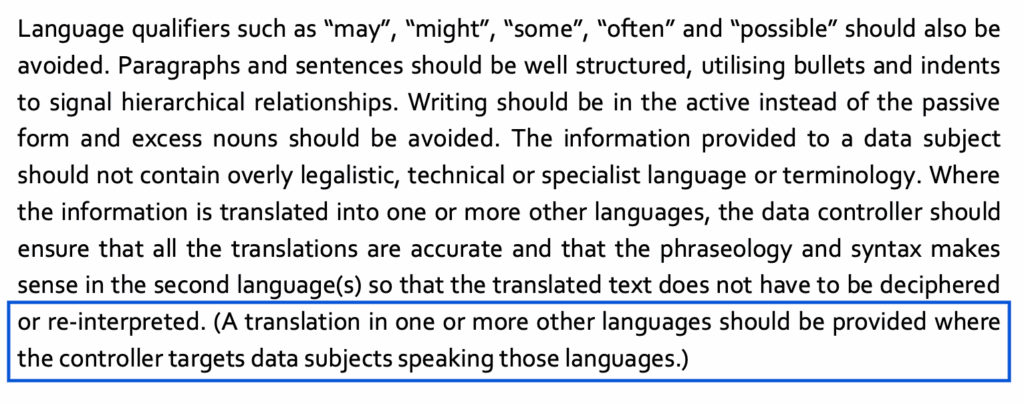
A key transparency requirement under most privacy laws, including GDPR, is to provide information in a clear, accessible, intelligible and easy-to-understand manner.
This highlights the importance of multilingual privacy policies to make the policy easier to understand.
Global privacy laws and the need for multilingual privacy policies
While not all privacy laws explicitly require translations, many emphasise the importance of presenting information clearly and understandably. If you operate in regions like the EU, California, Quebec, or China, providing a translated privacy policy may be necessary to meet these clarity and accessibility standards.
CalOPPA and CCPA: California
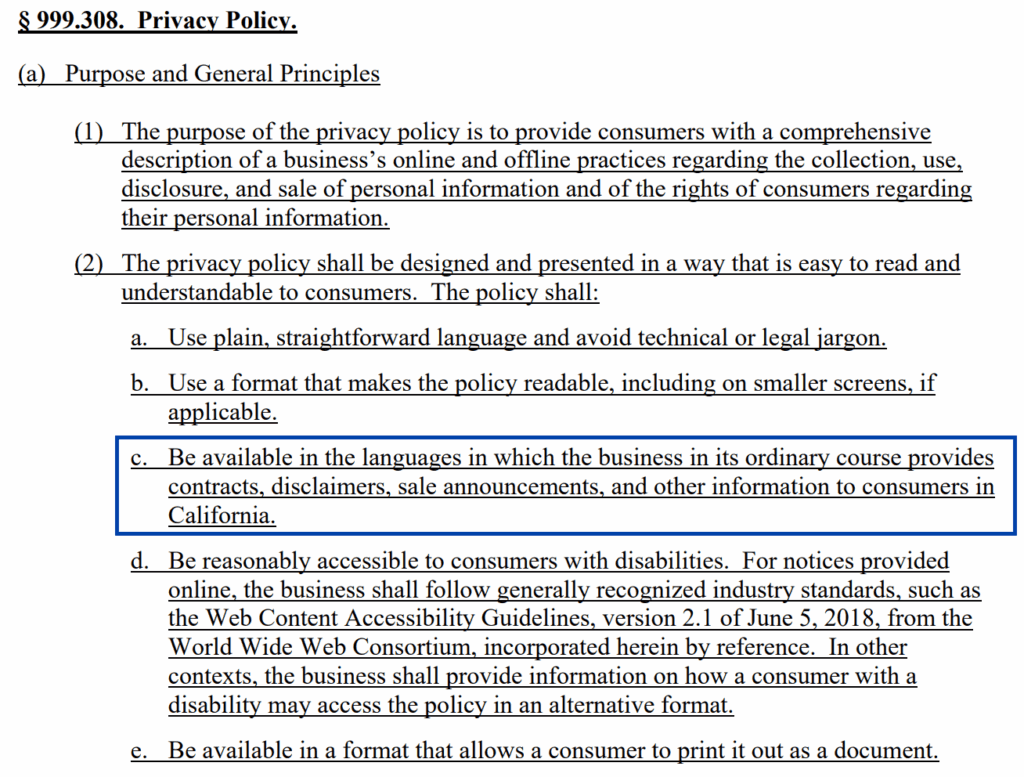
California's privacy laws, including the California Online Privacy Protection Act (CalOPPA) and the California Consumer Privacy Act (CCPA), prioritise transparency and require businesses to inform consumers about their data practices.
The CCPA regulations clearly require organisations to offer privacy policies in multiple languages based on their business locations.
While the GDPR doesn’t explicitly mandate translations, its requirement to present information in a concise, transparent, intelligible, and easily accessible manner, using clear and plain language, can imply the need for multilingual privacy policies in practice.
In 2021, the Dutch DPA fined TikTok € 750,000 for not providing its privacy policy in Dutch, despite being widely used by children.
Multilingualism is one of the founding values of the European Union. And language matters for good reason. According to a language report published by the EU, fewer than 30% of people in Poland are comfortable speaking English over their native language. In Ireland, that figure drops below 20%.
These numbers aren’t just statistics, but reminders that clarity in communication isn’t universal unless you make it so. When businesses fail to offer privacy policies in users' primary languages, they risk excluding the very people they aim to protect.
PIPEDA, Quebec law, and other provincial laws: Canada
Canadian laws like the Official Languages Act, An Act respecting French, the official and common language of Québec and the Use of French in Use of French in Federally Regulated Private Businesses Actwere enacted to prioritise native languages, particularly French.
While PIPEDA or Quebec privacy law does not explicitly require organisations to provide privacy policies in multiple languages, offering them a French privacy policy along with English is considered best practice.
Doing so helps businesses align with the spirit of Canada’s language laws, especially when operating in Québec or when federally regulated.
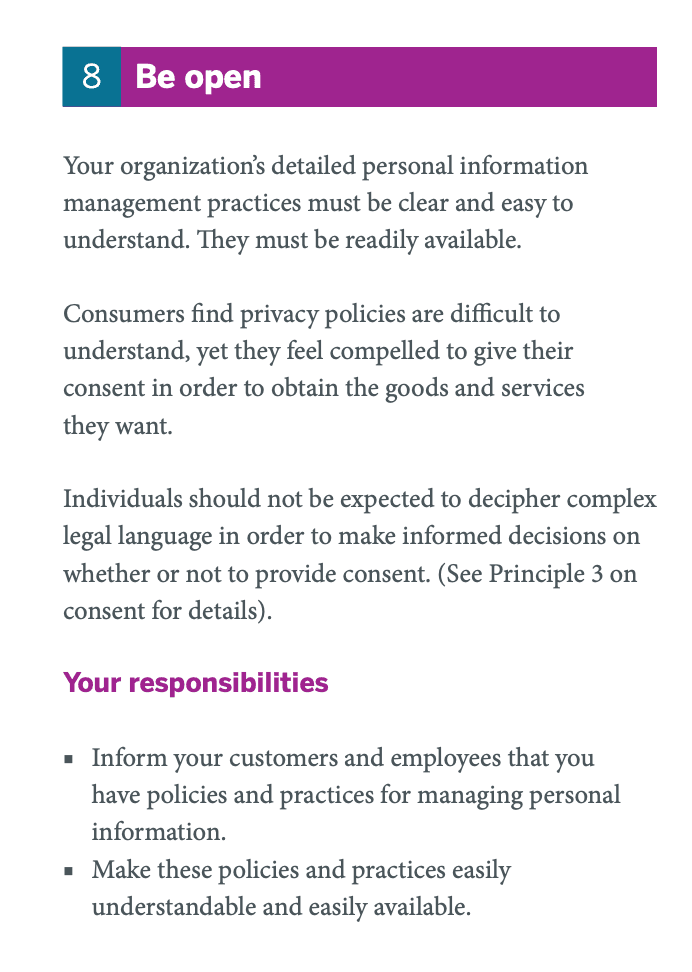
The Canada Privacy Commissioner, in its privacy guide for businesses, recommends that companies make their policies easy to understand and clear.
How to provide your privacy policy in multiple languages?
#1 Start with a clear, master privacy policy
Before translating, develop a master version of your privacy policy in your primary business language. This version should be:
Comprehensive: Cover all legal requirements under applicable data protection laws (e.g., GDPR, CCPA, LGPD).
Modular: Use distinct sections that can be easily updated or translated independently (e.g., data collection, user rights, cookies).
Plain Language: Avoid legalese to ensure the content is easy to understand and translates accurately.
Pro tip:
Write for clarity from the start; Machine or human translators work best with simple, unambiguous language.
Identify the languages spoken by your users based on:
Website traffic analytics like IP geolocation, browser language settings, etc. You may use tools like Google Analytics for this.
Business locations or operational regions.
Legal requirements (some jurisdictions mandate local language versions).
For example, Quebec requires French, Switzerland may need German, French, and Italian.
#3 Use the best translation method that suits your needs
When it comes to translating your privacy policy into multiple languages, you have two main options: machine translation and professional human translation. Each comes with its own advantages, limitations, and ideal use cases.
Method 1: Machine translation
Machine translation tools like Google Translate, DeepL, or Microsoft Translator offer fast, low-cost options for converting text into multiple languages. These are especially useful for:
Speed and scale: Translating content quickly across many languages.
Initial drafts: Producing a rough version to guide further editing.
Internal use: Providing basic comprehension for multilingual teams.
Considerations:
May misinterpret legal terms or introduce inaccuracies.
Often lacks contextual or cultural nuance.
Still requires human review to ensure clarity and compliance.
Best for: Businesses with limited budgets or in early stages of localisation, provided the translations are reviewed by fluent speakers or legal professionals before publication.
Method 2: Professional human translation
Professional legal translators offer nuanced, culturally appropriate, and legally sound versions of your privacy policy. This approach emphasises:
Terminological accuracy: Especially for legal concepts like “data processing” or “consent.”
Cultural alignment: Adjusting tone and examples to match regional expectations.
Legal clarity: Ensuring compliance with local privacy laws in each language.
Considerations:
Higher cost and longer turnaround times.
Requires coordination for updates across all language versions.
Best for: Businesses operating in regulated environments or with significant user bases in non-English-speaking regions where legal compliance and user trust are critical.
Pro tip:
Many organisations use a hybrid model, starting with machine translation and refining it with professional review. The key is to avoid publishing any translated privacy policy without quality checks to ensure it’s accurate, clear, and compliant.
#4 Implement language switching on your website
Ensure users can easily access the privacy policy in their preferred language. For this, you may
Offer a language selector at the top or bottom of your website.
Detect and auto-suggest languages based on browser settings or location.
Link to each language version from the footer or cookie banner for transparency and accessibility.
#5 Maintain version control and consistency
Whenever you update your master privacy policy:
Update all privacy policy translations simultaneously.
Track versions and maintain change logs.
Clearly date-stamp each version and display the “last updated” date in all languages.
#6 Test for accessibility and readability
Finally, ensure each translated version of the privacy policy is:
Mobile-friendly
Accessible to screen readers
Readable at an 8th-grade level (especially important for meeting GDPR’s “clear and plain language” requirement)
Run user tests if possible, especially in regions with complex privacy expectations.
#7 Harmonising layouts across languages
When providing your privacy policy in multiple languages, ensure that each version looks and feels the same. Don’t let a translation break your design or confuse users.
How do various websites provide multilingual privacy policies?
Here are examples of multilingual privacy policies from different websites. If you're looking for guidance on where to position your translator icon or a similar setup, this will be helpful.
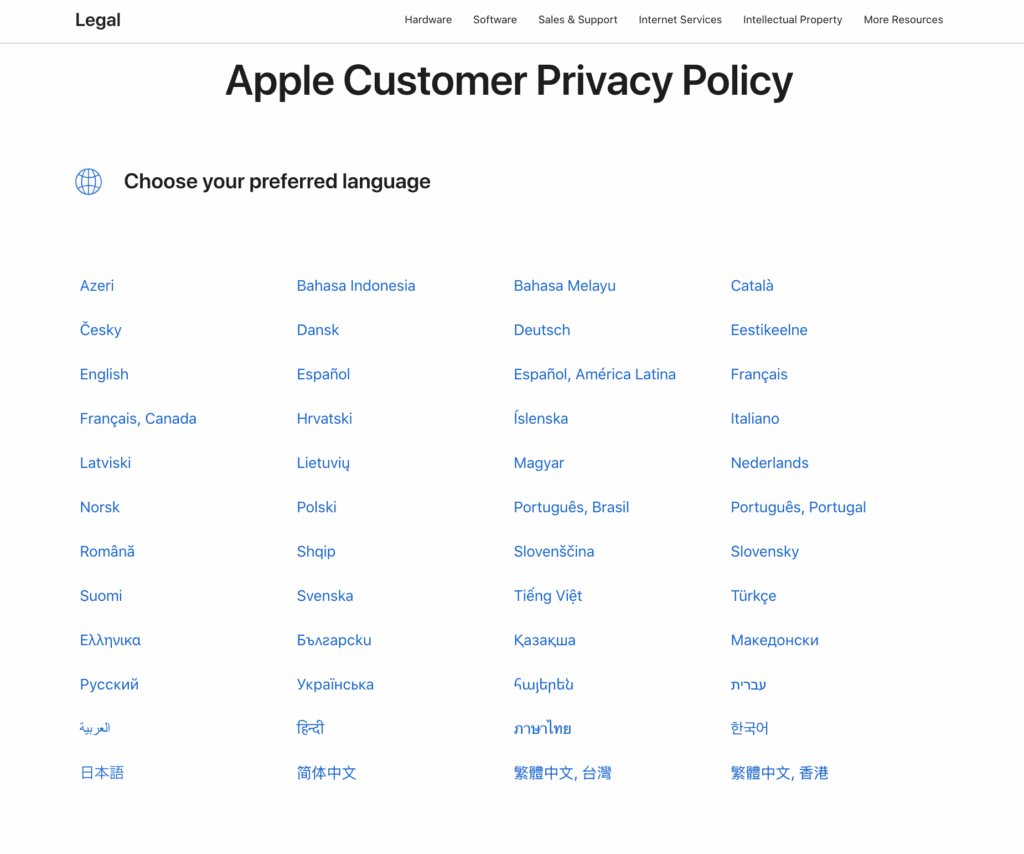
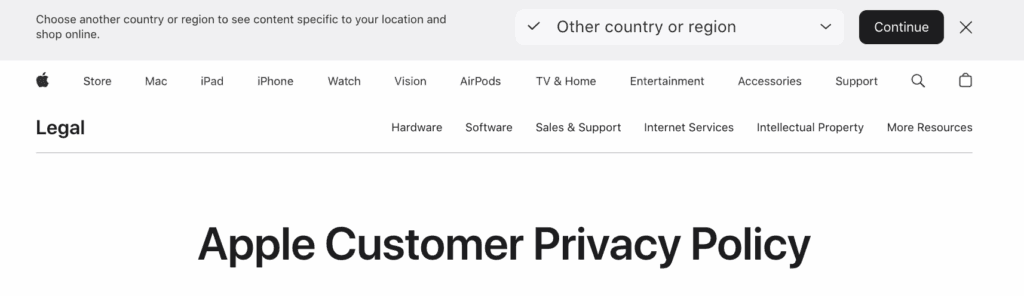
Apple
Apple provides its privacy policies in around 48 languages, including regional variants of the same language.
A language selector dropdown is available in the page header, allowing users to access the privacy policy in multiple languages.
Shopify
Shopify follows a different approach compared to the one shown above. It gives the translator in the website’s footer.
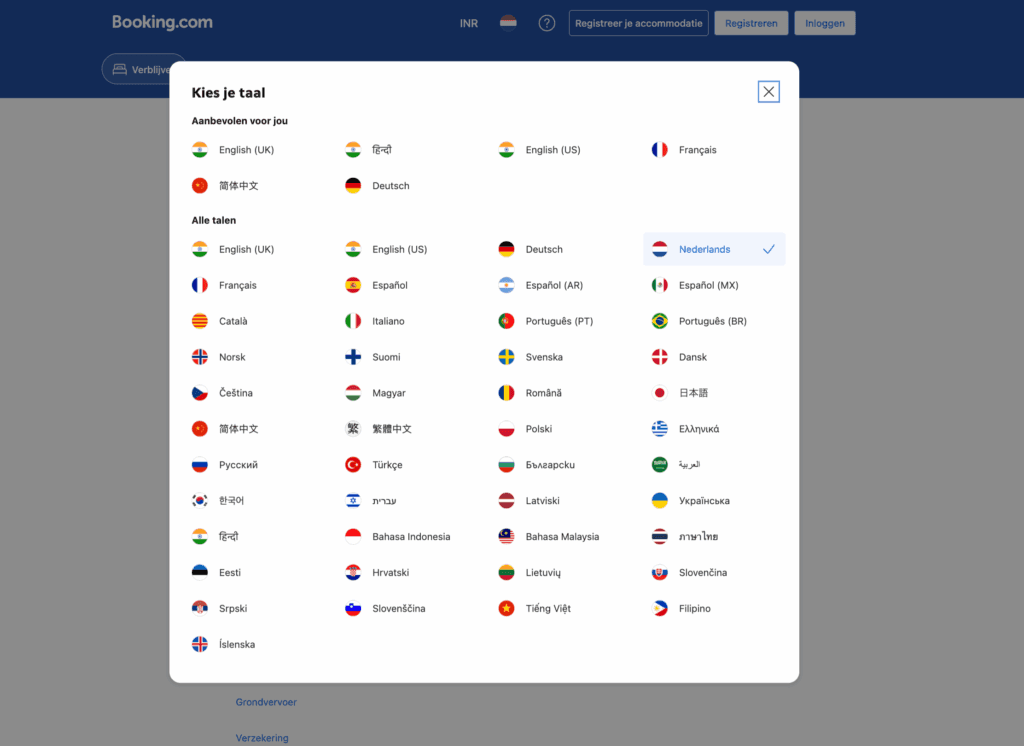
Booking.com
Here, users can choose their preferred language for viewing the policy using the translator dropdown located in the header.
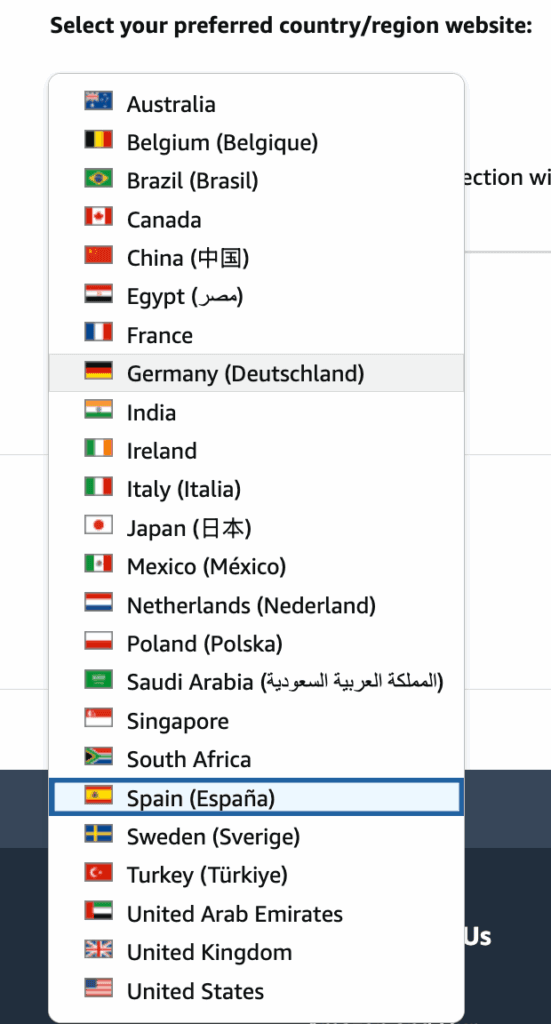
The website also displays country names alongside their respective flags, which is much more effective than showing only the flags.
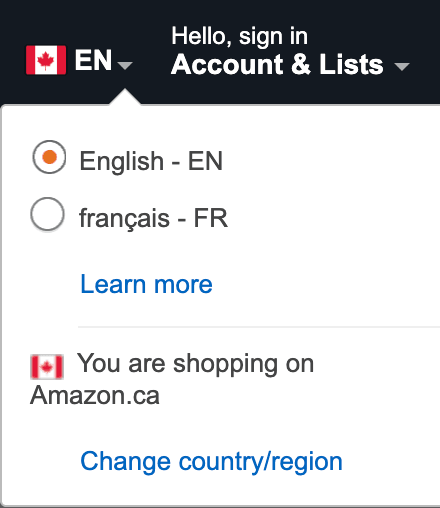
Amazon
Amazon’s website features a translator icon prominently at the top. In Canada, users can access the policy in both English and French.
The dropdown menu enables switching between different regional sites and languages.
Common challenges when providing a privacy policy in multiple languages
Legal nuance in language
Legal terms don’t always translate directly. Work with translators experienced in privacy laws to ensure meaning is preserved.
Budget and resource constraints
Translations cost money. But we would say money for compliance is an investment. Start with your top markets and scale up.
Technical implementation barriers
Syncing translations with your site, cookie banners, and consent tools can be tricky. Choose tools or agencies that support multilingual compliance out of the box.
Are there legal requirements for translating privacy policies into multiple languages?
While not all jurisdictions necessitate multilingual privacy policies, many emphasise the importance of clarity and accessibility. For instance, Article 12 of the EU's GDPR requires information to be provided in a clear and understandable manner, which may necessitate translations for non-native speakers.
How do I determine which languages my privacy policy should be translated into?
Analyse your user base and target markets using tools like Google Analytics. If a significant portion of your audience speaks a particular language, it's advisable to provide your privacy policy in that language to ensure comprehension and compliance.
What are the best practices for translating a privacy policy?
Professional translation: Use certified translators familiar with legal terminology to ensure accuracy.
Cultural sensitivity: Ensure that translations are culturally appropriate and resonate with the target audience.
Regular updates: Keep all language versions updated to reflect any changes in data practices or regulations
What role does multilingual SEO play in privacy policies?
Multilingual SEO ensures that your privacy policy is discoverable by users in different regions and languages. Implementing hreflang tags, localised keywords, and region-specific content can improve visibility and compliance.