Full site index for AI agents: llms.txt. Every page is also available as Markdown: replace the trailing slash with .md, so /pricing/ becomes /pricing.md. Or send the header Accept: text/markdown to the page URL itself.
A privacy policy is a legal document that explains how a business collects, uses, discloses, and protects personal information gathered from users. It outlines the types of data collected, the purpose for which the data is used, and how users can exercise control over their information.
For travel websites, this includes personal details like names, payment information, travel itineraries, and even sensitive data such as passport numbers.
This blog guides you on how to write a privacy policy for your travel website.
Why do you need a privacy policy for your travel website?
Running a travel business online means handling personal and sometimes sensitive data. From booking flights to managing itineraries, your users trust you with details that deserve protection.
Here’s why a privacy policy isn’t optional:
Builds trust with users: People are more likely to book if they know their data is in good hands. A privacy policy proves you’re handling it responsibly.
Keeps you legally compliant: Privacy laws require you to disclose how data is collected and processed. Skip this, and you could risk fines and reputation damage.
Protects your business: A clear policy may also limit liability in the event of disputes. It also demonstrates due diligence.
Supports user rights: Laws like GDPR and CCPA give users control over their data. A privacy policy on your travel website helps you meet those legal obligations head-on.
Which privacy laws apply to travel websites?
Whether your customers are booking safaris in Kenya or city breaks in Barcelona, privacy regulations also look at where your users are, not just your headquarters. Here's what you need to know:
The General Data Protection Regulation (GDPR) has been protecting EU personal data since 2018. It applies to your website if you target Europeans, monitor their behaviour (eg, for advertising purposes) or collect their personal data.
Key requirements include respecting data subject rights, maintaining transparency, obtaining opt-in consent and implementing security safeguards for data protection.
The California Consumer Privacy Act (CCPA) covers the personal data of California residents.
You must allow users to know what data you collect and opt out of data sharing and selling. Also, maintain a well-structured mechanism for fulfilling consumer requests.
All organisations that collect, use or share Canadian’s personal data for commercial activities must comply with PIPEDA. It requires informed consent, secure data storage and ways to fulfil data subject requests.
Brazil’s LGPD mirrors GDPR in many ways. It mandates clear data collection purposes, transparency, and data rights for Brazilian users.
How to write a privacy policy for your travel website?
If you do not have a law degree, don’t worry. Here is a practical, step-by-step approach to designing a privacy policy for your travel website. The key is clarity and openness.
#1 Introduce your business
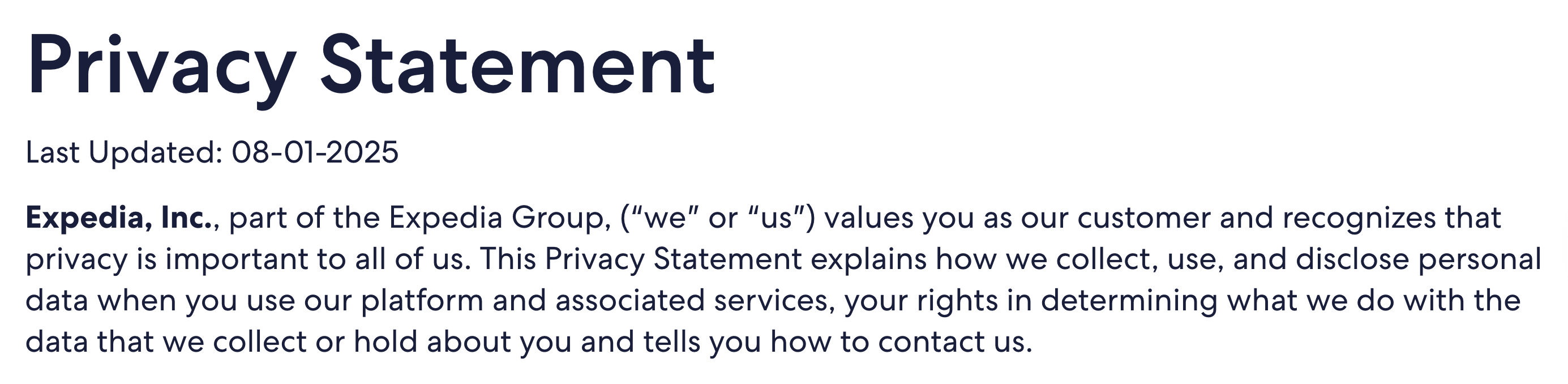
Start with a simple explanation of who you are and what your policy covers. Also, provide the last update date of your privacy policy.
Sample clause:
TravelWithEase (we/our/us) is committed to protecting the privacy of our customers. This privacy policy explains how we collect, use, and protect your personal information when you book a trip through our platform.
Map whatever data you collect from your customers. This could range from personal data like names to sensitive data like passports and banking details.
Be specific. Break it down into tables or bullet points. This could include
Payment info: Bank account number, credit card details, billing address
Tech data: IP address, device type, cookies
Sample clause:
Categories of personal data we collect
We collect basic personal details you provide to us, such as your full name, email address, phone number, and travel preferences
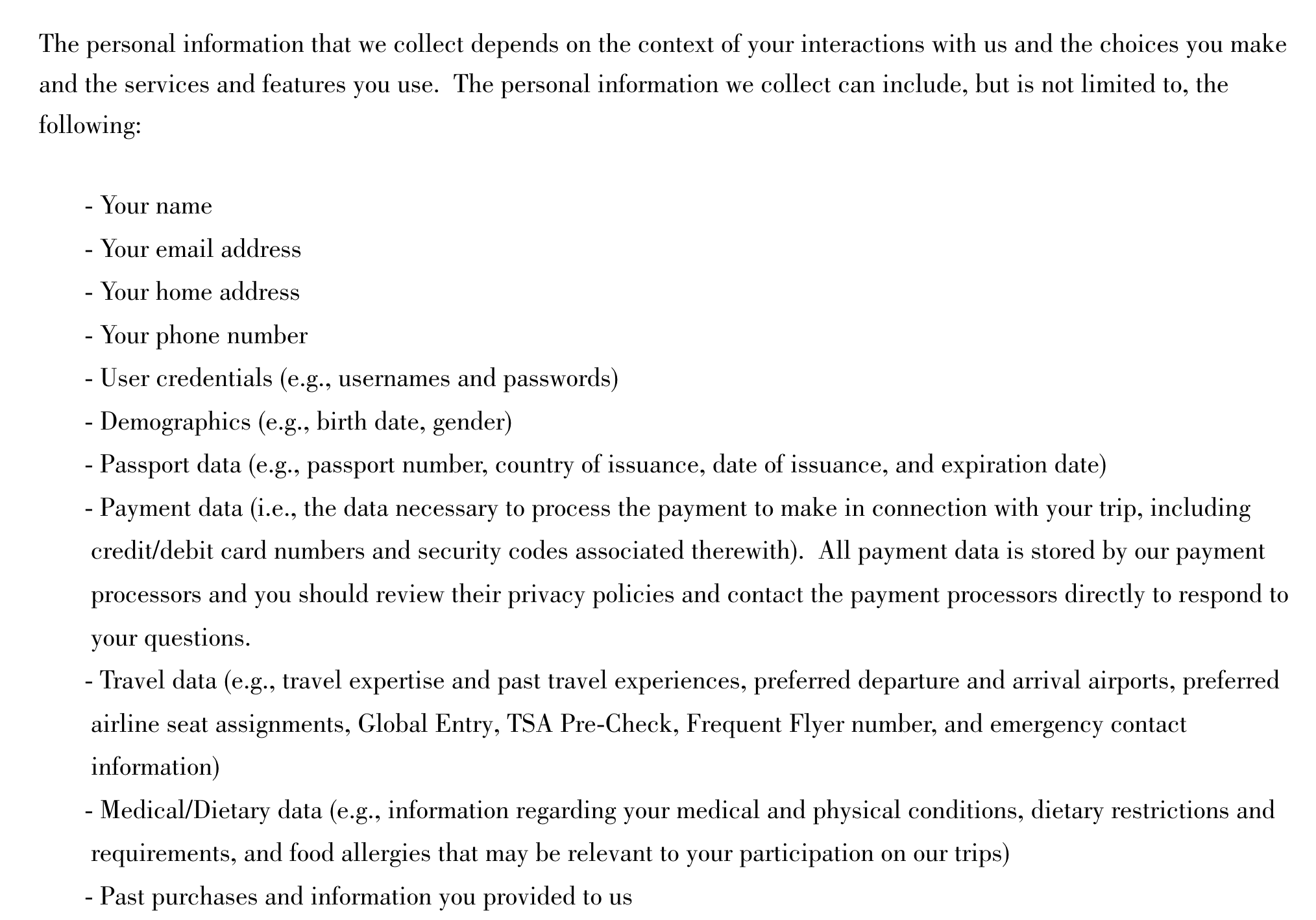
Example:
Types of data collected as explained in the privacy policy of Travel Beyond.
#3 Data retention
State how long you keep personal data.
Sample clause:
We retain your personal information only as long as necessary to fulfil the purposes outlined in this policy (unless a longer retention is required by law). For example, we keep your booking history so you can review past trips and for our financial reporting, typically for 5 years.
If you delete your account or request deletion, we will erase or anonymise your data unless we need to keep it for legal reasons.
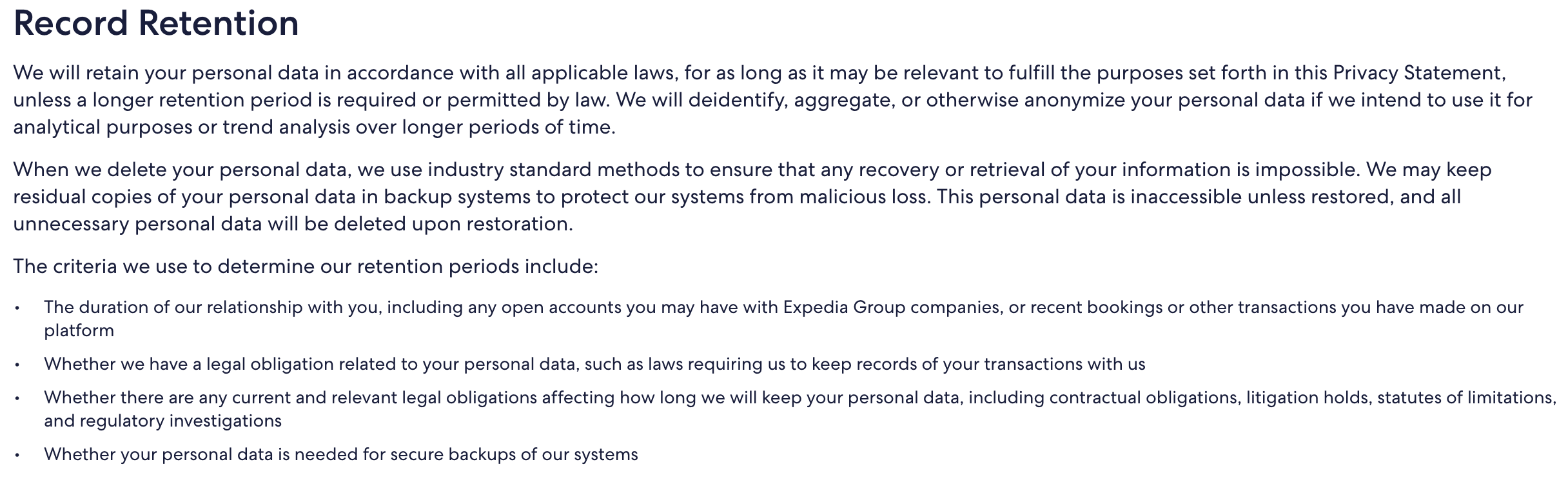
Example:
Retention clause as seen on Expedia’s privacy policy.
#4 Explain why you collect it and its sources
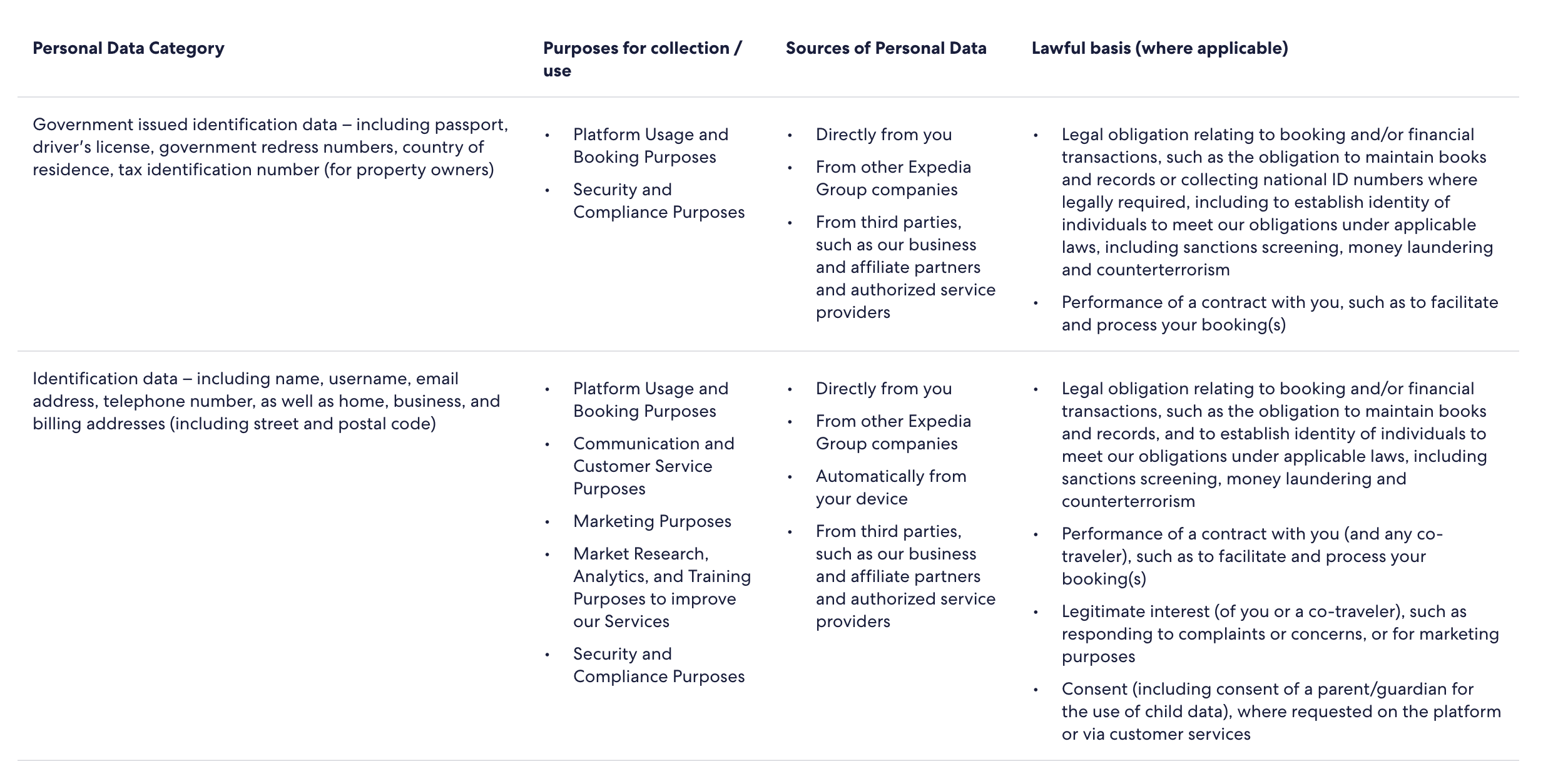
This helps users understand why their data is used. For this, you have to clearly define the purposes for which each type of data is collected. If you are subject to GDPR, you must also specify the lawful basis of collection.
Additionally, provide the source of collected data. This could be from the customers or sometimes from a third party. It is best to provide all of this in a single place, like a table, so that it is easier to access and understand. Common purposes include booking confirmations, customer support, legal compliance, personalised travel offers, etc.
Sample clause:
We collect and use the following categories of personal data for the following purposes:
Type of Data
Sources
Purposes for Collection
Lawful Basis
Passport, name, email address, phone number
Directly from you, third-parties
Booking, verification, customer service,marketing, security and compliance
Legal obligation, performance of contract, legitimate interest
Dietary needs, accommodations, destinations
Directly from you, third-parties
Personalising services, communication, customer service, and marketing
Legitimate interest, consent
Example:
Purposes of data collection as seen on Expedia’s privacy policy.
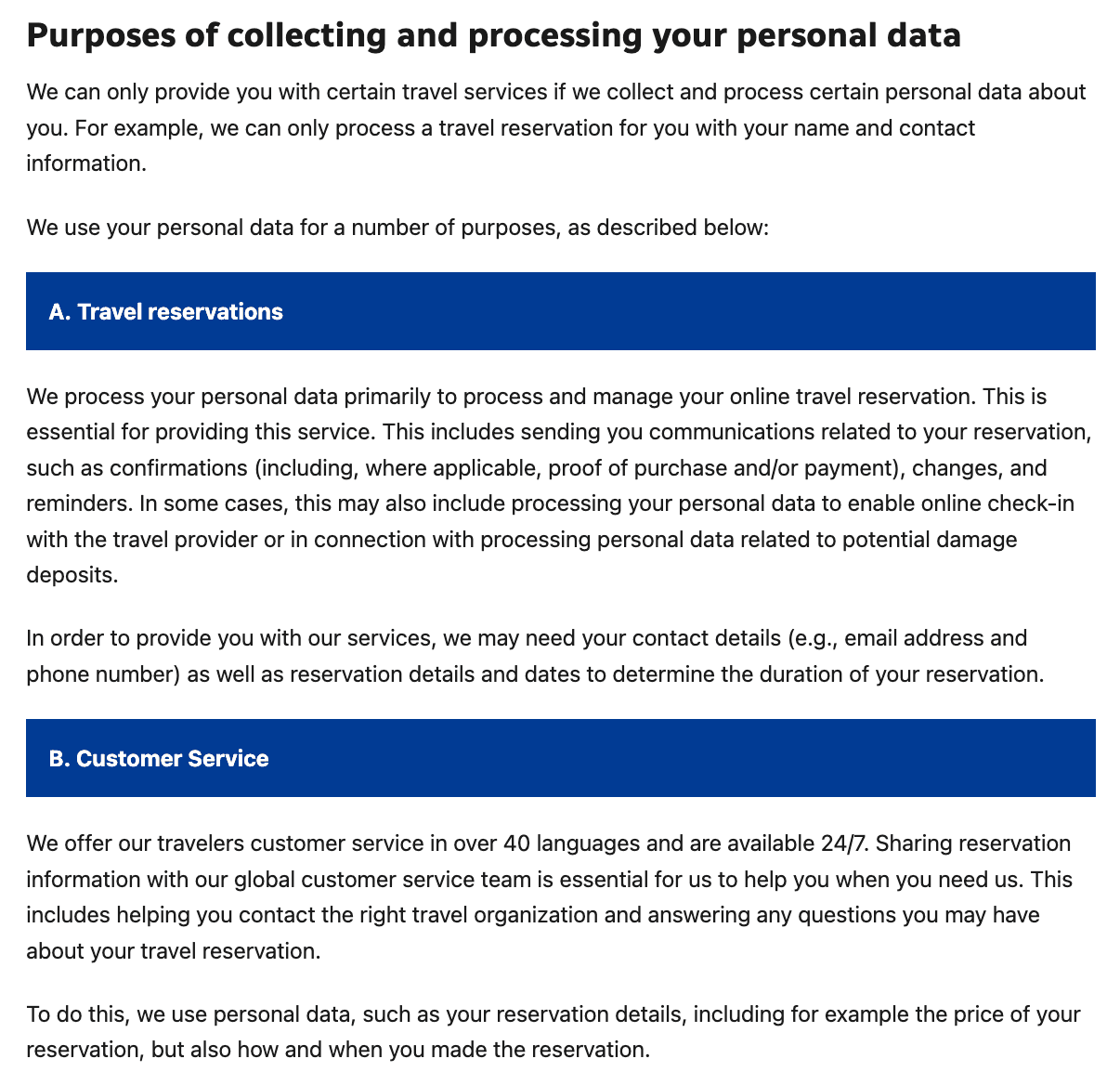
You can also list out the purposes separately with a brief description of the use. This is how Booking.com does it.
#5 Disclose who you share it with
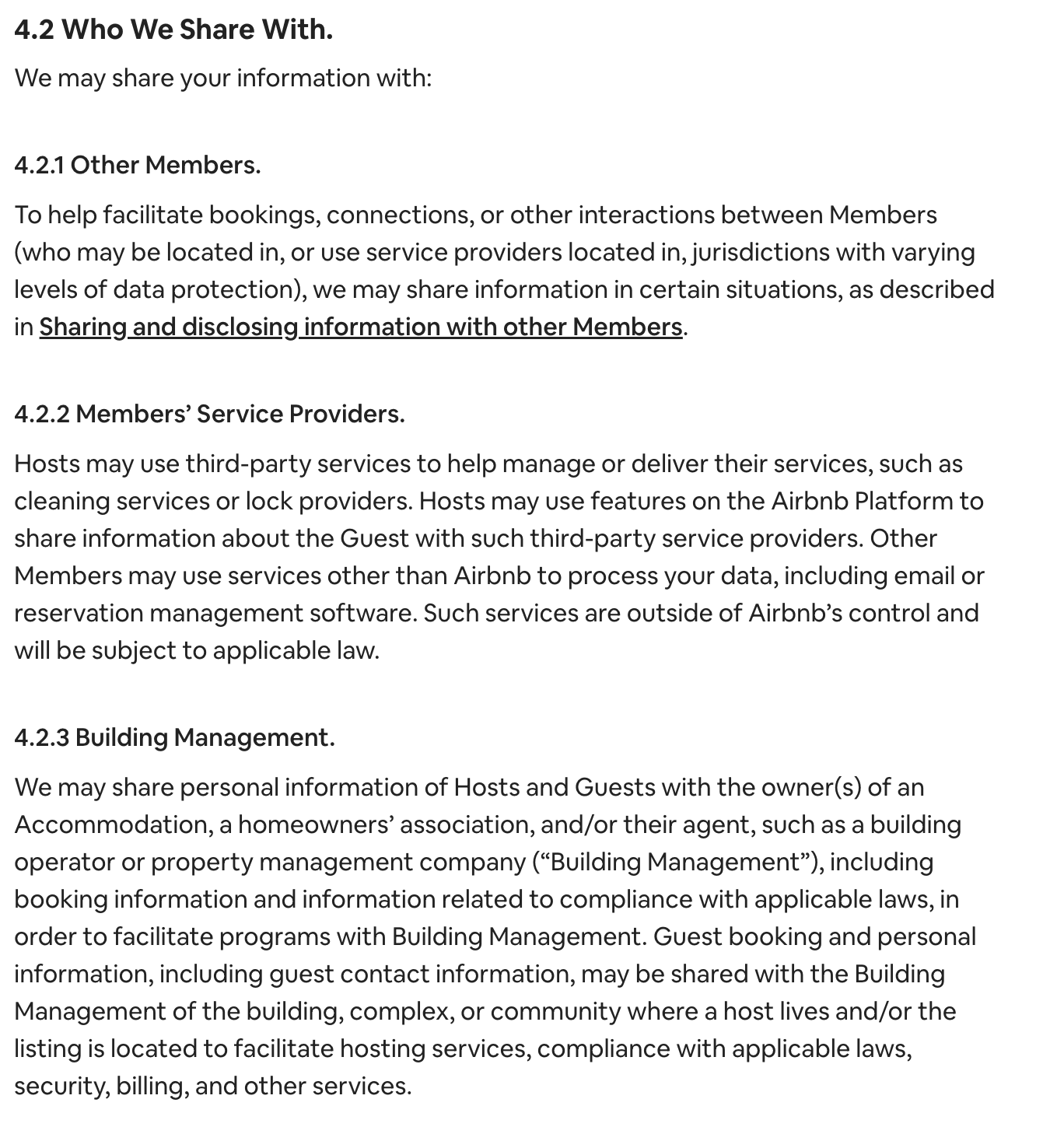
It is important to inform users whether you share customer data. If you do, then disclose who you share them with. It is also best to link to their privacy policies.
Some of the places you might be sharing the data with are airlines and hotels, Payment processors, or Analytics or marketing tools.
Sample clause:
We may share booking data with hotel partners and airlines to complete your reservations.
Depending on applicable laws, users may have the right to:
Access or delete their data
Request for correction
Opt-out of automated decisions
Withdraw consent
Opt out of cookies or email marketing
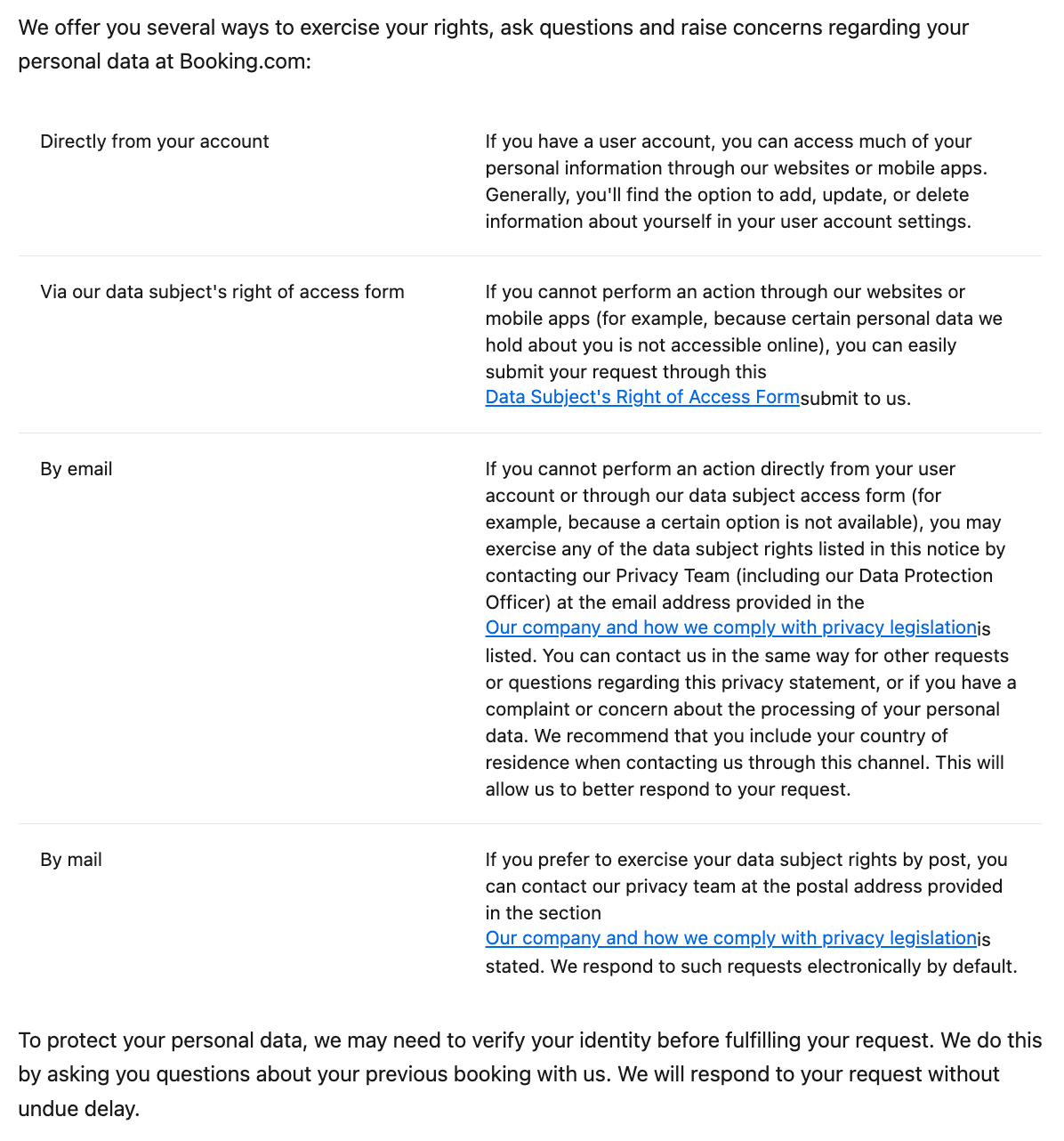
Clearly write down what their rights are and how they can exercise them. Provide at least two ways, like an online form or an email address.
Sample clause:
You can request to access or delete your data at any time by contacting us at [email protected] or filling out this form (link).
Example:
Booking.com privacy policy
#7 Talk about data security
Explain how you keep data safe and how long you retain it.
Sample clause:
We use encryption and secure servers to protect your personal data. We retain it only as long as needed to fulfil your travel bookings or legal obligations.
Example:
Security clause as seen on Make My Trip privacy policy
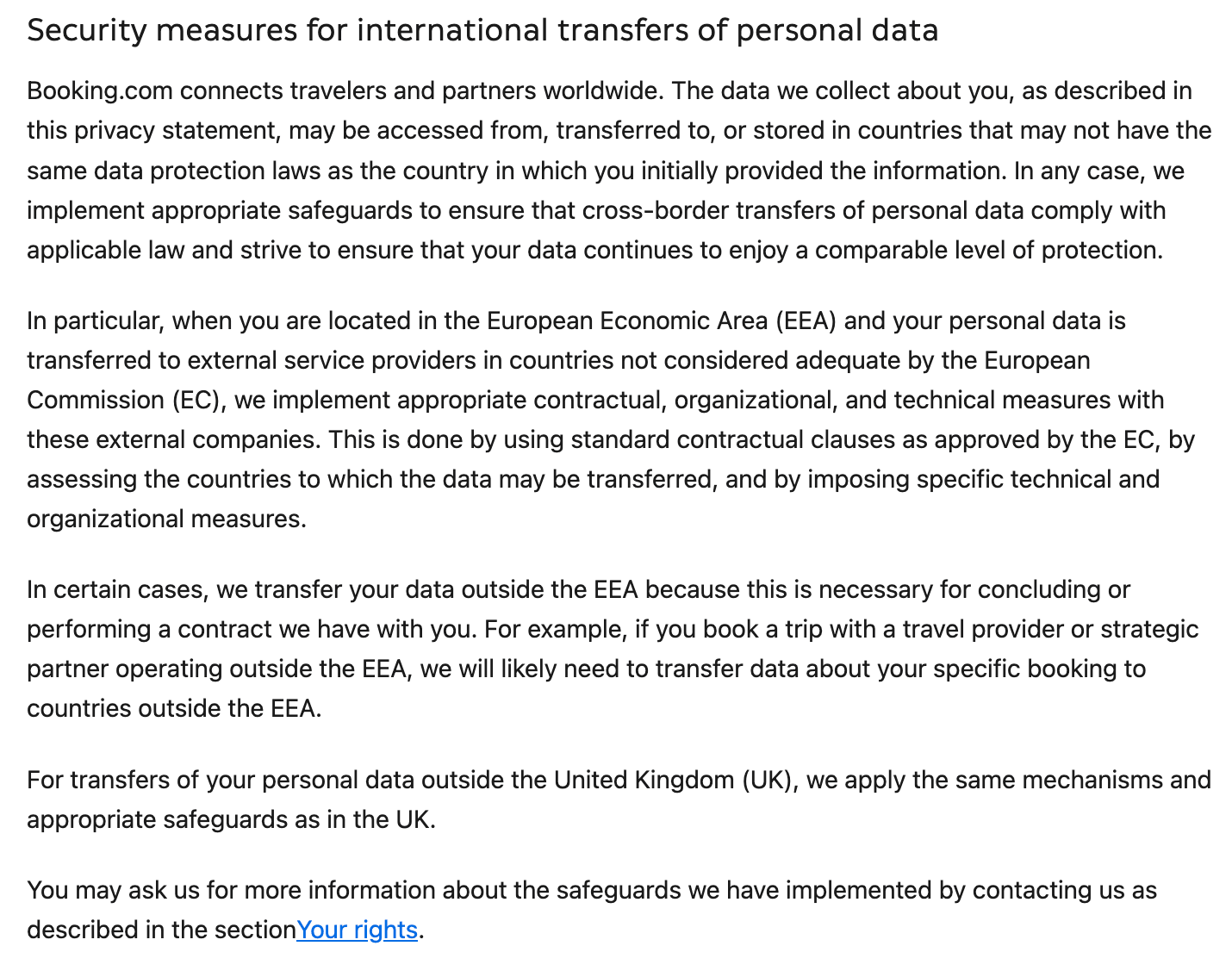
#8 Mention international transfers
If your users are global or your servers are in multiple countries, highlight this. Also, mention the data security practices you have implemented.
This reassures users that cross-border data movement is handled lawfully.
Sample clause:
Your information may be transferred to and processed in countries other than your own. We have servers in the United States and the EU. If you are in the EU or UK, note that your personal data may be transferred outside of the EEA. We rely on approved legal mechanisms to ensure adequate data protection when we transfer data internationally, such as Standard Contractual Clauses.
Example:
International transfer clause as seen on Booking.com’s privacy policy
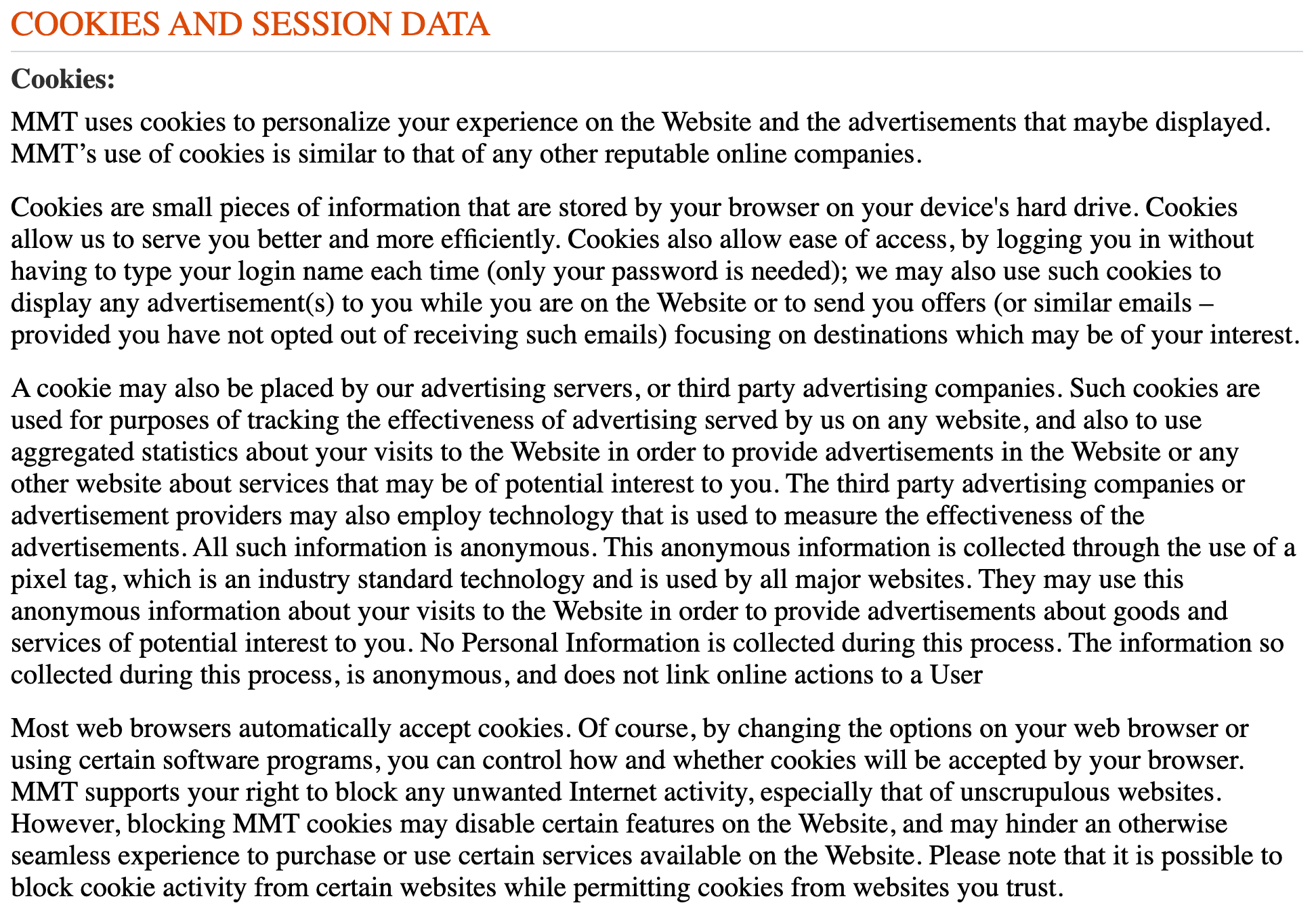
#9 Include cookie usage
Let users know about cookies and tracking technologies that your website uses and the link to your Cookie Policy.
Sample clause:
We use cookies to personalise your browsing experience. You can manage your cookie preferences anytime in your browser settings.
Example:
Cookie usage clause on Make My Trip’s privacy policy
#10 Do Not Track signals
If relevant, state whether you respond to Do Not Track signals. If you are subject to California CalOPPA, this is important.
Sample clause:
If we detect a Do Not Track or Privacy Control signal from your browser, we will treat it as a valid opt-out of sale/sharing for that browser/device.
Example:
Privacy policy of Agoda clarifies whether they respond to “Do Not Track signals”
#11 Update notifications
Tell users how you’ll inform them about the changes to your privacy policy.
Sample clause:
We’ll update this policy when needed. Any changes will appear here, with the latest revision date at the bottom.
Example:
Expedia’s privacy policy describes how they notify any updates to the policy
#12 Children’s privacy
Even if your travel site isn’t meant for kids, include a brief statement regarding it.
Sample clause:
Our services are not directed to children under 13 (or 16 in certain jurisdictions), and we do not knowingly collect personal information from children. If we become aware that we have inadvertently collected data from a child without proper consent, we will delete it. If you are a parent or guardian and believe your child has provided us information, please contact us to remove it.
For family-oriented travel businesses, you might adjust this to say data of minors is only provided by parents/guardians and used solely for the purpose of delivering services (e.g. airline tickets for children) with appropriate consent.
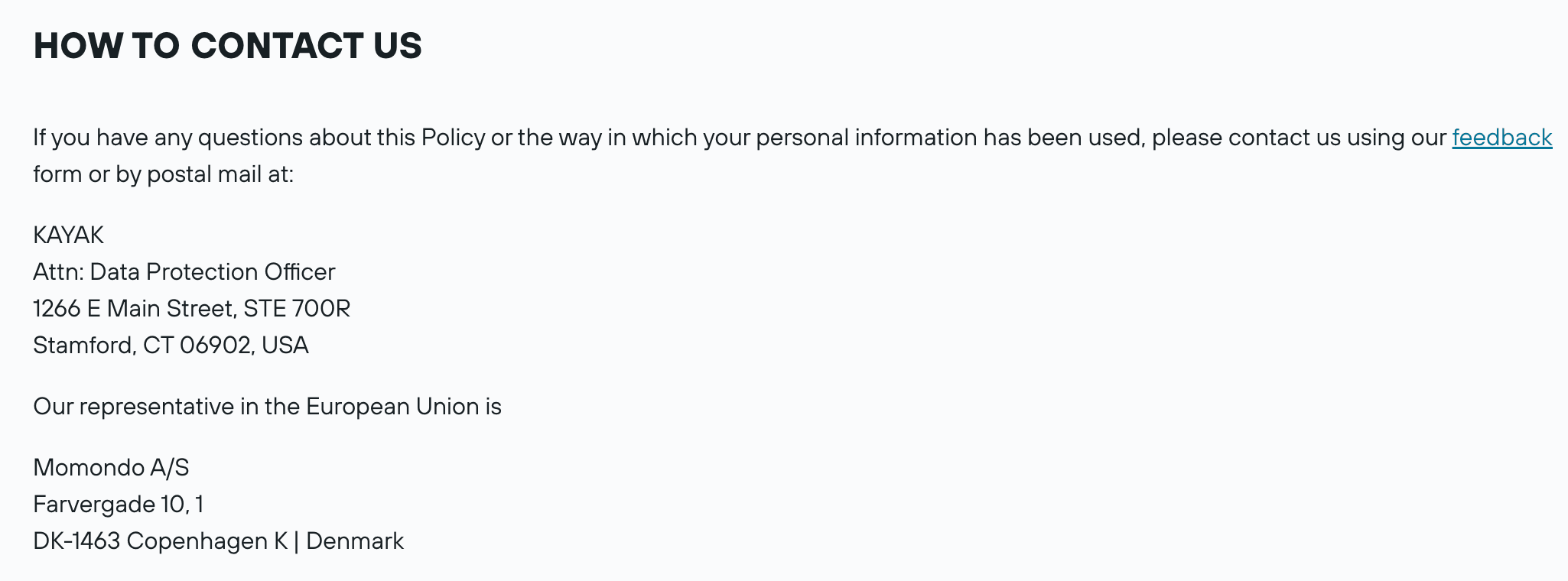
#13 Contact information
Provide contact details for privacy inquiries. Ideally, an email address dedicated to privacy (and/or a mailing address, phone number if you accept that).
You might also include the name of a contact person or department (e.g. “Privacy Officer” or “Data Protection Officer” if you have one).
Sample clause:
If you have any questions or concerns about this Privacy Policy or our data practices, please contact us at: Privacy Team, [TravelSite], [physical address]; Email: [email protected]; Toll-free: 1-800-XXX-XXXX.
Example:
The contact information as seen on Kayak’s privacy policy
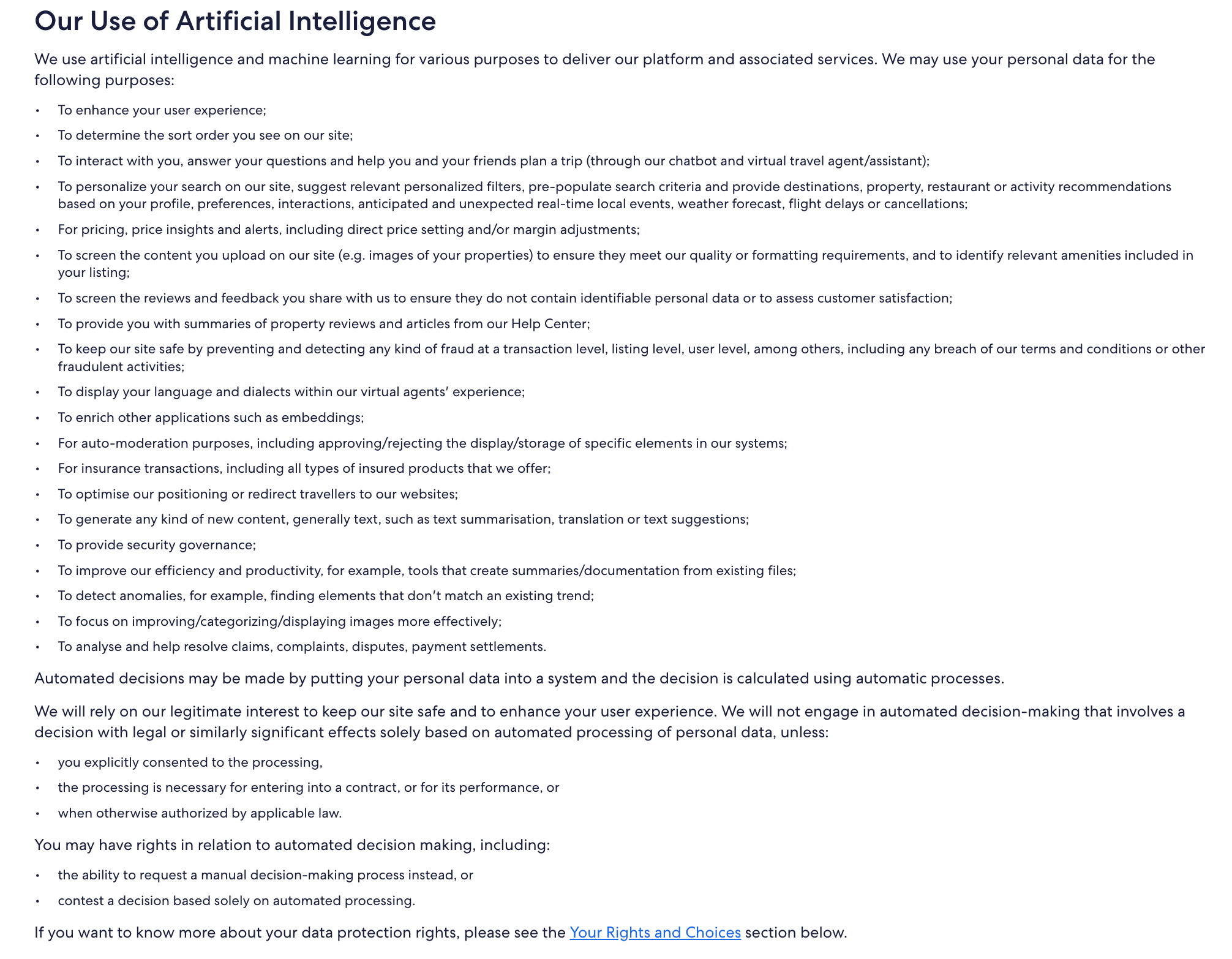
#14 Use of Artificial Intelligence
If your travel website uses artificial intelligence or automation to improve how it works, like suggesting destinations or flagging suspicious activity, your privacy policy should explain this clearly.
Be transparent about how AI is used, including:
What kinds of decisions does it help make, such as showing personalised recommendations or detecting fraud
Whether these decisions happen automatically without human review
What that means for your users, and what choices they have
Sample clause:
We use AI to make your experience smoother. For example, we might recommend trips based on your past bookings or help detect unusual activity. Some decisions, like which listings appear first, may be made automatically. If any of these decisions significantly affect you, you can reach out to ask for a review or learn more about how it was made.
Example:
AI clause as seen on Expedia’s privacy policy
Where on my travel website should I publish the privacy policy?
The key rule is that it should never be hard to find. Place it conspicuously:
In your website footer
On checkout, signup, and booking pages
In your mobile app settings menu, if applicable
Make sure it’s easy to read both on large displays and small screens like mobile devices.
I only operate in one country. Do I still need a policy?
Yes. You must comply with the privacy laws of that country. For example, websites in California must meet CCPA and CalOPPA rules.
Is a privacy policy the same as terms and conditions?
No. Your privacy policy explains how you use data. Terms and conditions outline how users interact with your services.
Do I need a policy if I don’t take payments?
Yes. Even collecting emails or itinerary preferences counts as personal data and needs a privacy policy.
Can I use a free privacy policy template?
You can start with one, but customise it for your specific business needs. Better yet, try the CookieYes Privacy Policy Generator to create a tailored, legally compliant policy.