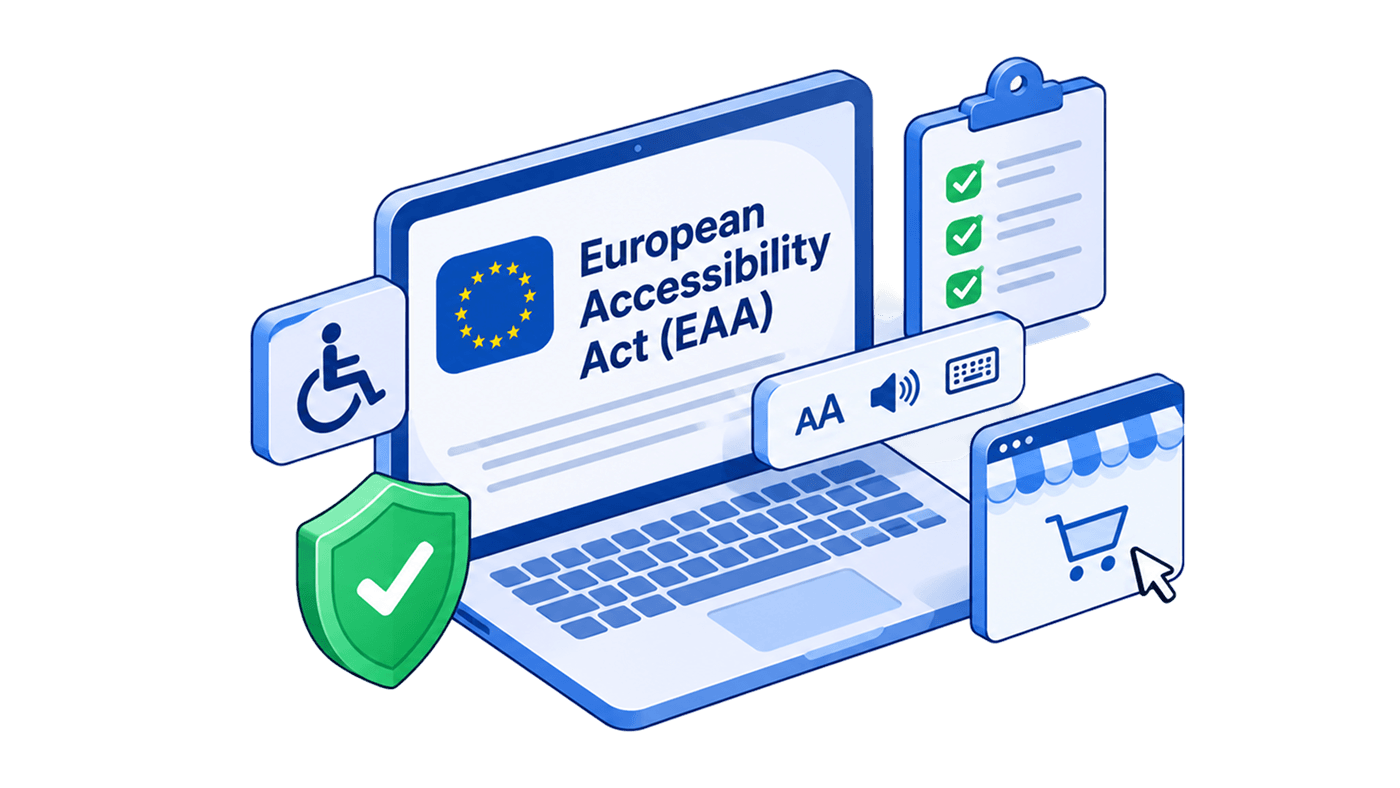
The European Accessibility Act (EAA) has applied since 28 June 2025, introducing common accessibility requirements for certain products and services sold across the EU. For businesses covered by the law, this means making websites, apps and other relevant services accessible to people with disabilities.
But where does that leave your business? Does every website need to comply? Which accessibility standards apply, and what are the consequences of getting it wrong?
This guide breaks down the EAA's requirements, who must comply, the available exemptions, and the practical steps businesses can take to meet their obligations.
Key takeaways: European Accessibility Act
- EAA sets accessibility requirements for specific products and services sold to consumers in the EU, including e-commerce, banking and passenger transport services.
- It applies to businesses outside the EU too, if they provide covered products or services to EU consumers.
- Certain microenterprises are exempt from the accessibility requirements
- The current European accessibility standard (EN 301 549 v3.2.1) points to WCAG 2.1 AA, and the newer EN 301 549 v4.1.1 moves to WCAG 2.2.
- Existing websites must comply. Transitional periods apply only to certain existing contracts and equipment, running until 28 June 2030 at the latest.
- Penalties are set by each EU country, so fines and enforcement vary. Germany
- The EAA does not cover B2B services, and covers only a few B2B products, such as payment terminals and ATMs.
What is the European Accessibility Act (EAA)?
The European Accessibility Act (EAA), officially Directive (EU) 2019/882, is an EU law that establishes accessibility requirements for certain products and services.
It aims to make everyday products and services easier for people with disabilities to use while creating more consistent accessibility rules across EU countries.
For example, an online shop should make it possible for customers using screen readers or keyboards to browse products, complete purchases, and access important information.
The EAA is a directive, meaning each EU country had to incorporate its requirements into national law by 28 June 2022. All 27 EU countries have now adopted national legislation to implement the EAA

Around 87 million people in the European Union have some form of disability- European Commission
Who must comply with the European Accessibility Act?
The European Accessibility Act (EAA) applies to businesses that manufacture, import, or distribute covered products or provide covered services in the European Union. These include products and services identified as the most important for people with disabilities.
The specific accessibility requirements depend on the type of product or service and the role your business plays in providing it.
Products and services covered by the EAA
Article 2 of the EAA covers specific categories of products and services, not every website or business operating in the EU.
Products include:
- Computers and operating systems
- Smartphones and certain communications equipment
- ATMs, ticketing and check-in machines
- E-readers
- Payment terminals
- Interactive self-service information terminals
- Certain equipment used to access audiovisual media services
Services include:
- E-commerce services
- Consumer banking services
- Electronic communications services
- E-books and dedicated software
- Services providing access to audiovisual media
- Certain passenger transport information, ticketing and related services
The EAA's service requirements generally apply to services provided to consumers, not those offered exclusively to other businesses (B2B).
For example, an online clothing store selling to EU consumers must meet the relevant accessibility requirements, while a software platform serving only businesses generally falls outside these service requirements.
However, the EAA also covers certain products, such as payment terminals, even when they are sold to businesses.
Does the EAA apply to businesses outside the EU?
Yes. Businesses based outside the European Union can be subject to the European Accessibility Act when they provide covered products or services to consumers in the EU.
For example, a US-based online retailer offering products to consumers in Germany may need to comply with Germany's national accessibility legislation implementing the EAA.
Businesses should check the applicable requirements in the EU countries where they operate or provide covered services.
Who is exempt from the European Accessibility Act (EAA)?
The European Accessibility Act provides an exemption for microenterprises providing services.
A microenterprise is a business that has:
- Fewer than 10 employees; and
- annual turnover or an annual balance sheet total not exceeding €2 million.
Though they are exempt from the EAA's service accessibility requirements and related obligations, it does not extend to manufacturers of covered products just because they qualify as microenterprises.
Are there any other exceptions under EAA?
Article 14 of the EAA provides some exceptions to the accessibility requirements for businesses if meeting them would:
- Fundamentally change the nature of the product or service; or
- Impose a disproportionate burden on the business.
These exceptions are not automatic. Businesses must assess whether the conditions are met, consider relevant factors, and document their findings, subject to the directive's requirements.
What are the European Accessibility Act requirements for websites?
For covered digital services, the EAA requires websites and mobile applications to be accessible in ways that make them perceivable, operable, understandable, and robust (POUR).
These four principles also form the foundation of the Web Content Accessibility Guidelines (WCAG).
1. Perceivable: Make information accessible to users
Make it easy to access website content in different ways, including through assistive technologies.
Practical measures include:
- Adding meaningful alternative text to informative images
- Providing captions for relevant video content
- Using sufficient colour contrast between text and backgrounds
- Ensuring information is not communicated through colour alone
For example, a checkout form should not identify an error only by highlighting a field in red. It should also explain what needs to be corrected.
2. Operable: Make website features easy to use
Visitors should be able to navigate and interact with the website without relying exclusively on a mouse.
This includes:
- Supporting keyboard navigation
- Making buttons, links and forms keyboard-accessible
- Providing visible keyboard focus indicators
- Avoiding keyboard traps
- Giving users sufficient time to complete tasks where applicable
For example, a customer should be able to navigate a shopping cart and complete checkout using a keyboard.
3. Understandable: Keep content and navigation clear
Website information and controls should be easy to understand and behave predictably.
Businesses can improve accessibility by:
- Using clear headings and instructions
- Providing descriptive labels for form fields
- Explaining errors and how to correct them
- Keeping navigation consistent
- Avoiding unexpected changes when users interact with controls
For example, a payment form should clearly identify required fields and explain why a payment could not be processed.
4. Robust: Support assistive technologies
This means that website content should work reliably with assistive technologies such as screen readers.
This includes using appropriate HTML elements and ensuring interactive components expose the information assistive technologies need.
For example, a screen reader should be able to identify whether a checkbox is selected or whether a menu is expanded.
Take the first step toward EAA website compliance
Add a free accessibility widget that helps visitors adjust text, colour contrast, spacing, and navigation to suit their needs.
Add the free widgetHow is the EAA different from WCAG?
The European Accessibility Act (EAA), Web Content Accessibility Guidelines (WCAG), and EN 301 549 are related, but they serve different purposes.
Law/standard | What it means |
|---|---|
European Accessibility Act | EU Directive establishing accessibility requirements for covered products and services. |
WCAG | International guidelines explaining how to make web content accessible. |
EN 301 549 | A European technical standard covering accessibility requirements for ICT products and services, including websites and apps. |
In simple terms, the EAA establishes the legal obligations. WCAG provides practical criteria for improving digital accessibility, while EN 301 549 can help businesses demonstrate that they meet relevant accessibility requirements.
Is WCAG mandatory under the EAA?
The European Accessibility Act does not explicitly require websites to meet a particular WCAG version. Instead, it sets out accessibility requirements in Annex I, which businesses must follow if their products or services fall within the law's scope.
The Web Content Accessibility Guidelines (WCAG) help businesses put these requirements into practice by providing technical guidance on accessible website design, including keyboard navigation, readable content, and compatibility with screen readers. The current European accessibility standard still uses WCAG 2.1 Level AA

Related read:
What are the new WCAG guidelines for 2026?
The current European accessibility standard, EN 301 549 version 3.2.1, follows WCAG 2.1 Level AA.
However, An updated version, EN 301 549 version 4.1.1, was published in September 2026. It includes WCAG 2.2 requirements, such as making keyboard navigation easier, improving button sizes and making login processes more accessible. However, this updated version has not yet been officially recognised as a standard for demonstrating EAA compliance.
The W3C is also developing WCAG 3, with a new draft published in September 2026. It is still a work in progress and is not yet an applicable accessibility standard under the EAA. WCAG 2.2, published in October 2023, remains the latest version.
Do existing websites have to comply with EAA?
Yes. Websites created before 28 June 2025 must also meet the EAA's accessibility requirements if they provide services covered by the law. There is no general exemption for older websites.
However, Article 32 gives businesses extra time for certain existing contracts and equipment:
- Existing contracts: Service contracts signed before 28 June 2025 can continue unchanged until they expire or 28 June 2030, whichever comes first.
- Existing equipment: Certain products already used to provide services before 28 June 2025 can remain in use until 28 June 2030.
- ATMs and ticket machines: Certain machines already in use before the deadline can remain in service for up to 20 years from when they were first used.
European Accessibility Act deadlines
The EAA has three important dates.
Date | Milestone |
|---|---|
28 June 2022 | Deadline for EU countries to incorporate the EAA into national law. |
28 June 2025 | General date from which national accessibility requirements began applying. |
28 June 2030 | End of the main transitional period for certain existing service arrangements. |
What are the penalties for EAA non-compliance?
The EAA does not establish a single EU-wide fine for accessibility violations.
Instead, each EU member state sets penalties through its national legislation. Under Article 30, these penalties must be effective, proportionate and dissuasive.
Depending on the country and violation, enforcement measures may include:
- Orders to correct accessibility problems
- Restrictions on selling non-compliant products
- Withdrawal of certain products from the market
- Administrative fines or other national sanctions
For example, Germany's Accessibility Strengthening Act (Barrierefreiheitsstärkungsgesetz, or BFSG) provides for fines of up to €100,000 for certain violations.
How to comply with the European Accessibility Act: A practical checklist
How to comply with the European Accessibility Act: A practical checklist
- Check if the EAA applies to your business: Identify whether your products or services fall under Article 2, check for exemptions, and review applicable national laws.
- Audit your website and apps: Use website accessibility checkers or conduct manual audits, keyboard and screen reader testing, to identify accessibility barriers.
- Fix accessibility issues: Prioritise essential functions such as navigation, forms, and checkout. Alongside fixing accessibility issues, you can use tools like AccessiYes to give visitors more control over text size, contrast, reading and navigation preferences.
- Document your compliance: Explain how your services meet accessibility requirements, as required by Article 13 and Annex V. Publish this information in an accessible format through your terms and conditions or an equivalent document, such as an accessibility statement.
- Monitor accessibility regularly: Retest after website updates, plugin installations or design changes, and address any new accessibility issues.
Frequently asked questions
Is the European Accessibility Act mandatory?
Yes. The EAA establishes requirements that EU countries have implemented through national legislation. Businesses providing covered products or services must comply with the applicable national requirements unless an exemption or exception applies.
Does the European Accessibility Act apply to all websites?
No. The EAA covers specific products and services, including e-commerce services. A website does not automatically fall within its scope simply because it is accessible from the EU.
Does the European Accessibility Act apply to the UK?
The EAA does not directly apply in the UK, because it is no longer an EU member state. However, UK businesses may need to comply with relevant national EAA requirements when supplying covered products or services to consumers in the EU.
Businesses should also consider separate UK accessibility legislation, including the Equality Act 2010 in Great Britain.
Do small businesses need to comply with the EAA?
Small businesses providing services, with fewer than 10 employees and annual turnover or a balance sheet total of no more than €2 million, are exempt from the EAA's service accessibility requirements. However, this exemption does not generally apply to manufacturers of covered products.
Can an accessibility widget make my website EAA-compliant?
An accessibility widget may help users adjust certain aspects of a website, but installing one does not automatically make the website compliant. Businesses must assess and address underlying accessibility barriers throughout the covered service.