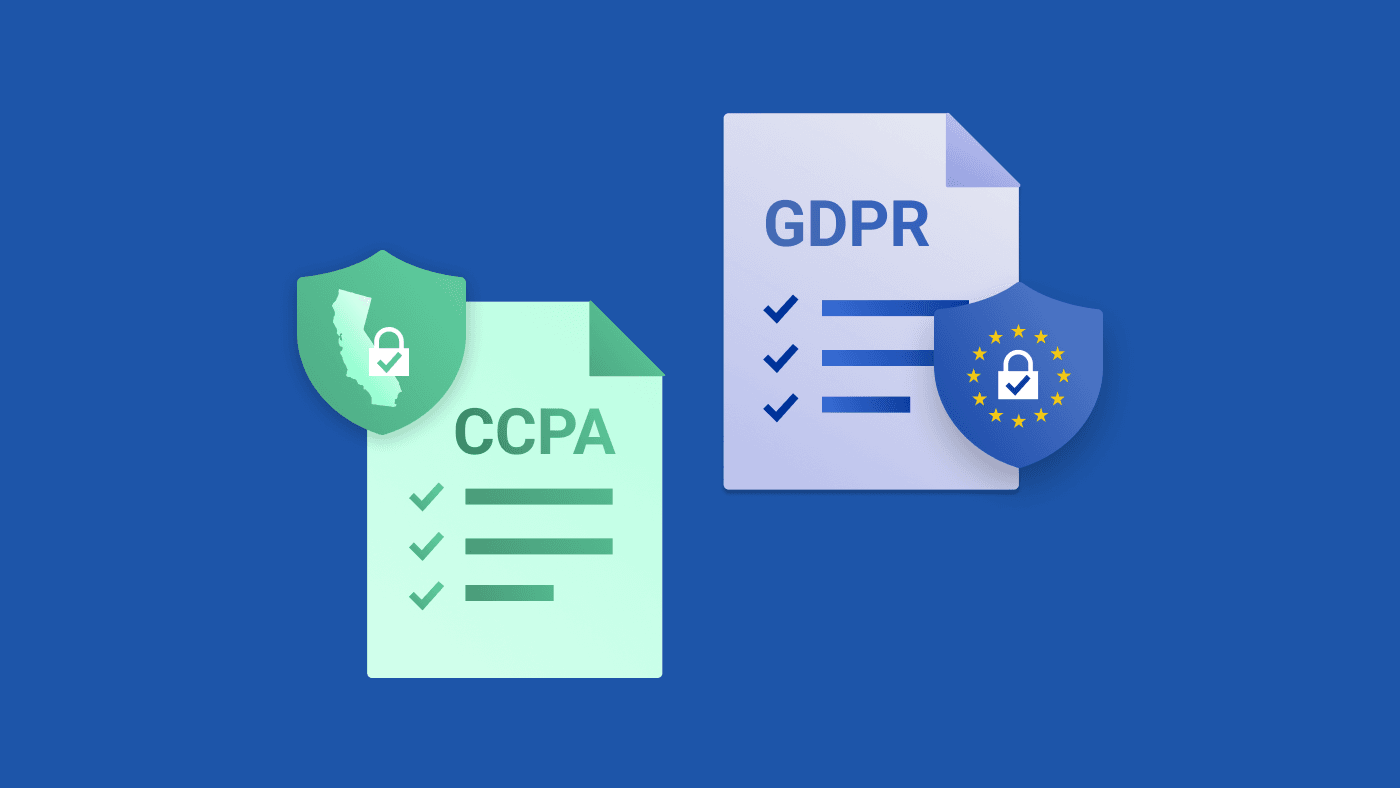
California’s Consumer Privacy Act (CCPA) and the European Union's General Data Protection Regulation (GDPR) are two of the biggest regulations regarding consumer privacy in recent times. Rightfully so with the amount of data that is being collected about individuals. While both laws are focused on user privacy rights and putting control over personal data back into users’ hands, there are many differences between the two. Here is a look at the key CCPA vs GDPR differences.
The California Privacy Rights Act (CPRA) amended the CCPA from 1 January 2023, so this comparison covers the CCPA as amended.
For a detailed look at CPRA and how it differs from CCPA, click here.
CCPA vs GDPR: 11 differences explained
#1 Type of law
CCPA
The CCPA is a California statute, enforced by the California Privacy Protection Agency (CPPA) and the Attorney General. Consumers can sue directly only over data breaches caused by a business failing to keep reasonable security.
GDPR
The GDPR is an EU regulation, binding and directly applicable in every member state without national legislation. Individuals can complain to a supervisory authority, go to court, and claim compensation for damage.
#2 Subjected entities
CCPA
The CCPA applies to for-profit businesses that do business in California, wherever they are based, and meet at least one of these thresholds:
- Annual gross revenue over $26,625,000 in the preceding year
- Buys, sells, or shares the personal information of 100,000 or more consumers or households a year
- Derives 50% or more of its annual revenue from selling or sharing personal information
CPRA: The CPRA updated these thresholds, and the revenue figure is adjusted for inflation every odd-numbered year.
GDPR
The GDPR applies to organisations processing personal data in the context of an establishment in the EU, wherever the processing happens. It also applies to organisations outside the EU that offer goods or services to people in the EU or monitor their behaviour there.
The GDPR is broader, as it has no size threshold.
#3 Type of data covered
Both laws have a similar definition of personal data. However, the CCPA also covers households, while the GDPR covers only individuals.
CCPA
"Information that identifies, relates to, describes, is reasonably capable of being associated with, or could reasonably be linked, directly or indirectly, with a particular consumer or household". E.g. name, email address, purchase records, browsing history, location, biometric data, and inferences from other personal information.
The CCPA excludes the following personal data sets from its scope:
- Medical information covered by the CMIA or HIPAA
- Information collected for clinical trials
- Personal information sold to or by consumer reporting agencies, as regulated by the Fair Credit Reporting Act
- Personal information covered by the Gramm-Leach-Bliley Act
- Information covered by the federal Driver's Privacy Protection Act of 1994
- Publicly available information, such as information lawfully made available from federal, state, or local government records
Since 1 January 2023, employee and business-to-business data are no longer exempt.
CPRA: The CPRA added a category called sensitive personal information (SPI), similar to the GDPR's special category data. It includes government ID numbers, precise geolocation, racial or ethnic origin, religious beliefs, health data, and sex life or sexual orientation. Unlike the GDPR, it does not include political opinions.
GDPR
"Any information relating to an identified or identifiable natural person ('data subject'); an identifiable natural person is one who can be identified, directly or indirectly". E.g. a name, identification number, location data, online identifier, email address, or phone number. Special category data includes racial or ethnic origin, political opinions, religious beliefs, health data, genetic and biometric data, and sex life or sexual orientation.
The GDPR excludes the following sets of personal data:
- Data related to deceased persons
- Data processed without automated means, unless it forms part of a filing system
- Anonymous data
- Data processed for purely personal or household activities
#4 Disclosure to users
Transparency is a common requirement between the two laws. Both require organisations to disclose how they handle users' personal information (CCPA) or personal data (GDPR). Both require businesses to tell users what data they collect, how and why, who they share (or sell) it with, what rights users have, and how to contact the business. However, there are minor but key differences in what each law requires you to tell users.
CCPA
A consumer's right to know covers the 12 months before their request, or longer for data collected since 1 January 2022, unless that is impossible or disproportionate
Read more about CCPA Notices.
A third party can't resell personal information unless the consumer has had explicit notice and a chance to opt out.
GDPR
The GDPR also requires organisations to tell users the legal basis for processing, any transfers outside the EU, and their right to withdraw consent at any time.
Both laws now require you to state how long you keep each category of data.
#5 Rights of users
Under both laws, people get certain data rights that they can exercise.
CCPA
- Right to know about and access personal information
- Right to delete personal information collected from consumers
- Right to opt out of the sale of personal information
- Right to non-discrimination for exercising CCPA rights
The CCPA allows businesses 45 days to respond to requests, and they can extend this once by another 45 days when reasonably necessary, with notice to consumers.
CPRA: The CPRA added the right to correct inaccurate personal information, the right to opt out of sharing for cross-context behavioural advertising, and the right to limit the use of sensitive personal information (SPI). CPPA regulations add rights to access and opt out of automated decision-making technology used for significant decisions, with compliance required from 1 January 2027.
GDPR
- Right to access personal data
- Right to correct personal data in case of inaccuracy
- Right to delete personal data
- Right to restrict personal data processing
- Right to port data to another controller
- Right to object to personal data processing
- Right not to be subject to decisions based solely on automated processing, including profiling
Businesses have one month to respond to requests. They can extend this by two further months for complex or numerous requests, but must give reasons within the first month.
#6 Right to opt-out
CCPA
The CCPA doesn't require consent to collect personal information. Instead, consumers can opt out of its sale or sharing.
If your business has a website, add a "Do Not Sell or Share My Personal Information" link to your homepage and every page that collects personal information. This link should lead to a dedicated page or setting where users can exercise their right to opt out. You must also treat opt-out preference signals, such as Global Privacy Control (GPC), as valid opt-out requests. Once users opt out, stop selling or sharing their data and wait at least 12 months before asking them to opt back in.
CPRA: The CPRA added the right to opt out of sharing, which covers disclosing personal information for cross-context behavioural advertising. It also added a "Limit the Use of My Sensitive Personal Information" link, which you can combine with the opt-out link into one.

Explore how CookieYes supports CPRA compliance with opt-out controls for your website.
GDPR
Under the GDPR, every processing activity needs one of six lawful bases: consent, contract, legal obligation, vital interests, public task, or legitimate interests. Where you rely on consent, it must be opt-in, and users can withdraw it at any time, as easily as they gave it. Read more about both opt-in and opt-out.
Users can also object to processing based on legitimate interests or public task, and always to direct marketing.
#7 Age of consent
CCPA
Businesses must not sell or share the personal information of consumers they know are under 16, unless the consumer (aged 13 to 15) or a parent or guardian (under 13) opts in. Wilfully disregarding a consumer's age counts as knowing it.
CPRA: This now covers sharing as well as selling.
GDPR
For online services offered directly to children on a consent basis, the age is 16. Member states can lower it to no less than 13. Below that age, a parent must give or authorise consent.
#8 Cookie control
CCPA
The CCPA is not as strict as the GDPR on cookie consent. Websites don't need consent before storing cookies on visitors' devices. They only need to let visitors opt out of cookies that sell their personal information. They should also explain what kinds of cookies the website uses, why, and how visitors can manage them.
CPRA: This now covers cookies that share personal information for cross-context behavioural advertising, and you must treat opt-out preference signals, such as GPC, as valid opt-out requests.
GDPR
EU cookie consent comes from the ePrivacy Directive, with the GDPR setting the standard for valid consent. Non-essential cookies, such as advertising cookies, need prior opt-in consent. Strictly necessary cookies are exempt.
Like the CCPA, EU rules require websites to explain what cookies they use and why, before asking for consent. Websites must also let users withdraw consent as easily as they gave it
Leading cookie compliance solution for GDPR and CCPA/CPRA
Sign up on CookieYes and make your website GDPR and CCPA/CPRA compliant for cookies for free.
Try FREE Cookie Consent- Free 14-day trial
- Cancel anytime
#9 Security requirements
CCPA
Although the CCPA does not set specific security requirements, it requires reasonable security and lets consumers sue when a failure to maintain it leads to a data breach.
CPRA: Under CPPA regulations effective 1 January 2026, businesses whose processing presents significant risk must carry out risk assessments and, in some cases, annual cybersecurity audits. First submissions are due from April 2028.
GDPR
Data security is one of the main requirements of the GDPR. Organisations must implement technical and organisational measures that ensure security appropriate to the risk, including, as appropriate, pseudonymisation and encryption of personal data.
#10 Fines and penalties for non-compliance
CCPA
The CPPA can impose administrative fines, and the Attorney General can seek civil penalties in court. Both are capped at $2,663 per violation, or $7,988 per intentional violation or violation involving consumers the business knows are under 16. These figures are adjusted for inflation in odd-numbered years.
In breach lawsuits, consumers can claim $107 to $799 per consumer per incident, or actual damages if higher. Consumers must give the business 30 days' written notice before suing for statutory damages, and a business that cures the violation in that time avoids them.
CPRA: Regulators no longer have to offer a cure period; the CPPA may choose to give a business time to cure. In March 2025, the CPPA fined American Honda Motor Co. $632,500.
GDPR
There are two levels of GDPR fines depending on the severity of the violation:
- For less severe violations, up to €10 million or 2% of worldwide annual turnover of the preceding financial year, whichever is higher
- For more severe violations, up to €20 million or 4% of worldwide annual turnover of the preceding financial year, whichever is higher
Data protection authorities in the EU member states impose GDPR fines.
#11 Enforcing Authority
CCPA
The California Privacy Protection Agency (CPPA) and the California Attorney General both enforce the CCPA.
CPRA: The CPRA created the CPPA, which enforces the CCPA through administrative actions and issues regulations under it.
GDPR
Each EU member state's supervisory authority enforces the GDPR. For cross-border processing, the authority of the main establishment leads, and the EDPB ensures the GDPR is applied consistently.
The two laws share goals and several rights, but they differ in how they work, so complying with one doesn't mean complying with the other. Both also reach beyond their home jurisdictions. Companies that want to comply with both laws should understand the differences between them, or risk making decisions that could land them in legal trouble.
Frequently asked questions
What do GDPR and CCPA stand for?
The GDPR stands for General Data Protection Regulation, an EU regulation that protects the personal data and privacy of people in the EU. The CCPA stands for California Consumer Privacy Act, a US state law that protects the data and privacy rights of California residents.
How is CCPA different from GDPR?
The main difference is the default model. The GDPR requires a lawful basis, such as consent, before processing personal data, while the CCPA lets businesses collect personal information but gives consumers the right to opt out of its sale or sharing. The GDPR also applies whatever an organisation's size, while the CCPA applies only above set thresholds.
Is CCPA like GDPR?
In some ways. Both give people rights over their personal data, such as access and deletion, and both apply beyond their home jurisdictions. But the CCPA is a California law built on opt-outs and size thresholds, while the GDPR is an EU regulation that requires a lawful basis for all processing and gives people more rights.
Is CCPA stricter than GDPR?
The CCPA is a privacy law specific to businesses that do business in California. It applies to businesses that meet certain criteria, such as a set level of annual revenue or buying, selling, or sharing the personal information of a set number of consumers or households. The GDPR applies to organisations in the EU, and to those outside it that offer goods or services to, or monitor, people in the EU. Both laws aim to protect personal data and give people certain rights, but the GDPR has more detailed requirements and stricter penalties for non-compliance. It's hard to say which law is stricter, as they have different provisions and serve different purposes.
CCPA vs GDPR: Which is better?
Both laws have similar goals regarding user privacy. However, the GDPR has a broader scope, as it protects the personal data of people in the EU whatever the size of the organisation, while the CCPA is specific to California residents. The GDPR also provides more user rights and gives users more control, especially through opt-in consent.
What is CCPA compliance?
CCPA compliance refers to the adherence of a business's privacy practices to the California Consumer Privacy Act. The CCPA is a US state law that applies to for-profit businesses that do business in California and meet at least one of its thresholds. It was created to give consumers more control over their data and increase transparency about how that data is handled. The CCPA became operative on 1 January 2020.
What is GDPR compliance?
GDPR compliance means complying with the requirements of the EU GDPR. The GDPR applies to organisations in the EU, and to organisations outside it that process the personal data of people in the EU to offer them goods or services or monitor their behaviour there. Its requirements are broad and cover anything related to personal data, including collecting, storing, or transferring it, unless it is processed for purely personal or household activities. It has applied since 25 May 2018.